Testimony
Rachel Kleinfeld
{
  "authors": [
    "Rachel Kleinfeld"
  ],
  "type": "legacyinthemedia",
  "centerAffiliationAll": "dc",
  "centers": [
    "Carnegie Endowment for International Peace"
  ],
  "collections": [
    "U.S. Democracy in Comparative Perspective"
  ],
  "englishNewsletterAll": "democracy",
  "nonEnglishNewsletterAll": "",
  "primaryCenter": "Carnegie Endowment for International Peace",
  "programAffiliation": "DCG",
  "programs": [
    "Democracy, Conflict, and Governance"
  ],
  "projects": [],
  "regions": [
    "North America",
    "United States"
  ],
  "topics": [
    "Political Reform",
    "Democracy"
  ]
}
Source: Getty
While the road out of today’s extreme political polarization in the United States isn’t obvious, adopting reforms like ranked choice voting could reduce polarization and better represent the will of the people.
Source: Hill
Between 1869 and 1900, Congress voided state elections 30 times. In 26 cases, the House ordered the loser seated due to fraud or violence. That reconstruction-era history is sadly pertinent today.
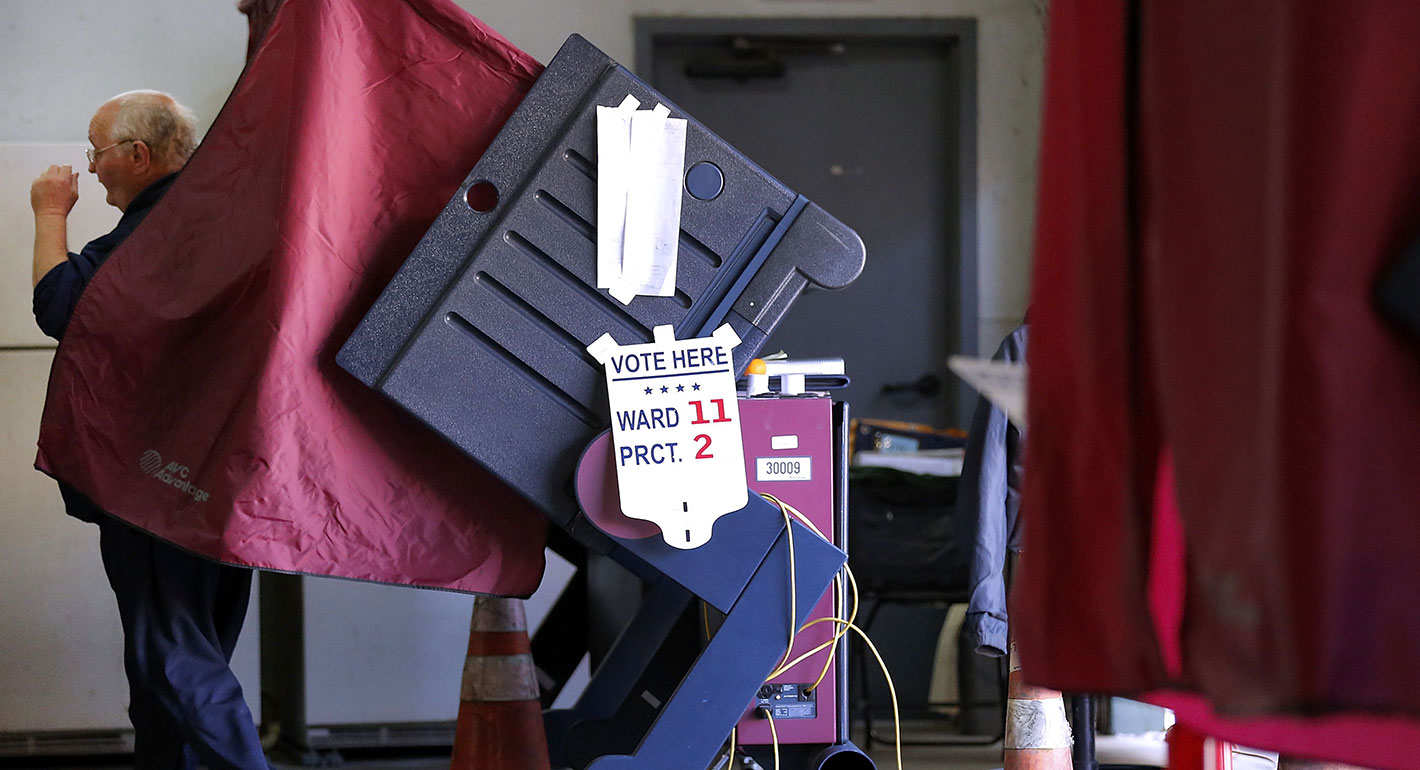
Democracy requires citizens’ votes to be counted fairly, and those votes must determine who wields power. Likely voter fraud in North Carolina is challenging the first principle. The second is under threat in Wisconsin, where the Republican legislature has stripped the incoming Democratic governor of capabilities that voters assumed their leader would have when they voted.
America has been here before. In the late 1800s the country faced similar levels of partisanship and inequality. Then, as now, the parties were at a near tie: congressional majorities flipped five times from 1870 to 1900. The temptation to put a thumb on the scales was great.
In the reconstruction South, the result was politicians stoking white supremacist groups. We assume their lynchings were out of control mob violence. In fact, they increased on the eve of elections. Since newly enfranchised blacks flocked to Lincoln’s party, racial violence also suppressed the Republican vote. It was thus encouraged by former confederate politicians, who also engaged in electoral fraud. As Ben Tillman, a governor and senator from South Carolina declared, “We stuffed ballot boxes. We shot them. We are not ashamed of it.” Northern Democrats chose to look the other way as Dixiecratic colleagues helped them gain Congressional majorities.
In this atmosphere, the House decided that it had the power to overturn elections and override state rulings on election laws. The Senate continued to overturn a number of elections in the 1920s tainted by fraud, and as recently as 1975 ordered a seat vacant after a disputed election in New Hampshire.
Should the House do the same today?
Members must walk a fine line. Any action will be seen through a partisan lens. Yet U.S. democracy is weakening, and our leaders must take action to stop the rot.
I recently co-authored a study for the Democracy Fund looking at democratic degradation in other countries. Our research suggests that such deterioration has been underway in the United States for years. Populist executives are symptoms of such decline. They capitalize on voter discontent by claiming that they alone can solve the problems bickering parties fail to address by breaking the normal norms and institutional restraints of the democratic process.
Norm-breaking doesn’t end when such a leader is voted out. Voters like leaders who claim they can solve problems by cutting bureaucracy. After tasting such personalization of power, they demand it from future leaders. To compete, parties on both sides of the aisle tend to mimic institution-destroying behaviors and rhetoric.
The United States is at particular peril for this sort of degradation. Our constitution is the oldest in the world, and predates many modern political shenanigans that newer constitutions legislate against. Thus, America’s democracy has long rested more on norms than laws. That’s fine when norms hold — the “spirit of the laws” is often stronger than mere words on paper, claimed Montesquieu, an enlightenment philosopher who influenced our Founders. But it means there are few legal remedies to stop democratic free fall once parties begin to violate norms.
So how should politicians who want to put country ahead of party respond?
First, in North Carolina, it shouldn’t matter whether fraudulent ballots were plentiful enough to turn the election — all voters need to trust that their votes are counted fairly. That means that Congress should not seat the challenger — but should not embrace the putative winner. A new election would ideally begin with a do-over of the Republican primary, where the same political operative seems likely to have affected the outcome.
Patriots of both parties should also call foul in Wisconsin. Altering the balance of power among institutions is a legitimate democratic choice — doing so after the winner is known denies the will of the voters. Ideally, pressure leads Governor Scott Walker to exercise his veto. Regardless, other states should draft stronger sore loser laws to legislate against such post-hoc power shifts during future lame duck sessions.
These actions will, inevitably, lead to accusations of partisanship. The roadmap out of today’s extreme polarization isn’t obvious. The partisanship of the late 1800s declined because Jim Crow laws allowed southern Dixiecrats to gain power. Those conservative Democrats worked easily with midwestern Republicans, leading to what we now consider a golden age of bipartisanship. Disenfranchisement in the name of comity is no democratic solution.
Other options are possible. Rep. Josh Gottheimer and the bipartisan Problem Solvers Caucus took a positive step by extracting concessions from House leadership that allow bipartisan legislation to get a hearing.
Progressives in the House could use the new rules to get policies adopted that are desired by their base and working families of all political stripes — such as Make It Work’s childcare proposals. As members and their staffs get used to achieving positive policy wins by working across the aisle, it could strengthen the muscles of real lawmaking.
On the Republican side, while starting a third party is unlikely, creating a Conservative Party breakaway is a possibility. For Republicans unwilling to vote for a Democrat, but unhappy with the populism of President Trump and the anti-democratic methods adopted by Republican leaders, such a party would offer a way to uphold their conservative values and their partisan preference.
Few would support a spoiler party. Thus, the deepest reforms would encourage states to adopt the ranked choice voting system chosen by Maine’s voters. By counting second and third choices, ranked choice voting would allow the rise of a Conservative Party challenger who could represent true conservative views without handing elections to Democrats. Research suggests that RCV also reduces the polarizing effects of party primaries and yields less partisan leaders, while better representing the will of the people.
Politics today is not politics as usual – it is damaging the foundations of our democracy. Politicians have the power to halt the decline. It is time to act.

Senior Fellow, Democracy, Conflict, and Governance Program
Rachel Kleinfeld is a senior fellow in Carnegie’s Democracy, Conflict, and Governance Program, where she focuses on issues of rule of law, security, and governance in democracies experiencing polarization, violence, and other governance problems.
Recent Work
Rachel Kleinfeld
Renée DiResta, Rachel Kleinfeld
Carnegie does not take institutional positions on public policy issues; the views represented herein are those of the author(s) and do not necessarily reflect the views of Carnegie, its staff, or its trustees.

Four Middle East experts analyze the region’s reactions and next steps.



Amr Hamzawy, Andrew Leber, Eric Lob, …

As the war between the United States, Israel, and Iran continues, Carnegie scholars contribute cutting-edge analysis on the events of the war and their wide-reaching implications. From the impact on Iran and its immediate neighbors to the responses from Gulf states to fuel and fertilizer shortages caused by the effective shutdown of the Strait of Hormuz, the war is reshaping Middle East alliances and creating shockwaves around the world. Carnegie experts analyze it all.
The return of war as the organizing factor in Middle Eastern politics has predictable consequences: governments are prioritizing regime stability and becoming averse to political and social reform.

Sarah Yerkes, Amr Hamzawy
Donald Trump has repeatedly bashed NATO and European allies, threatening to annex Canada and Greenland and deploring their lack of enthusiasm for his war of choice in Iran. Is this latest round of abuse the final straw?

Rym Momtaz, ed.

The future looks bleak for independent media worldwide, but there is a robust infrastructure of knowledge, organizations, and people to build upon.


Daniel Sabet, Susan Abbott