

Commentary
H. A. Hellyer
{
  "authors": [
    "H. A. Hellyer"
  ],
  "type": "legacyinthemedia",
  "centerAffiliationAll": "dc",
  "centers": [
    "Carnegie Endowment for International Peace"
  ],
  "collections": [
    "Arab Awakening"
  ],
  "englishNewsletterAll": "menaTransitions",
  "nonEnglishNewsletterAll": "",
  "primaryCenter": "Carnegie Endowment for International Peace",
  "programAffiliation": "MEP",
  "programs": [
    "Middle East"
  ],
  "projects": [],
  "regions": [
    "North America",
    "United States",
    "Middle East",
    "North Africa",
    "Egypt"
  ],
  "topics": [
    "Political Reform",
    "Foreign Policy"
  ]
}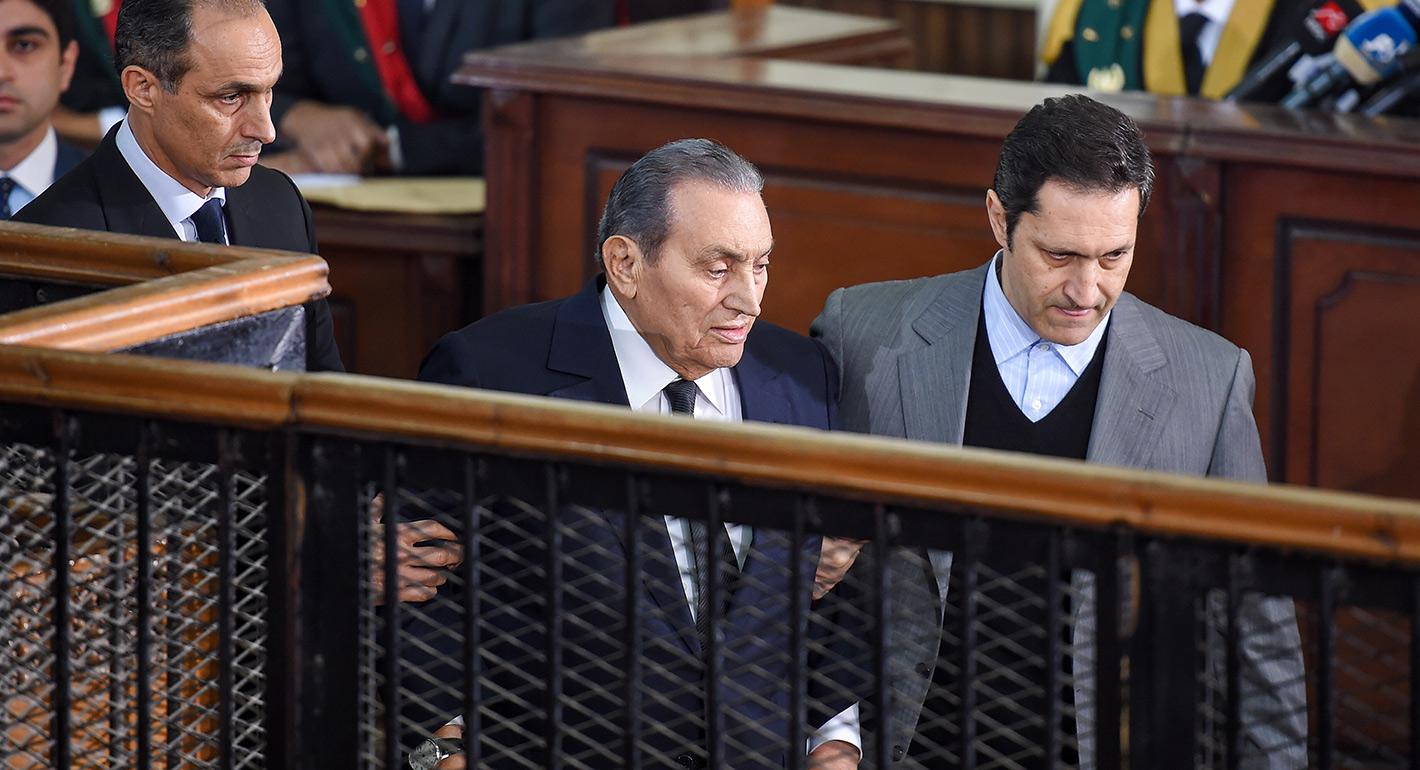
Source: Getty
Mubarak made his name in Egypt as a military man. As younger Egyptians look back on the past decade, Mubarak won’t be a hero to their generation.
Source: Foreign Policy
One of modern Egypt’s most famous preachers was Sheikh Muhammad Metwalli al-Sharawi, who died in 1998 at the age of 87. He was popular in the days before social media even existed—yet a clip of his continues to be seen online more than 20 years after his death. It’s a line he delivered to former Egyptian President Hosni Mubarak at the height of the latter’s popularity—a line often touted as an example of a scholar speaking truth to power. Sharawi declared to Mubarak: “If you are our fate, then may God grant you success. And if we are your fate, then may God help you handle it.”
On Feb. 25, Mubarak went to his fate, dying in Cairo at the age of 91. And despite Sharawi’s warning, Mubarak didn’t handle his fate with the Egyptian people, and his legacy will always be their uprising against him.
Mubarak made his name in Egypt as a military man, first training at the Military Academy and then the Air Force Academy, an institution he would eventually lead, becoming commander of the Air Force in 1972. He then became vice president under then-Egyptian President Anwar Sadat a few years later—and rose to the top office not out of deft political maneuvering but because his boss was assassinated.
That assassination happened right in front of Mubarak’s eyes; Sadat was killed by an extremist Islamist while Mubarak was sitting next to him. That experience defined Mubarak’s worldview going forward: an emphasis on security and a narrow interpretation of what that meant. In a country that was beset by extremist Islamist movements in the 1980s and 1990s, Mubarak’s consolidation of his authority went largely unopposed, and he created a regime on that basis. Egypt’s security apparatus, as scholars like Tarek Masoud and Hazem Kandil point out, grew substantially during Mubarak’s reign, far more than the country’s population growth warranted.
But autocratic rule and the deep securitization of the state were of secondary consideration to Mubarak’s international partners, particularly in the West. Few outside of Egypt considered the medium- to long-term repercussions of a regime that was built on repression of social and political grievances. Nor did many out of the country recognize that an economic system that enfranchised a tiny slice of the population in the elite, buttressed by corruption, while the vast majority of Egyptians continued to be poor, inevitably would lead to a backlash of some sort or another.
Few outside of Egypt considered the medium- to long-term repercussions of a regime that was built on repression of social and political grievances.
More important to Western capitals was Mubarak’s willingness to uphold the peace treaty with Israel and Cairo’s pivoting away from Moscow and into the Western sphere of influence. When a revolutionary uprising finally came in 2011, many Western leaders denied what was staring them right in the face: that Mubarak’s rule had been untenable for many years and, if anything, the uprising was an escape valve to save the Egyptian state from complete and utter destruction.
As Egypt entered the 21st century, the regime that Mubarak built became more and more strained under the surface. The radical Islamist extremists were no longer the threat they had been in the ’80s and ’90s, and citizens wanted more access to the nation’s wealth and to be given more liberty. But the Mubarak regime wanted neither; a narrow securitization, coupled with an economic system that served only the upper echelons—betraying any notion of a trickle-down effect—meant that the system’s cracking was a matter of time.
Mubarak’s regime implemented an emergency law, which severely restricted Egyptian civil society in the name of security. For years on end, those of all political stripes—political Islamists, non-Islamist leftists, and others—were silenced or punished. The regime was built on autocracy, corruption, cronyism, and the use of 20th-century state institutions to stifle dissent.
The 2011 uprising was spontaneous—one that happened as the result of many years of neglect and the failing of the Egyptian state to give a sense of dignity to scores of Egyptians.
If one man is responsible for that, it is Mubarak. It was he and his regime that allowed an untenable situation to fester; it was he and his regime that failed to tackle the country’s corruption, cronyism, and inequality when they had the chance to do so, multiple times over 30 years; it was he and his regime that chose to respond to the protesters with brute force over the 18 days of the 2011 uprising. And it was thus he who precipitated his own downfall. That, indeed, is his legacy.
The 2011 uprising was spontaneous—one that happened as the result of many years of neglect and the failing of the Egyptian state to give a sense of dignity to scores of Egyptians.
If one man is responsible for that, it is Mubarak. It was he and his regime that allowed an untenable situation to fester; it was he and his regime that failed to tackle the country’s corruption, cronyism, and inequality when they had the chance to do so, multiple times over 30 years; it was he and his regime that chose to respond to the protesters with brute force over the 18 days of the 2011 uprising. And it was thus he who precipitated his own downfall. That, indeed, is his legacy.
I was in Tahrir Square on the night of Feb. 11, 2011. I remember the joy of the people that night when his departure was finally confirmed. “Raise your head up—you’re Egyptian!” I remember hearing the crowd chant. On the one hand, it was electrifying to see Egyptians so energized by the prospect of an alternative future. And on the other, it was an unfinished revolution because the uprising hadn’t managed to get the state and the regime to restructure and hence there was little to no accountability for the ousted leader himself.
His downfall wasn’t the downfall of the regime. And in that regard, the 2011 revolutionary uprising was successful as an uprising but not as a revolution. The revolution was unfinished and thus undone.
Nine years later, as younger Egyptians look back on the past decade, Mubarak won’t be a hero to their generation. Rather, the heroes of their generation are those who revolted against him—and their dream of building a new Egypt of possibility is, as yet, unrealized.
Former Nonresident Scholar, Middle East Program
Dr. H.A. Hellyer was a nonresident scholar at the Carnegie Endowment for International Peace. He serves as a senior associate fellow at the Royal United Services Institute for Defence and Security Studies in London, and as a Cambridge University fellow.
Recent Work
H. A. Hellyer
H. A. Hellyer
Carnegie does not take institutional positions on public policy issues; the views represented herein are those of the author(s) and do not necessarily reflect the views of Carnegie, its staff, or its trustees.
Its reinstatement should be celebrated, but it retains some major shortcomings.

Leonardo Martinez-Diaz
Despite long-standing differences, China and Vietnam are reinforcing common ground for collaboration, especially in public security. This internal security–centered diplomacy offers a strengthened road map for how China moves forward with Southeast Asia.
Sophie Zhuang
Climate mobility interventions can vary, but they all present opportunities to unlock transformative results that mitigate costs associated with inaction.

Alejandro Martin Rodriguez
For Morocco, integrating gender into climate governance is not simply a matter of social justice. It is a strategic imperative for effective adaptation.
Fadwa Rajoauni
Four Middle East experts analyze the region’s reactions and next steps.



Amr Hamzawy, Andrew Leber, Eric Lob, …