

Paper
Christopher Shell
{
  "authors": [
    "Christopher Shell"
  ],
  "type": "commentary",
  "centerAffiliationAll": "dc",
  "centers": [
    "Carnegie Endowment for International Peace"
  ],
  "collections": [],
  "englishNewsletterAll": "americanStatecraft",
  "nonEnglishNewsletterAll": "",
  "primaryCenter": "Carnegie Endowment for International Peace",
  "programAffiliation": "ASP",
  "programs": [
    "American Statecraft"
  ],
  "projects": [],
  "regions": [
    "North America",
    "Haiti",
    "Central America and the Caribbean"
  ],
  "topics": [
    "Democracy",
    "Security",
    "Civil Society"
  ]
}
Source: Getty
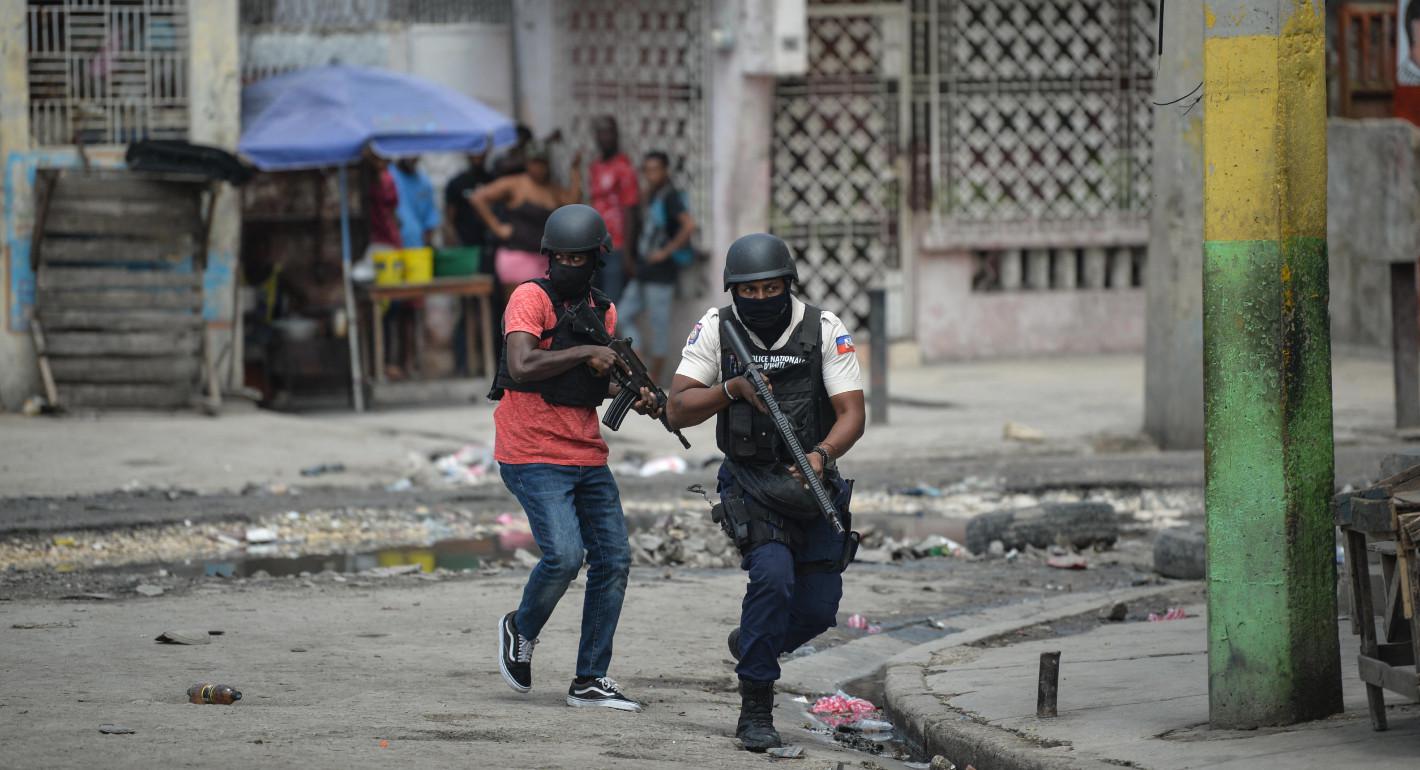
The Kenyan-led UN peacekeeping force has many detractors, but no alternative can bring about the security the island needs to rebuild.
For two years, acting Haitian Prime Minister Ariel Henry had been calling for an international security force to restore law and order in the capital, Port-au-Prince. On Tuesday, Henry finally received an answer, when the UN Security Council approved the deployment of a UN force to quell the violence. Many are bound to criticize another intervention in Haiti, but this is the only feasible way forward in a very difficult situation.
More than two years after the assassination of Haitian President Jovenel Moïse, Haiti has lost all semblance of being a functional democracy—or even a working state. Violence is rampant, and Port-au-Prince is overrun with feuding gangs that are murdering, kidnapping, and impeding the flow of humanitarian aid to the island. Progress on economic and political fronts is nearly impossible under these conditions, which existed even before Moïse’s death. Moïse had been ruling by decree after he postponed the nation’s presidential election in 2019, and Henry has followed suit. Earlier this year, Haiti’s ten remaining senators left office. The nation now has no elected government officials.
The UN’s multinational security force will be led by Kenya, which has volunteered to send roughly 1,000 police officers, with an undisclosed number of officers from Jamaica, the Bahamas, and Antigua and Barbuda. The United States has pledged $100 million in logistical support.
Although the UN authorization has been derided by some, in part due to the fact that the Kenyan police have a track record of excessive force, it could set Haiti on a better course if conducted correctly. Moreover, this iteration of a specialized armed force has the potential to elevate the status of African nations as world mediators—and potentially deepen the relationship between the African Union and the African diaspora.
Many policy solutions have been proposed to alleviate Haiti’s suffering: rooting out government corruption, shoring up the country’s beleaguered police force, and attacking the root causes of the gangs’ appeal to youth—abject poverty—through sustained humanitarian aid and some semblance of financial reparations. But none will work if the capital lacks basic security, gangs serve as the de facto government, and the Haitian people cannot elect a leader of their choice.
Security will be impossible without outside support. U.S. President Joe Biden’s administration has already sanctioned Haitian elites and politicians with ties to drugs and arms trafficking. The United States and Canada have provided the Haitian police force with armored vehicles and tactical training. Earlier this year, Canada deployed two war ships to Haiti for intelligence-gathering. None of these measures have remotely put a dent in the gangs’ activities.
The primary goal of the security mission should be to assist the Haitian police force in opening up avenues for humanitarian aid to flow freely while deterring the gangs’ abilities to operate. Ultimately, and if possible within the mission’s one-year time span, this stability should not be used to ensconce Henry’s power but rather to create a pathway for Henry’s administration and Haitian civil society organizations to reach an agreement on when and how to hold elections, as well as to facilitate a transfer of governance in which the Haitian people’s voices are included.
The tragic and painful track record of international intervention in Haiti has understandably led to extreme reticence from United States, the international community, and human rights groups about once again using force to solve the island’s problems. Haiti has languished under a complex history that includes several failed U.S. interventions of the twentieth century (1915–1938, 1991, 2004, and briefly in 2010) and brutal military regimes that received tacit support from Washington. UN peacekeeping missions from 2007 to 2017 were accused of sexual abuse and exploitation, introducing diseases to the island, and committing human rights abuses against the very people they were meant to protect.
Alternative solutions to international intervention such as canceling the nation’s debt, installing a transitional government approved by Haitian civil society, or moving the capital to the northern port city of Cap-Haïtien are all excellent ideas that can offer a democratic reset and place Haiti on the path to stability. But they cannot work unless security is reestablished.
In addition, another international intervention will be futile if the Haitian people’s voices are not central to the democratic rebuilding process. A small peacekeeping force does not have to be mutually exclusive with a Haitian-led solution. The country’s civil society has attempted to articulate a vision for its future through two agreements: the December 21 Accord and the Montana Accord. However, talks to administer a transitional government as outlined in the documents have not come to fruition.
This moment is an opportune time to reset the democratic process in Haiti. Voices of civil society leaders need to be taken into account, lest Haiti and the international community find themselves in the same predicament in a few years. Washington will have to take a more forward-leaning posture to ensure that Henry is working with civil society to create a transitional government in which the Haitian people have a say. If done correctly, the Kenya-led force has the potential to make African nations a go-to world mediator, set Haiti on the path to democracy, and demonstrate that the United States can support peace in a more disciplined manner.
Former Fellow, American Statecraft Program
Christopher Shell was a fellow in the American Statecraft Program at Carnegie Endowment for International Peace.
Recent Work
Christopher Shell
Christopher Shell
Carnegie does not take institutional positions on public policy issues; the views represented herein are those of the author(s) and do not necessarily reflect the views of Carnegie, its staff, or its trustees.

Japan’s long-term security policy is driven by concerns about China, and there is little appetite for (or interest in) pursuing a confrontation with Moscow.

James D.J. Brown

Russia is testing the waters of NATO’s mutual defense clause. What do strikes in Romanian territorial waters mean for the alliance’s posture toward Moscow?

Dimitar Bechev
Why Pakistan, Saudi Arabia, and Turkey are joining forces on regional security.


Alper Coşkun, Amr Hamzawy

The truth of the strategic situation is that Europe and Russia are extremely unlikely to be able to “turn the page” on their confrontation within the next two decades.

Arkady Moshes

Despite public disputes over trade and immigration, the strategic partnership’s foundations remain sturdy.

Sameer Lalwani