

Commentary
Andrei Kolesnikov
{
  "authors": [
    "Andrei Kolesnikov"
  ],
  "type": "commentary",
  "blog": "Carnegie Politika",
  "centerAffiliationAll": "",
  "centers": [
    "Carnegie Endowment for International Peace",
    "Carnegie Russia Eurasia Center"
  ],
  "collections": [],
  "englishNewsletterAll": "",
  "nonEnglishNewsletterAll": "",
  "primaryCenter": "Carnegie Russia Eurasia Center",
  "programAffiliation": "",
  "programs": [],
  "projects": [],
  "regions": [
    "Russia"
  ],
  "topics": [
    "Political Reform",
    "Security",
    "Military",
    "Economy"
  ]
}
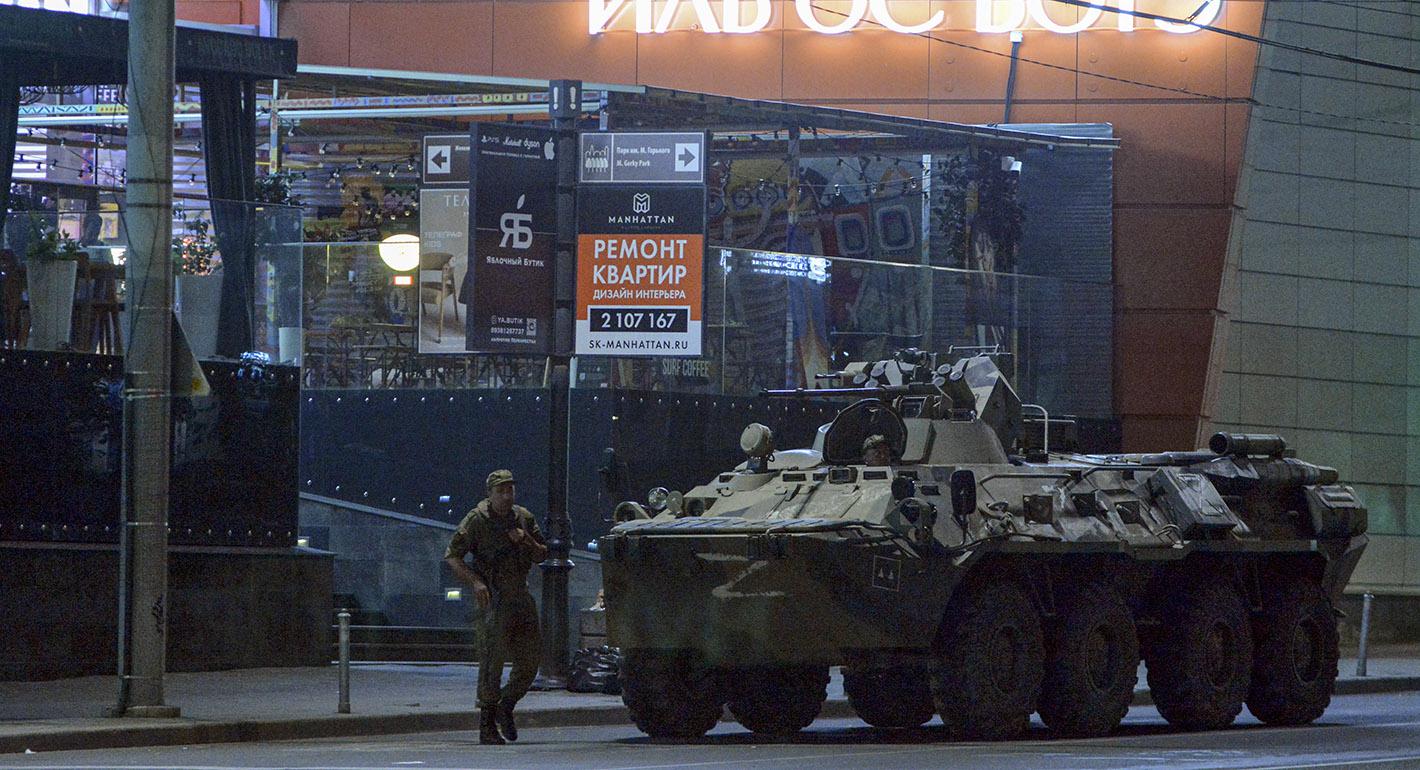
Source: Getty
The regime is driven by ideas of supremacy and messianism, nationalism and imperialism. In this respect, there is no difference between Putin and his inner circle and Prigozhin.
A version of this article first appeared in Russian in the New Times.
“Treason doth never prosper, what’s the reason? For if it prosper, none dare call it treason,” wrote the Elizabethan English poet John Harington.
The actions of Yevgeny Prigozhin, who defiantly marched his Wagner mercenary army across Russia on Saturday before abruptly stopping short of Moscow, are being described as treason and mutiny. Really, however, the weekend’s events would be better described as an “anti-utopia,” as something similar to Alexander Kabakov’s 1990 dystopian novel No Return, with its portrayal of civil war and the collapse of the state.
For this is indeed the beginning of the collapse of the state. The more outwardly fearsome it is, the more people and organizations it tars as “foreign agents” and “undesirable,” the longer prison sentences it hands down to dissenters, the more inclined it is to put elderly cancer patients in jail—the weaker it is institutionally. The fabric of the state is disintegrating.
State institutions are losing their monopoly on violence in two senses. Firstly, they are outsourcing these functions, which is how a contractor broke away from the mothership, feeling strong enough to do so. Secondly, by establishing authoritarian or totalitarian law with parliament’s approval, the government and the constitutional court are destroying the constitutional foundations of the state. The repressive new law is in contradiction of the basic law.
Disregard for the constitution is a sign of the collapse of the state’s institutional framework, leading to the most brutal domestic repression, a decline in morals, the archaization of ideology and propaganda, and the elevation to a pedestal of a sledgehammer and of criminals pardoned by the state in exchange for giving up their bodies to the war in Ukraine. And then, all of a sudden, the court-appointed supplier of these convicts-turned-cannon fodder—Prigozhin—emerges as an independent political entity.
Then it turns out that Vladimir Putin actually paid for the mutiny with taxpayers’ money: the president admitted this week that the “private” military company Wagner was in fact funded entirely by the state all along, and that it received 86.3 billion rubles ($1.01 billion) from the state budget between May 2022 and May 2023. Another 110 billion rubles was spent on insurance payments to mercenaries. Prigozhin’s catering firm, Concord, earned 80 billion rubles supplying food to the military during the same period.
Prigozhin wanted to rise from his humble professional beginnings as “Putin’s chef” and troll farm kingpin to become the president’s equal. When he didn’t get an answer from Putin, he went for broke, raised the stakes, took advantage of the weakness of state institutions, and bypassed the head of state and official bodies to appeal directly to the people for support.
But that appeal had a fundamental flaw: quite simply, Russians do not want to live “like North Koreans,” as Prigozhin recently said they should be prepared to. They want to live in the country they lived in before Russia’s invasion of Ukraine on February 24, 2022, or, better still, before New Year 2022. Not in a country where even as Putin congratulates young people on Youth Day and talks about how great the country’s economy is, those same young people are fleeing the country en masse.
The indifferent average Russian, therefore, is likely to prefer Putin to Prigozhin, with his anti-elitist methods and attempts to test a system that cannot cope with his own ambitious plans.
Prigozhin himself is entirely a product of the Putin system: just another oligarch who made a fortune thanks to his ties to the state. The courts of that state refused to recognize until recently—even after Prigozhin himself had admitted it—that he was the owner of Wagner. There has been no command from above rescinding the sacred commandment of never under any circumstances entering into agreements with dissident elements. So how should Prigozhin be described now?
Both Russia’s Federal Security Service and Putin himself referred to Prigozhin’s actions as a “stab in the back.” Indeed, that’s what you get when you deliberately outsource state functions to convicted criminals, pardon them, release them back into society, and elevate them to the status of heroes, all in the name of “protecting the people of Donbas.” You get a criminalized country and a foretaste of civil war.
Prigozhin’s mutiny is an antecedent of civil unrest unfolding in real time, and it brings us back to where we started: to the unravelling of the fabric of state and society, which had previously only seemed to be so strong because the regime is brutal and unmanageable in its desire to rule the world.
Contrary to Prigozhin’s accusation, it’s not corruption that drives the regime. Corruption is a way for the regime to exist and, at the same time, a social by-product constantly generated by it. The regime is driven by ideas of supremacy and messianism, nationalism and imperialism. In this respect, there is no difference between Putin and his inner circle and Prigozhin. Any discrepancies between them are, as the Soviet dissident Andrei Sinyavsky once quipped, “purely stylistic.” They will mean a protracted disaster for the Russian nation, and indeed for the entire world.
Former Senior Fellow, Carnegie Russia Eurasia Center
Kolesnikov was a senior fellow at the Carnegie Russia Eurasia Center.
Recent Work
Andrei Kolesnikov
Andrei Kolesnikov
Carnegie does not take institutional positions on public policy issues; the views represented herein are those of the author(s) and do not necessarily reflect the views of Carnegie, its staff, or its trustees.

Russia spent years building a “sovereign internet,” concentrating web infrastructure exclusively within Russian territory. Ukrainian drone attacks have shown how vulnerable that approach has left the Russian internet.

Maria Kolomychenko

Putin’s conservative staffing policies and search for ever greater control have cemented parliament’s transformation into a bureaucratic appendage of the executive branch.

Andrey Pertsev

Russia’s AI-driven propaganda campaigns operate in a fragmented, chaotic, and often illogical manner. That’s not necessarily a problem for the Kremlin, though: It’s much easier to mimic genuine public debate that way.

Ilya Klishin

Russian strikes are weakening the economy sustaining Ukraine’s war effort. Closing the growing funding gap will require more European support and politically contentious reforms in Kyiv.

Balázs Jarábik

Ex-president Gurbanguly Berdimuhamedov remains interested in politics, but his son Serdar, Turkmenistan’s current president, is becoming increasingly independent and willing to break with his father’s legacy. If their covert rivalry goes too far, both risk losing power.

Galiya Ibragimova