

Commentary
The real test may come after the leaders leave the room.
- +1
Sheena Chestnut Greitens, Oriana Skylar Mastro, Yukon Huang, …
{
  "authors": [
    "James M. Acton",
    "Saskia Brechenmacher",
    "Cecily Brewer",
    "Frances Z. Brown",
    "Evan A. Feigenbaum",
    "Steve Feldstein",
    "Andrew Leber",
    "Ariel (Eli) Levite",
    "Leonardo Martinez-Diaz",
    "Aaron David Miller",
    "Marwan Muasher",
    "Jane Munga",
    "Michael R. Nelson",
    "Marc Pierini",
    "Eugene Rumer",
    "Milan Vaishnav",
    "Barbara Weisel",
    "Andrew S. Weiss",
    "Stephen Wertheim",
    "Sarah Yerkes",
    "Tong Zhao"
  ],
  "type": "other",
  "blog": "Emissary",
  "centerAffiliationAll": "",
  "centers": [
    "Carnegie Endowment for International Peace",
    "Carnegie Europe"
  ],
  "englishNewsletterAll": "",
  "nonEnglishNewsletterAll": "",
  "primaryCenter": "Carnegie Endowment for International Peace",
  "programAffiliation": "",
  "programs": [],
  "projects": [],
  "regions": [
    "United States"
  ],
  "topics": [
    "Foreign Policy",
    "Domestic Politics",
    "Security",
    "Defense"
  ]
}
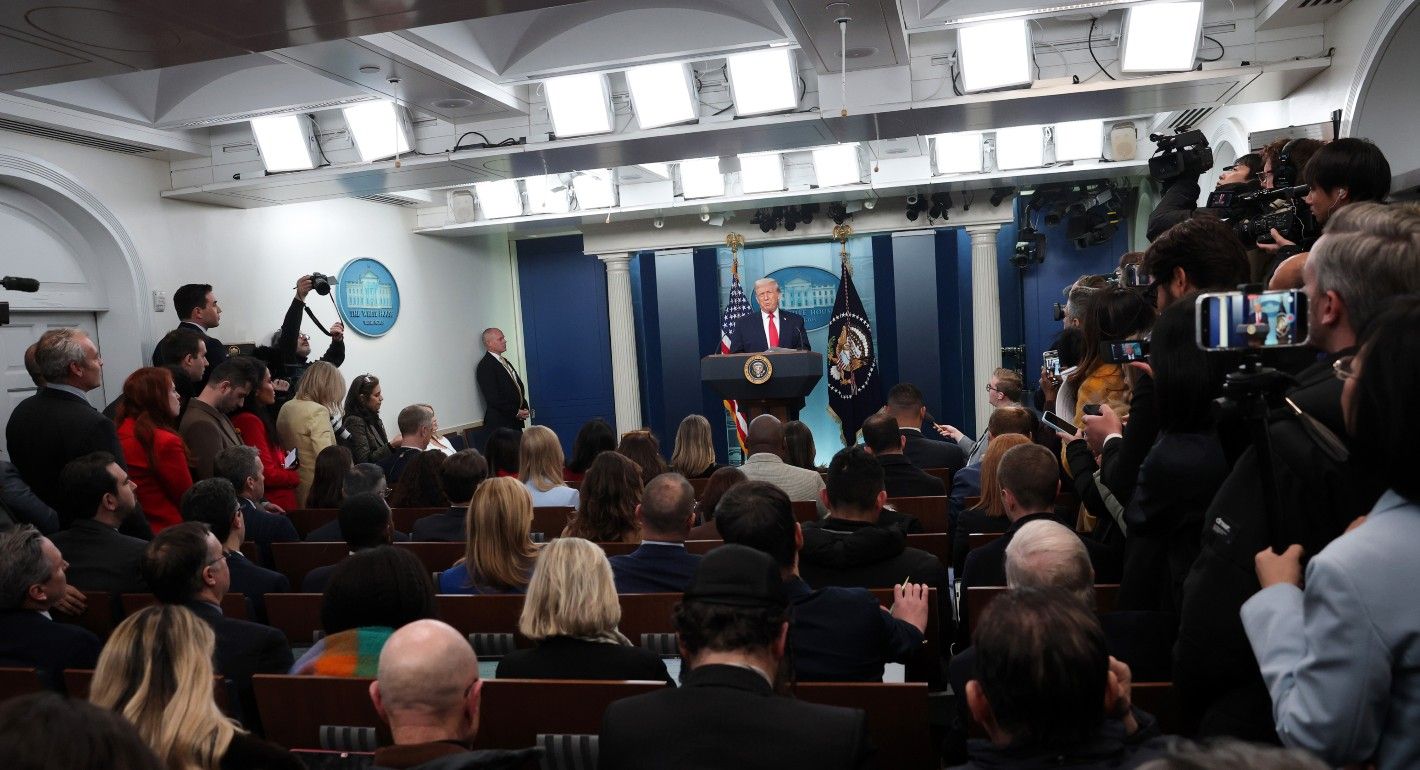
Trump speaks to the media at the White House on January 20, 2026. (Photo by Kevin Dietsch/Getty Images)
Carnegie scholars examine the crucial elements of a document that’s radically different than its predecessors.
Last month, President Donald Trump issued the first National Security Strategy (NSS) of his second administration. The document marked a stunning departure from previous such strategies, including the more conventional 2017 strategy that set the agenda for Trump’s first term. The 2025 NSS is, as Thomas Hobbes might have quipped, “nasty, brutish, and short.” Overall, it promises significant changes in how America acts in and on the world, and it assumes that these changes can bring benefits to U.S. interests in world politics and the global economy without fundamentally changing those systems themselves.
Here, more than twenty Carnegie scholars offer brief observations of key elements of the 2025 NSS: what was present, what was absent, and what it might mean for the coming years.
—Dan Baer
National security strategies are typically the work of many keyboards. As a result, they tend to be dull. The process of reaching consensus strips them of controversial ideas—including those that will eventually be enacted. A normal NSS is neither a playbook nor a fantasy novel, but a rough guide to policy.
This NSS is different. Whether you like it or not—and I really don’t—it is not the result of compromise. Reportedly, it was largely the work of one man, Michael Anton. The vision he articulates is relatively detailed and largely coherent, especially if you ignore claims of a “predisposition to non-interventionism.” The United States’ seizure of Venezuelan President Nicolás Maduro appears to herald the document’s implementation (see “Trump Corollary” to the Monroe Doctrine). As a result, it’s tempting to read this NSS as a policy blueprint for the next three years.
That reading may be correct—but it is too early to tell. Anton has left government, reportedly after becoming frustrated with the administration. The absence of a consultative drafting process is likely to reduce buy-in from the administration at large. Moreover, events have a way of asserting themselves. The NSS may frame the U.S.-China relationship in almost exclusively economic terms, but Beijing clearly doesn’t view it that way. It’s not difficult to imagine that, in the near future, perhaps as the result of a crisis over Taiwan, great power competition will again become the driving force of U.S. foreign policy.
In short, this NSS seems just as likely to be forgotten as to be seen as foundational. Still, the fact that both these outcomes are entirely possible is a sign of how different this document is from its predecessors.
References to democracy and human rights in national security strategies are inevitably fraught, given the recurring trade-offs between the U.S. government’s stated value commitments and its geopolitical and economic interests. Yet the new NSS reflects not just a different balancing act, but a more fundamental rupture.
Gone are any references to universal human rights. Instead, the Trump administration embraces the “God-given natural rights of American citizens,” signaling a religious understanding of rights divorced from international human rights covenants. National sovereignty emerges as a core principle: not to limit military intervention (as the administration’s recent actions in Venezuela underscore), but to push back against “intrusive” international organizations and rights regimes. Finally, the strategy invokes the language of rights to elevate a narrow set of core liberties threatened by elite-driven efforts to “protect democracy,” namely free speech, religious freedom, and “the right to choose and steer our common government.”
In this reframing, the primary enemies of freedom, democracy, and rights are no longer autocratic and corrupt regimes, but transnational institutions such as the EU or even traditional U.S. allies in Europe that are taking measures to regulate information ecosystems, protect minority rights, and constrain executive power.
Trump’s NSS strives to make peace great again. Although other administrations have highlighted peace, security, and prosperity as end goals and prioritized specific negotiations, such as with Afghanistan or Iran, this strategy makes proactive peacemaking a top five national security priority. The strategy includes the Trump administration’s 2017 NSS “peace through strength” principle that a strong America will deter other nations from threatening U.S. interests. But this strategy goes further, arguing that “realignment through peace” is a cost-effective means to project American power around the world even in “regions and countries peripheral to our immediate core interests.”
Yet contrary to the strategy’s emphasis on peace, with its actions in Venezuela less than a month after the NSS publication, this administration appears to be prioritizing military might over peacemaking as a means to project power—a signal aggressors may point to in the future. Further, although surgical military action can appear to be quick and cost-effective, time and again the United States has learned that, without a political strategy for a long-term peace, what looks to be a quick solution can spiral into a forever war. Despite the NSS’s (questionable) claim that Trump has resolved eight conflicts in eight months, at this moment it appears that Trump is likely to be remembered more for the long-term implications of his military actions than his peacemaking.
The Africa section of the NSS faces a principal challenge: the lack of an overarching strategic framework in which to nest. Up to this point, each recent NSS offered up a fairly clear global logic, enabling readers—especially U.S. officials themselves—to discern how Africa fit within this framework. For example, the George W. Bush strategies emphasized combating terrorism, strengthening weak states, and promoting democracy, and the U.S. government’s priorities in Africa followed accordingly. Trump’s 2017 strategy made the seminal shift to great power competition, with clear implications for Africa. The 2022 document from President Joe Biden’s administration maintained focus on strategic competition while also pushing cooperation on transnational problems.
Each strategy’s overarching framework signaled what Washington aspired to achieve in the world and—by implication and sometimes explication—how U.S. policy in Africa fit in. Thus, even as Africa watchers often yearned for greater reflection of the continent’s complexity, past strategies provided a roadmap of how to align Africa policy with White House priorities. In contrast, the 2025 NSS features notable and ideological agendas on some other regions, but amid the inconsistencies and vitriol, an overall global strategic logic is hard to discern.
The Africa section does invoke several worthy goals the United States should pursue. The challenge here is matching means to ends. For example, the document cites the enormously important goal of conflict resolution—yet in practice, the administration has undermined this by its elimination of the U.S. Agency for International Development, termination of the State Department’s conflict-focused bureau, broader sapping of U.S. diplomatic bandwidth, and deprioritization of governance and development. Or consider the document’s worthy objective of moving from an aid paradigm to emphasize trade and investment on the continent. After the administration has instated widespread tariff regimes, announced travel barriers, and eliminated Prosper Africa—the initiative launched in the first Trump administration explicitly to boost trade and investment with the continent—with no clear follow-on, achieving this commendable goal is even more remote.
The closing lines of this NSS’s introduction read: “The questions before us now are: 1) What should the United States want? 2) What are our available means to get it? and 3) How can we connect ends and means into a viable National Security Strategy?” These are the correct questions. Yet as far as the Africa elements of the strategy go, they remain unanswered.
The 2025 NSS features notable and ideological agendas on some other regions, but amid the inconsistencies and vitriol, an overall global strategic logic is hard to discern.
The United States now asserts its primacy in the Western Hemisphere but is pursuing a NSS that also asserts preeminence in Asia, a far cry from the fantastical notion that it will “accept spheres of influence” that curtail its role in the region. But it is doing so with diminishing credibility—offering rhetorical paeans to “openness, transparency, and trustworthiness” while imposing tariffs on its closest allies, closing its market, coercing partners for investment, and curtailing technology flow. And it is attempting to do so on the cheap—taking a transactional approach to everyone and everything in Asia while withdrawing from the traditional U.S. role of providing security and economic related public goods.
In fact, providing public goods has been the price of American preeminence. Since 1945, the United States has been the principal underwriter of Asia’s security and economic orders. Now, however, it has an almost entirely transactional approach and is using threats and coercion to extract what it wants. Bluntly put, the strategy for Asia is neither principled nor strategic: If it were principled, the United States would seek coalitions of the like-minded around shared ideas. If it were strategic, the United States would not pick fights with countries, such as India and Vietnam, that can help balance the rise of Chinese power. Asking allies to “step up” is not the same as withdrawing public goods, trashing pacts and rules, and leveraging an array of coercive tools against the very partners one needs to foster a balance of power. In short, the United States is long on attitude, short on strategy. And it is simply inexplicable that North Korea, which can target the U.S. homeland with missile-delivered nuclear weapons, did not rate even a single mention. That is hardly America First.
Trump’s 2025 national security strategy is America’s first post-democracy document. It is a radical departure from previous approaches to democracy—including the president’s own 2017 strategy. The 2025 version includes only three references to democracy, and all of them pervert traditional usages of the term.
The first reference is a warning shot. The document cautions that the U.S. government has been granted “fearsome powers,” and those powers should never be abused under the guise of “protecting our democracy” to censor opposing viewpoints (which seems to be a veiled reference to the Biden administration’s legal efforts to hold Trump’s supporters accountable for acts of political violence).
The other two democracy references relate to Europe. The strategy warns that the Trump administration “finds itself at odds” with European governments that are trampling on “basic principles of democracy” to suppress opposition voices (that is, far right political parties), and that American diplomacy should continue standing up for “genuine democracy” that celebrates European nations’ “individual character and history” (another signal of support for right-wing nationalist movements against centrist governments).
In contrast, Trump’s 2017 national security strategy reads like it was lifted from a liberal internationalist textbook. Its first reference to democracy describes how America’s defeat of fascism and vanquishing of Soviet communism eliminated any doubts about the “power and durability of republican democracy.” In subsequent paragraphs, that strategy discusses how the United States’ commitment to “liberty, democracy, and the rule of law” serves as an inspiration globally and advances America’s influence, how protecting free speech and a free press is fundamental to building democratic resilience, and that advancing American values is a primary objective. The 2017 strategy includes thirty-eight references to “values.”
Trump’s decision to strip all reference to democracy and values from the new document makes crystal clear his intent to radically overhaul the post-1945 international liberal order. He rejects the notion that Washington should remain bound by international law, multilateralism, alliances, and shared values. His strategy is a declaration that the American empire is finally shedding the constraints of the old system—the very one that the United States spent decades designing, building, and leading.
The NSS entry on the Middle East is noteworthy for revolving around the sovereign wealth funds of Gulf monarchies such as Qatar, Saudi Arabia, and the United Arab Emirates (UAE). Though none are mentioned by name, the Gulf states are the core of a region seen as “a source and destination of international investment” and a potential broker between the United States and other “friendly and open markets.” Israel’s security is still a core U.S. interest in the Middle East but something of an afterthought, as is “great power competition”—China’s influence in the region has been downgraded to “jockeying,” with the United States in “the most enviable position.”
Still, the NSS’s optimistic view of the region as “a place of partnership, friendship, and investment” banks hard on the idea that sidelining Iran is the same as peacebuilding. With Iran’s nuclear program degraded and its proxies weakened, so the NSS thinking goes, the rest of the region can focus on shared economic interests. Yet bombing Iran and its proxies into submission may simply change the axes of regional competition, as seen in clashes between Saudi and Emirati-backed forces in Yemen. The failure of the Trump administration to invest in peace agreements beyond headline “deals” leaves plenty of room for simmering conflicts in Yemen, Sudan, Israel and Palestine, and elsewhere to boil over into yet more regional instability. This highlights the limits of the NSS’s overall focus on economic nationalism as a core priority for U.S. national security.
Reading the new NSS makes us appreciate the congressional requirement for new administrations to produce a NSS early in their terms—even more so that this administration faithfully complied. The NSS did away with any illusion that the prior speeches, statements, and actions of Trump and his senior lieutenants were either capricious or ad-hoc, rather than driven by a deeply rooted worldview.
Although the NSS hardly lays out a strategy, it does articulate a radical new vision of the United States and its role in the world. This vision not only stands in sharp contrast with that of Trump’s immediate predecessor, but with virtually all of them.
We are better off absorbing the reality that henceforth—for the next three years, but possibly much longer—the U.S. administration will be guided by the narrowest possible definition of national self-interest, geographically, economically, and politically. Alliances based on shared values, ideology, or even enduring common security interest have no real role. Instead, the United States will be operating boldly, muscularly, transactionally, and eclectically, never hamstrung by common understandings of international law, norms, or binding precedents or commitments.
Significant segments of the U.S. business community have already adjusted themselves to this reality, some even seizing on it to promote their own interests. Similar developments are occurring abroad, among U.S. partners and even key competitors and adversaries, while traditional U.S. allies find themselves exposed and vulnerable. Even if this radical change of direction ultimately proves short-lived and myopic, the implementation of the NSS shock therapy is already causing fissures and realignment. These will be difficult to heal and reverse if the United States reverts to what used to be, at least in the previous century, its more mainstream attitude toward the world.
Alliances based on shared values, ideology, or even enduring common security interest have no real role.
Two things struck me most about the new NSS, beyond its much discussed hostile and frankly racist approach to Europe. First, the document officially signals to the world that the Obama-Trump-Biden-Trump swings in U.S. foreign policy were not an aberration but part of a recurring pattern. As a result, much of world will hedge by diversifying away from the United States, hoping it will come back as a responsible stakeholder but no longer banking on it. New financial, trade, technological, security, and cultural relationships will quickly emerge that circumvent the United States, with the net effect of reducing U.S. global influence and creating new challenges for U.S. foreign policy.
The second is that the NSS was conceived with a remarkably short time horizon in mind. Its strategic vision is only as long as the time it takes to make a deal—very little matters beyond that. In this truncated perspective, cross-border challenges that take decades of sustained attention to tackle—climate change and pandemic prevention being the most obvious—disappear from view. By implication, the strategy seems to be “we will deal with these problems when they reach our doorstep,” which seems to me a very dangerous approach.
This is not your grandfather’s NSS—a mile-wide, inch-deep kitchen-sink exposition of an administration’s foreign policy and national security goals. Instead, Trump’s NSS is sharply written, often in non-blob, beyond-the-Beltway prose.
It is less an implementable and sound strategy and more a list of the administration’s prejudices, priorities, and principles, whose sum total seems designed to shock and to turn much of its Republican and Democratic predecessors’ internationalist policies on their heads.
It minimizes competition among and between great powers. And although it never talks about conceding rivals’ spheres of influence, it is explicit when it comes to U.S. dominance in the Western Hemisphere, validated by the recent U.S. military operation against Venezuela. The document sends the unmistakable message: Stay out of America’s backyard, and we may be prepared to stay out of yours. It’s America First, but not isolationist. And it’s Trumpian to the core.
Previous iterations of the NSS contained scattered quotes from presidents. But Trump is referred to as a key driver of this policy no fewer than twenty times. He also has the distinction (with apologies to Teddy Roosevelt) of having his own corollary.
The Middle East’s listing near the bottom of the NSS was no coincidence. Although the United States’ intention to stop viewing the Middle East as a top priority started under Obama, the new strategy spelled it out in a clear way: “America’s historic reason for focusing on the Middle East will recede.” For the past two decades or so, the United States’ involvement in the affairs of the region has been one of necessity rather than choice. The one exception to this strategy has been Israel, where the different U.S. administrations have prioritized Israeli interests. Even this prioritization is today under serious discussion among some of Trump’s traditional supporters.
Bringing peace to the region is no longer a key objective of Washington. Even when the strategy mentioned peace, it was largely about ending the war on Gaza, but not articulating in any meaningful way bringing an end to the Arab-Israeli conflict. The obvious priority in the region appears to be the expansion of the Abraham Accords, more out of economic reasons rather than for a peaceful settlement between Palestinians and Israelis.
The strategy will ring hollow, however, with most people in the region, particularly as it talks about nonintervention in the affairs of other nations or the protection of free speech. The United States’s policy since October 7, 2023, is seen by most in the region as heavily interfering in the affairs of several countries, including Lebanon, Syria, Iran, and Gaza. Free speech, particularly domestically, has also been significantly thwarted.
Bringing peace to the region is no longer a key objective of Washington.
The Africa section of the NSS—though brief and positioned at the tail end of the document—delivers a clear and consequential text that shows Washington’s approach to Africa has reset, with significant policy shifts.
First, aid and democratic norms are replaced by a framework focused on trade, investments, and geopolitics and delivered through selective engagement with countries that guarantee stability and open markets and deliver investment opportunities.
Second, Africa is no longer relegated to a separate policy approach, as has often been the norm. The continent is folded into the NSS’s overarching America First agenda, subject to the same transactional logic shaping U.S. engagement elsewhere. This framing affirms the Bureau of African Affairs’ Commercial Diplomacy Strategy and provides renewed hope for U.S.-Africa trade through the revival of the African Growth and Opportunity Act, which expired in September 2025. Even peace efforts—whether in the Democratic Republic of the Congo–Rwanda corridor, Sudan, or the Horn of Africa—are framed as conflict prevention that can unlock and secure investments for the United States.
Third, the continent’s strategic value is identified in energy—a signature priority of the America First agenda—and critical minerals. Both are areas with “good return on investment” and geopolitical payoff in global competition, according to the NSS. For Africa, this creates a space to bargain but also raises questions of how countries can strategically navigate this landscape of economic and political power imbalances.
Lastly and equally telling is what the NSS omits from the Africa region: technology, artificial intelligence, and Africa’s youth dividend. This a reversal of fortunes for technology, which prominently featured in the previous administration’s Digital Transformation for Africa initiative, and an omission that confirms Washington’s economic security agenda favors immediate tangible returns rather than longer-term potential.
The Trump administration’s 2025 NSS departs radically from previous versions—often in ways that ignore critical realities.
As a physicist, technologist, and futurist, I had hoped the strategy would spotlight how the U.S. could provide true digital leadership to shape the next phase of digital development worldwide.
Since the first Trump administration released its 2017 NSS, humanity has generated more than twice as much data as in all the years before. The 2017 strategy referenced “data” eighteen times and offered concrete proposals for securing and leveraging it. It warned: “Today, actors such as Russia are using information tools in an attempt to undermine the legitimacy of democracies. Adversaries target media, political processes, financial networks, and personal data.”
By contrast, the new NSS does not contain the words data, information, media, or internet. The new NSS takes an “America only” approach, with no mention of international cooperation or data-sharing.
Other administration initiatives—such as the Artificial Intelligence Action Plan and the recently announced Genesis Mission—show that some staff in the White House understand that access to high-quality data is critical for research and economic growth. Yet NSS 2025 fails to emphasize how the United States could collaborate with allies on coordinated digital policies—essential for our military and intelligence agencies. By doubling down on America First, the NSS ignores the urgent need for global efforts to share, verify, and protect data and information.
Seen from Brussels, the substance of the NSS is not entirely new, and it even has one blunt merit: It describes what to expect from U.S. diplomacy until January 2029 at least.
But the real novelty is that a document bearing the president’s seal and signature launches a virulent ideological fight against the EU and some of its member states—a massive reversal of U.S. foreign policy of eighty years.
The NSS’s brief section about Europe is nothing short of a tirade: “civilizational erasure,” “regulatory suffocation,” “activities . . . that undermine political liberty and sovereignty,” “subversion of democratic processes.”
European hard-right parties have now become Trump’s privileged partners, and their growing influence “gives [the administration] cause for great optimism.” We can now foresee vibrant relations with the European governments most closely aligned with the United States—Hungary, Czech Republic, and Slovakia—on topics such as the reduction of military support to Ukraine or normalization with Russia. These “domestic disruptors” have now gained a massive and public ideological support from the White House and are promoted as real patriots, in perfect tune with Moscow’s stance against the EU and NATO. (Last month, the EU’s heads of state allocated 90 billion euros of assistance through 2027. In the shadow of the NSS, the Czech Republic, Hungary, and Slovakia unsurprisingly opted out of the decision.)
The new NSS is a considerable challenge for EU leaders. Clearly, a further surge in European cohesion and courage will be necessary in the time to come.
But the real novelty is that a document bearing the president’s seal and signature launches a virulent ideological fight against the EU and some of its member states—a massive reversal of U.S. foreign policy of eighty years.
Trump’s first-term NSS was drafted by the so-called adults on his national security team, resulting in a rather conventional document, albeit with Trumpian America First flourishes. It underscored the value of alliances in Europe and Asia as the cornerstones of American prosperity, security, and global leadership and took pride in American generosity toward other nations.
Not so with the second-term NSS, a true reflection of the president’s vision. There is no better proof of Joseph Stalin’s dictum that “cadres decide everything” than the NSS written by the very small team of Trump acolytes with no apparent input from the bureaucracy. They extoll his (oft imaginary or exaggerated) peacemaking accomplishments and break with long-established pillars of U.S. foreign policy, such as commitment to European allies, denigrating them for supposedly undermining political liberty and democratic processes.
Any NSS gets a close read at the Department of Defense, whose leaders have to translate the commander-in-chief’s vision into the National Defense Strategy and National Military Strategy—the blueprints for defending the nation that guide regional and functional combatant commands—and the Global Posture Review, intended to align the U.S. military footprint around the world with the president’s vision.
Those three documents are more concretely consequential than the NSS. They outline the administration’s defense priorities and posture. Watch that space.
India does not feature prominently in the new NSS, but the few places where it does appear are likely to offer New Delhi modest consolation after a bruising year in bilateral relations. In 2025, U.S.-India ties experienced their most severe strain in a quarter-century. The imposition of 50 percent tariffs (half justified by India’s continued imports of Russian crude), new restrictions on high-skilled immigration (from which Indians have been major beneficiaries), and renewed U.S. outreach to Pakistan combined to generate significant turbulence in the relationship.
Against this backdrop, the NSS strikes a more reassuring, if limited, note. The document emphasizes the need to improve commercial and strategic relations with India in order to encourage New Delhi to play a larger role in Indo-Pacific security, including through continued cooperation with Australia, Japan, and the United States in the Quad—a minilateral grouping many in New Delhi had feared the Trump administration had sidelined. More broadly, it calls for aligning the actions of allies and partners to prevent domination by any single competitor power (China is the subtext, if not the text, here).
India is also explicitly named as a partner in wider coalition-building efforts, including coordination with European and Asian allies in the Western Hemisphere and cooperation in securing critical minerals in Africa. Together, these references suggest that even amid bilateral frictions, Washington continues to view New Delhi as an important—if imperfect—strategic partner in managing Beijing’s rise.
The strategy includes economic security as a key national security priority, but the actions it proposes lack coherence and clarity. The strategy asserts a bargain between the United States and its allies and partners in the Indo-Pacific: U.S. deterrence of war in the region in exchange for their support in addressing China’s unfair economic practices and rebalancing China’s economy away from excess industrial production to domestic consumption. And it argues for consolidating the U.S. alliance system into an economic group.
But Indo-Pacific countries are negotiating economic deals with the United States not because Washington convinced them of the shared benefits of its comprehensive vision for the region but under the threat of punishing U.S. tariffs. Although regional leaders recognize that aligning with an America First approach may have been expedient in the short term, they also understand it put them at risk of ongoing U.S. demands—and potentially in China’s crosshairs—with little hope that any “economic group” will defend them. And most no longer believe the strategy’s assertion that the United States is differentiated by “our openness, transparency, and trustworthiness” and will hedge their geopolitical bets accordingly.
From Russian President Vladimir Putin on down, the Kremlin and its propaganda apparatus rejoiced following release of the NSS. Public comments were aimed squarely at the frayed nerves of Europeans who have conveniently served as public enemy number one following Trump’s return to office.
Putin directly invoked the NSS in an attack on NATO Secretary General Mark Rutte, mocking his warnings about the risk of European complacency about the looming Russian threat. Putin also called European elites “under-swine who thought they could make a killing by participating in the destruction of Russia” and looked forward to their eventual replacement (undoubtedly by the nationalist-populist forces whom the NSS portrays as its allies in the fight against “civilizational erasure”).
Such MAGA-friendly themes align with longstanding Russian goals to divide the West, and the Kremlin is happy to use them as a cudgel to make the specter of Russian power and a possible U.S. retreat from its transatlantic security commitments appear more distressing—and inevitable. But cooler heads inside the Russian national security establishment can tell the difference between cheap debating points and the yawning disparities in U.S. and Russian political, economic, military, and technological power.
Perhaps most uncomfortable for Russian officialdom is the realization that Trump will not be in office forever and that nothing in the NSS will bind his successors. Putin’s own spokesman admitted as much publicly.
In the meantime, Trump is planning a $1.5 trillion defense budget to cover the cost of Golden Dome space-based ballistic missiles interceptors and other advanced weapons that will be deeply unnerving for Russian defense planners. Despite all the theatrics, the Kremlin’s long-term insecurities and mistrust of the United States will surely remain the bedrock of its own national security strategy.
Perhaps most uncomfortable for Russian officialdom is the realization that Trump will not be in office forever and that nothing in the NSS will bind his successors.
Trump’s NSS begins by renouncing “permanent American domination of the entire world.” No longer, it declares, will the United States “shoulder forever global burdens” disconnected from U.S. interests. Then—as if those words alone had wiped the slate of history clean—the NSS goes on to name not a single defense commitment or military position the United States will shed. Instead, it layers new, potentially far-reaching ambitions atop the forever burdens it theoretically rejects but implicitly maintains.
True, the NSS vilifies European allies while avoiding hostile rhetoric toward Russia. Yet it doesn’t say the United States will reduce its regional military presence or empower Europeans to become more independent of Washington. To the contrary, the NSS introduces a novel mission: to transform the politics of Europe by “cultivating resistance to Europe’s current trajectory within European nations.” If anything, the implication is that Europe—facing the supposed prospect of “civilizational erasure”—will remain unready to defend itself absent a wholesale cultural, demographic, and economic makeover.
Yes, the NSS drops adversarial verbiage toward China (albeit often by simply referring to the country implicitly). But it offers Beijing nothing but the chance to accept coexistence on Washington’s terms. On Taiwan, the issue most likely to bring the two powers to blows, the NSS is uniquely specific: The island has major strategic and economic importance, and the United States will “build a military capable of denying aggression anywhere in the First Island Chain.”
Sure, the NSS speaks of avoiding costly entanglements in the Middle East. How so? Not by backing away from security partners, settling accounts with adversaries, or solving political problems, but by imagining that the past year of violence, featuring an unprecedented Iran-Israel war and unspeakable brutality in Gaza, somehow indicates that the region is poised for peace.
If all that weren’t enough, the NSS identifies the Western Hemisphere as its foremost priority. It claims an almost limitless warrant to employ hard power across the region—to strike at cartels and “narcoterrorists,” to expel migrants and keep them out, and to roll back all manner of extra-hemispheric (namely, Chinese) influence, in what the NSS dubs the “Trump Corollary” to the Monroe Doctrine. Thankfully, the annexation of territory goes unmentioned. Just not by the president himself.
In affirming what it calls “flexible realism,” the Trump NSS is explicitly breaking with previous administrations’ approaches toward the values versus interests conundrum. By acknowledging that the United States sees “nothing inconsistent or hypocritical” in partnering with autocrats while preaching the supremacy of U.S. values, the administration is, in effect, saying the quiet part out loud.
While previous U.S. presidents—Democrats and Republicans alike—have spoken loudly about championing U.S. values while quietly propping up brutal dictators, Trump has removed any pretense of balance. In fact, the terms “human rights” and “values” do not appear once in the document.
This approach is perhaps no clearer than in the Middle East, where the NSS asserts unequivocally that the United States will no longer promote democratic reform nor prioritize it above other regions. Yet here, the Trump NSS falls into the same trap as its predecessors, seeking to demote the importance of or pull back from the Middle East.
But no matter where it prioritizes the Middle East—or to which region it tries to pivot—the Trump administration will likely get pulled back into the region that has demanded so much American blood and treasure over the past century. Take, for example, the 2010 Obama NSS, which sought a dramatic shift away from both the region writ large and especially the democracy promotion agenda of George W. Bush—only to get sucked violently back in to democracy promotion in the Middle East as the Arab Spring took hold of the region.
No NSS can predict the future, nor should it necessarily try. But it is a mistake to ignore history, which indicates that the Middle East has a way of consuming U.S. presidents’ attention, time and again—no matter what the NSS says.
The NSS is likely to encourage the very aggressive behaviors it seeks to deter. The Trump Corollary to the Monroe Doctrine invites rival powers to ask why they, too, should not claim the right to deny external “competitors the ability to position forces or other threatening capabilities, or to own or control strategically vital assets” within regions where they claim preeminence. The unsettling ambiguity surrounding the scope of America First—including whether it now extends to new territorial claims justified on national security grounds—risks fatally weakening deterrence against revanchism by already revisionist powers.
The strategy’s call to safeguard domestic “spiritual and cultural health” and to be “unapologetic about our country’s past and present” closely mirrors the language of social control and nationalist mobilization employed by authoritarian rivals. Coupled with highly visible domestic dysfunction, democratic backsliding, and the retreat from even rhetorical commitments to universal values or international law in diplomacy, this posture risks extinguishing any residual incentives for liberal reform in authoritarian states. The likely outcome is the further consolidation of authoritarian rule and dimmer prospects for genuine, durable reconciliation between Washington and its autocratic competitors.
The NSS correctly observes that “we cannot assume that our system’s advantages will prevail by default.” Yet by discouraging self-reflection on America’s own past and present, it undermines the U.S. system’s core advantage: higher-quality decisionmaking grounded in critical and inclusive debate. Although the document affirms commitments to sustaining U.S. military superiority, including in the Asia-Pacific, it is conspicuously silent on the political will to employ that power in defense of allies and partners. Washington may grow more assertive in employing hard power in the Western Hemisphere, but the strategy ultimately places a bet on “presidential diplomacy”—relying on the mere “minor costs of time and attention” of the president—to preserve peace in “regions and countries peripheral to our immediate core interests.” One can only hope rival states do not read this thinly articulated commitment as an invitation to probe where America’s line of “immediate core interests” truly lies.

Jessica T. Mathews Chair, Co-director, Nuclear Policy Program
Acton holds the Jessica T. Mathews Chair and is co-director of the Nuclear Policy Program at the Carnegie Endowment for International Peace.

Senior Fellow, Democracy, Conflict, and Governance Program
Saskia Brechenmacher is a senior fellow in Carnegie’s Democracy, Conflict, and Governance Program, where her research focuses on democratic erosion, gender, and civic activism in the United States and globally. She also serves on the board of the International Center for Not-for-Profit Law.

Nonresident Scholar
Cecily Brewer is a nonresident scholar at the Carnegie Endowment for International Peace. Her research focuses on the U.S. approach to, and conduct of, international negotiations to advance American foreign policy.

Vice President for Studies
Dr. Frances Z. Brown is a vice president for studies at the Carnegie Endowment for International Peace. Brown served on the White House National Security Council (NSC) staff over the past three presidential administrations. Her research focuses on U.S. foreign policy, Africa, the Middle East, and governance.

Vice President for Studies
Evan A. Feigenbaum is vice president for studies at the Carnegie Endowment for International Peace, where he oversees work at its offices in Washington, New Delhi, and Singapore on a dynamic region encompassing both East Asia and South Asia. He served twice as Deputy Assistant Secretary of State and advised two Secretaries of State and a former Treasury Secretary on Asia.

Director and Senior Fellow, Democracy, Conflict, and Governance Program
Steve Feldstein is a senior fellow and director of the Democracy, Conflict, and Governance Program at the Carnegie Endowment for International Peace. His research focuses on technology, national security, the global context for democracy, and U.S. foreign policy.

Nonresident Scholar, Middle East Program
Andrew Leber is a nonresident scholar in the Carnegie Middle East Program.

Senior Fellow, Nuclear Policy Program, Technology and International Affairs Program
Levite was the principal deputy director general for policy at the Israeli Atomic Energy Commission from 2002 to 2007.

Senior Fellow and Director, Sustainability, Climate, and Geopolitics Program
Leonardo Martinez-Diaz is senior fellow and director of the Sustainability, Climate, and Geopolitics Program at the Carnegie Endowment for International Peace. His fields of expertise include climate politics and diplomacy, climate finance, and mitigating and managing the risks of climate change to economies and communities.

Senior Fellow, American Statecraft Program
Aaron David Miller is a senior fellow at the Carnegie Endowment for International Peace, focusing on U.S. foreign policy.

Vice President for Studies
Marwan Muasher is vice president for studies at Carnegie, where he oversees research in Washington and Beirut on the Middle East. Muasher served as foreign minister (2002–2004) and deputy prime minister (2004–2005) of Jordan, and his career has spanned the areas of diplomacy, development, civil society, and communications.

Fellow, Africa Program
Jane Munga is a fellow in the Africa Program focusing on technology policy at the Carnegie Endowment for International Peace.

Nonresident Scholar, Asia Program
Mike Nelson is a nonresident scholar in the Carnegie Asia Program. He studies the implications of emerging technologies, including digital technologies, biotechnology, and artificial intelligence.

Senior Fellow, Carnegie Europe
Marc Pierini is a senior fellow at Carnegie Europe, where his research focuses on developments in the Middle East and Turkey from a European perspective.

Director and Senior Fellow, Russia and Eurasia Program
Rumer, a former national intelligence officer for Russia and Eurasia at the U.S. National Intelligence Council, is a senior fellow and the director of Carnegie’s Russia and Eurasia Program.

Director and Senior Fellow, South Asia Program
Milan Vaishnav is a senior fellow and director of the South Asia Program and the host of the Grand Tamasha podcast at the Carnegie Endowment for International Peace. His primary research focus is the political economy of India, and he examines issues such as corruption and governance, state capacity, federalism, and electoral behavior. He also conducts research on the Indian diaspora.

Nonresident Scholar, Asia Program
Barbara Weisel is a nonresident scholar in the Asia Program at the Carnegie Endowment for International Peace and the former U.S. chief negotiator of the Trans-Pacific Partnership.

James Family Chair, Vice President for Studies
Andrew S. Weiss is the James Family Chair and vice president for studies at the Carnegie Endowment for International Peace, where he oversees research on Russia, Ukraine, and Eurasia. His graphic novel biography of Vladimir Putin, Accidental Czar: the Life and Lies of Vladimir Putin, was published by First Second/Macmillan in 2022.

Senior Fellow, American Statecraft Program
Stephen Wertheim is a senior fellow in the American Statecraft Program at the Carnegie Endowment for International Peace.

Acting Co-Director and Senior Fellow, Middle East Program
Sarah Yerkes is acting co-director and a senior fellow in Carnegie’s Middle East Program, where her research focuses on Tunisia’s political, economic, and security developments as well as state-society relations in the Middle East and North Africa.

Senior Fellow with the Nuclear Policy Program and Carnegie China
Tong Zhao is a senior fellow with the Nuclear Policy Program and Carnegie China, Carnegie’s East Asia-based research center on contemporary China. Formerly based in Beijing, he now conducts research in Washington on strategic security issues.
Carnegie does not take institutional positions on public policy issues; the views represented herein are those of the author(s) and do not necessarily reflect the views of Carnegie, its staff, or its trustees.

The real test may come after the leaders leave the room.



Sheena Chestnut Greitens, Oriana Skylar Mastro, Yukon Huang, …

The Horn of Africa countries are among those facing a new security calculus.

Andrew Leber, Lesley Anne Warner

Why governance of rapidly evolving technology will be distributed and complex.


Stewart Patrick, Scott Singer

It should address the shortcomings of previous crisis communication efforts and adapt to the demands of frontier AI.

Lucy Luo
Washington’s decision to support some UN functions while letting others wither is pulling the organization apart at the seams.
Stewart Patrick, Theodore Zaritsky