

• Research
  • Emissary
  • About
  • Experts
Carnegie Global logoCarnegie lettermark logo
DemocracyIran
  • Donate
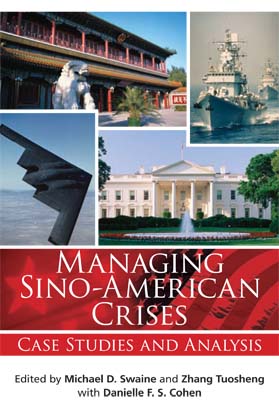
Managing Sino-American Crises: Case Studies and Analysis
Book

Managing Sino-American Crises: Case Studies and Analysis

Sensitivities and suspicions between Washington and Beijing have heightened as China’s global power and influence have grown. Arguably, this new international order could increase the chances of a political-military crisis—or perhaps outright conflict—between the two powers.

Link Copied
By Michael D. Swaine, Tuosheng Zhang, Danielle F.S. Cohen
Published on Dec 4, 2006

Additional Links

Table of ContentsIntroductionBook Review in <i>The China Quarterly</i>Paperback - $24.95
Program mobile hero image

Program

Asia

The Asia Program in Washington studies disruptive security, governance, and technological risks that threaten peace, growth, and opportunity in the Asia-Pacific region, including a focus on China, Japan, and the Korean peninsula.

Learn More

Source: Washington

The Taiwan Strait.  The Korean War and Vietnam. The bombing of the Chinese Embassy in Belgrade. The Sino-U.S. aircraft collision incident.  U.S.-China relations have witnessed significant tensions and conflict.

Sensitivities and suspicions between Washington and Beijing have heightened as China’s global power and influence have grown. Arguably, this new international order could increase the chances of a political-military crisis—or perhaps outright conflict—between the two powers. Managing Sino-American Crises brings together Chinese and American officials and participants in past confrontations, as well as scholars from both countries, to explore the changing features of crisis behavior and their implications for defusing future encounters. Using both conceptual analysis and historical case studies, the essays in this volume identify specific problems and opportunities that will likely confront both countries in the future and propose recommendations that will improve the effectiveness of crisis management skills between the United States and China.


About the Authors

Michael D. Swaine is a senior associate with the China Program at the Carnegie Endowment for International Peace.

Zhang Tuosheng is director of the research department and senior fellow at the China Foundation for International and Strategic Studies.

Danielle F. S. Cohen was a junior fellow with the China Program at the Carnegie Endowment for International Peace from 2005-2006.

Advance Praise

"This is an important and timely book that sheds new light on what will be the most important strategic relationship of the 21st century. By examining the similarities and divergence between Chinese and American approaches to crisis management over the past fifty years, this study produces insights which could literally mean the difference between peace and war in future crises. The rich historical detail, combined with the unique perspectives of both practitioners and scholars, make this volume invaluable for both policymakers and students of US-Chinese relations."
—James B. Steinberg, Dean, Lyndon B. Johnson School of Public Affairs, The University of Texas at Austin, and former deputy national security advisor to President Bill Clinton

"This volume is rich in insights ... Swaine's essays, and the case studies that they bracket, deserve a wide audience and careful consideration within China and without."
—The China Quarterly

About the Authors

Michael D. Swaine

Former Senior Fellow, Asia Program

Swaine was a senior fellow at the Carnegie Endowment for International Peace and one of the most prominent American analysts in Chinese security studies.

Tuosheng Zhang

Danielle F.S. Cohen

Authors

Michael D. Swaine
Former Senior Fellow, Asia Program
Michael D. Swaine
Tuosheng Zhang
Danielle F.S. Cohen
China

Carnegie does not take institutional positions on public policy issues; the views represented herein are those of the author(s) and do not necessarily reflect the views of Carnegie, its staff, or its trustees.

More Work from Carnegie Endowment for International Peace

  • Abstract image of China and AI
    Article
    China’s Pivot on Global AI

    Beijing’s AI diplomacy is pivoting from infrastructure and associated technical standards toward a more comprehensive effort aimed at recrafting global norms and institutions of AI governance.

      Arindrajit Basu

  • Tiananmen Gate with US and Chinese flags
    Commentary
    Emissary
    Trump and Xi Should Tackle a Previously Impossible AI Conversation

    Previous dialogues ended in failure. This time could be different.

      Scott Singer

  • Trump and others walking down a red carpet, with Air Force One in the background
    Commentary
    Emissary
    “China Doesn’t Do Anything for Free”

    Why the outcomes of the U.S.-China meetings may be limited.


      Aaron David Miller, David Rennie

  • Servers
    Article
    The Geopolitical Debates Over Controlling Cloud Compute

    If U.S. policymakers continue down the path of restricting China’s access to frontier AI, they will eventually have to implement some sort of restriction on cloud access.

      Noah Tan

  • Article
    From Labor Scarcity to AI Society: Governing Productivity in East Asia

    The debate over AI and work too often centers on displacement. Facing aging populations and shrinking workforces, East Asian policymakers view AI not as a threat, but as a cross-sectoral workforce strategy.

      Darcie Draudt-Véjares, Sophie Zhuang

Get more news and analysis from
Carnegie Endowment for International Peace
Carnegie global logo, stacked
1779 Massachusetts Avenue NWWashington, DC, 20036-2103Phone: 202 483 7600
  • Research
  • Emissary
  • About
  • Experts
  • Donate
  • Programs
  • Events
  • Blogs
  • Podcasts
  • Contact
  • Annual Reports
  • Careers
  • Privacy
  • For Media
  • Government Resources
Get more news and analysis from
Carnegie Endowment for International Peace
© 2026 Carnegie Endowment for International Peace. All rights reserved.