• Research
  • Emissary
  • About
  • Experts
Carnegie Global logoCarnegie lettermark logo
DemocracyIran
  • Donate
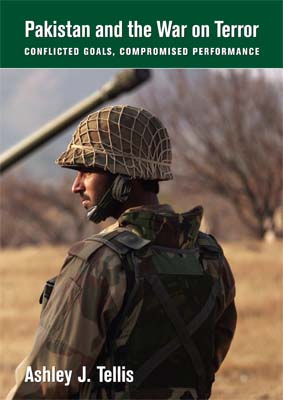
Pakistan and the War on Terror: Conflicted Goals, Compromised Performance
Report

Pakistan and the War on Terror: Conflicted Goals, Compromised Performance

The United States must shift its counterterrorism policy towards Pakistan away from a reciprocal approach—requiring Islamabad to perform desirable actions to receive support—towards one encouraging Pakistan to enact effective counterterrorism policies, not for an immediate payoff, but to strengthen institutionalized trust with the U.S. over time,

Link Copied
By Ashley J. Tellis
Published on Jan 18, 2008

Additional Links

Full Text
Program mobile hero image

Program

South Asia

The South Asia Program informs policy debates relating to the region’s security, economy, and political development. From strategic competition in the Indo-Pacific to India’s internal dynamics and U.S. engagement with the region, the program offers in-depth, rigorous research and analysis on South Asia’s most critical challenges.

Learn More

The United States must shift its counterterrorism policy towards Pakistan away from a reciprocal approach—requiring Islamabad to perform desirable actions to receive support—towards one encouraging Pakistan to enact effective counterterrorism policies, not for an immediate payoff, but to strengthen institutionalized trust with the U.S. over time, according to a new report from the Carnegie Endowment.

In Pakistan and the War on Terror: Conflicted Goals, Compromised Performance, Carnegie Senior Associate Ashley J. Tellis points to growing dissatisfaction in the United States with the Musharraf regime’s commitment to counterterrorism operations, given the influx of U.S. aid. But while Pakistan’s performance in the “war on terror” has fallen short of expectations, Islamabad’s inability to defeat terrorist groups cannot simply be explained by neglect or lack of motivation. U.S. policy makers must take into account the specific and complex counterterrorism challenges facing Pakistan and move away from their current unsustainable policies.

Nine strategies for more effective U.S. counterterrorism policies towards Pakistan:

  1. Speak clearly and forcefully to Musharraf in private about U.S. frustrations with Pakistan’s counterterrorism performance to outline the prospective consequences inaction will have on the U.S.-Pakistan relationship.

  2. Continue to encourage Pakistan’s border control efforts, but prioritize the targeting of Taliban leadership operating in Pakistan as part of the current counterterrorism concept of operations.

  3. Restructure the intelligence relationship between the U.S. and Pakistan to allow both the CIA and coalition forces in Afghanistan to acquire greater insight into existing terrorist networks inside Pakistan.

  4. Continue to assist Pakistan with technology and training to prosecute small-unit counterterrorism operations more effectively.

  5. Reform accounting practices to ensure effective oversight and auditing of coalition funds disbursed to Pakistan for counterterrorism operations.

  6. The reestablishment of stable democratic order is essential to stop Pakistan’s spiraling descent into extremism and disorder. The United States must integrate the ongoing political transition in Pakistan, including a return to democracy and rule of law, into the larger war on terrorism.

  7. Commit to long-term assistance for the Karzai government in Afghanistan to address the vacuum of governance, particularly with regards to security, economic development, and narcotics production.

  8. Commit more manpower and material contributions to help NATO live up to its security obligations in Afghanistan.

  9. Accelerate the raising of the Afghan National Army (ANA) as a hedge against the possible failure of NATO to restructure the International Security Assistance Force (ISAF) to effectively fight and win the war in Afghanistan.

“The Bush administration ought to persist with its current emphasis on the noncoercive engagement of Pakistan at least so long as there is a reasonable hope that the transformation of Pakistan into a moderate Muslim state is not a lost cause, that the Musharraf regime can be persuaded to expand its counterterrorism operations to those groups that have thus far remained beyond reach, and that the United States will have sufficient opportunity to switch to an alternative strategy before the present attempt at engagement is judged to have failed irremediably.”

A limited number of print copies are available.
Request a copy

About the Author

Ashley J. Tellis

Former Senior Fellow

Ashley J. Tellis was a senior fellow at the Carnegie Endowment for International Peace.

    Recent Work

  • Paper
    Multipolar Dreams, Bipolar Realities: India’s Great Power Future

      Ashley J. Tellis

  • Commentary
    India Sees Opportunity in Trump’s Global Turbulence. That Could Backfire.

      Ashley J. Tellis

Ashley J. Tellis
Former Senior Fellow
South AsiaPakistanSecurityMilitaryForeign Policy

Carnegie does not take institutional positions on public policy issues; the views represented herein are those of the author(s) and do not necessarily reflect the views of Carnegie, its staff, or its trustees.

More Work from Carnegie Endowment for International Peace

  • Commentary
    Carnegie Politika
    What Does Central Europe’s Post-Orban Russia Policy Look Like?

    Though Orban is gone, Putin can still count on some like-minded individuals in Central and Eastern Europe. However, they will seek to avoid open confrontation with EU institutions over Ukraine and their ties with Moscow.


      Dimitar Bechev

  • Commentary
    Carnegie Politika
    Are Russia-Japan Relations Really Warming Up?

    The truth is that Japan’s government is seeking a degree of reengagement but at a vastly reduced level than under Abe. Most significantly, Japan has shown no willingness to ease sanctions.

      James D.J. Brown

  • Commentary
    Carnegie Politika
    Brussels and Baku Are Talking Again: What Next?

    Azerbaijan’s relations with the EU appear to be going from strength to strength after several years in the deep freeze following the military escalation in Karabakh in 2023 and Azerbaijan’s bitter fallout with France and several other EU member states.

      Shujaat Ahmadzada

  • Commentary
    Strategic Europe
    Trump Turns NATO into a Tool of Coercion

    The full list of humiliations Europe has endured since Donald Trump returned to the White House makes for grim reading. But Washington’s adversarial approach to its allies undermines its own power base.

      • Rym Momtaz

      Rym Momtaz

  • Marine Le Pen and Jordan Bardella on stage during a Rassemblement National RN rally For la France du Travail in Macon in Saone et Loire France May 1 2026
    Paper
    The French Far Right’s Foreign Policy: Big Ambitions, Uncertain Direction

    The National Rally’s electoral strength, coupled with its internal fragility at a crucial political juncture, contributes to foreign policy vagueness.

      Catherine Fieschi

Get more news and analysis from
Carnegie Endowment for International Peace
Carnegie global logo, stacked
1779 Massachusetts Avenue NWWashington, DC, 20036-2103Phone: 202 483 7600
  • Research
  • Emissary
  • About
  • Experts
  • Donate
  • Programs
  • Events
  • Blogs
  • Podcasts
  • Contact
  • Annual Reports
  • Careers
  • Privacy
  • For Media
  • Government Resources
Get more news and analysis from
Carnegie Endowment for International Peace
© 2026 Carnegie Endowment for International Peace. All rights reserved.