

Commentary
Dmitri Trenin
{
  "authors": [
    "Dmitri Trenin"
  ],
  "type": "legacyinthemedia",
  "centerAffiliationAll": "",
  "centers": [
    "Carnegie Endowment for International Peace",
    "Carnegie Russia Eurasia Center"
  ],
  "collections": [],
  "englishNewsletterAll": "",
  "nonEnglishNewsletterAll": "",
  "primaryCenter": "Carnegie Russia Eurasia Center",
  "programAffiliation": "",
  "programs": [],
  "projects": [],
  "regions": [
    "North America",
    "United States",
    "Russia"
  ],
  "topics": [
    "Political Reform",
    "Foreign Policy"
  ]
}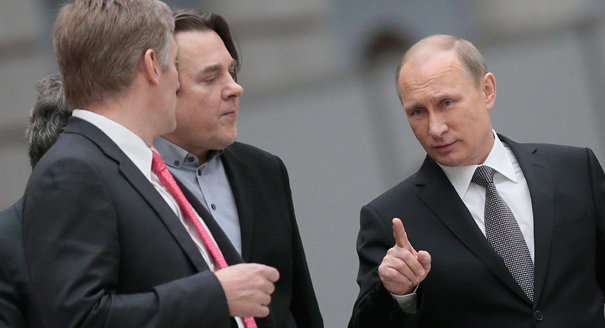
Source: Getty
Modern western leaders might wish to consider that, in the end, what killed the Soviet system was not Reagan’s Star Wars, or even the scarcity of goods in the shops. What actually did it was the loss of public faith in the domestic political system. So, improve or beware of exposure.
Source: Guardian
Asked by Bloomberg this month about Russian involvement in the hacking of the US Democratic national committee, Vladimir Putin issued a non-denial denial. Basically, his answer boiled down to this: whoever did it did a good thing. This response only added to the stir created by the initial accusation that Russia was behind the activities of the “Fancy Bears”. The fear of Russia manipulating presidential elections in the world’s mightiest democracy has been spreading across the United States.
Getting to the real perpetrators of hacking attacks is notoriously difficult. Yet seen from the Kremlin hackers perform a valuable public service by revealing secrets – not to foreign intelligence services, but to the western public. The political power of these revelations was first demonstrated by WikiLeaks, which broke the confidentiality of US diplomatic cables. The effect was much enhanced by the Snowden files, which exposed, inter alia, US spying on other western leaders.Information warfare has become, alongside geo-economics (sanctions and counter-sanctions), one of the principal battlefields in the new confrontation between Russia and the west.
Some cases look like direct tit-for-tats. The exposure of the Democratic national committee leadership secretly supporting one candidate against another and thus rigging the primary vote appears as payback for Hillary Clinton’s diatribes against Russia’s own flawed parliamentary elections of December 2011. The opening of World Anti-Doping Agency medical files shows that US Olympic champions did take banned drugs, while Russian athletes were banned en masse from participating in the Rio Games.
However, all this is just the tip of the iceberg. It may seem that all Russia is doing is trying to get even and making its accusers appear guilty of the same crimes with which they charge Moscow. There is a big difference, though. Russian public life is permeated with cynicism. The president is a tsar. Elections are about confirming rulers in power, not changing them: “You first get into the Kremlin, and then I’ll vote for you.” People get rich not before they enter government service or after they leave it, but while they are in government. Law is a tool of the high and mighty. This cynicism has its limits, and the Russian people’s proverbial patience may suddenly snap, but their level of tolerance is generally high. By contrast, western political systems have become used to more than a fair share of hypocrisy. Call it political correctness, or values, or ideology, but western societies are more vulnerable to the exposure of wrongdoing and abuse which is not individual but systemic, particularly when it comes to democracy.
It is one thing for the Russian people to be told that their vote has been stolen; it is totally different for the American electorate to believe, as Donald Trump has suggested, that presidential elections can be rigged. And democracy is again becoming an issue all over the European Union and America.
Putin certainly sees the widening gulf separating western elites from their disgruntled co-citizens, left behind in the process of globalisation and unrestrained money-making, and – insult to injury – branded “deplorable”. He also notes that the triumph of democracy over communism three decades ago has led to the political systems of Europe and America essentially eschewing any meaningful competition within those systems.
With inequality on the rise, this only leads to dissent and challenge emerging from outside the established systems and against them. As someone who is now locked in a battle with the US political establishment, he closely studies the state of his adversary and draws conclusions from it.
One conclusion which might surprise him is the notion that he can manipulate not just European politicians but also American elections, and lead, single-handedly, a global challenge against the existing liberal democratic order. By now Putin paranoia has reached a level far above the occasional playing of the “Russia card” against the opponent. This betrays a degree of uncertainty among the ruling elites of the western world which one could not imagine even a few years ago. This uncertainty is not necessarily good for Russia, as the risks tend to mount, but it surely can and will be exploited in the ongoing great power struggle.
There are many lessons to be drawn from the demise of the Soviet Union a quarter of a century ago. One is that imperial hubris is eventually punished; another is that attempts to bring a supposedly advanced political system to a nation unprepared for it usually ends in failure, and that the elites who get too far away from their public are caught up with the reality when it is already too late.
Modern western nations are not like the USSR, but their leaders might wish to consider that, in the end, what killed the Soviet system was not Reagan’s Star Wars, or even the scarcity of goods in the shops; the people in that part of the world had known worse. What actually did it was the loss of public faith in the domestic political system. So, improve or beware of exposure.
Former Director, Carnegie Moscow Center
Trenin was director of the Carnegie Moscow Center from 2008 to early 2022.
Recent Work
Dmitri Trenin
Dmitri Trenin
Carnegie does not take institutional positions on public policy issues; the views represented herein are those of the author(s) and do not necessarily reflect the views of Carnegie, its staff, or its trustees.
Orbán created an image for himself as virtually the only opponent of aid to Ukraine in the entire EU. But in reality, he was simply willing to use his veto to absorb all the backlash, allowing other opponents to remain in the shadows.
Maksim Samorukov
Beirut’s desire to break free from Iranian hegemony may push it into a situation where it has to accept Israel’s hegemony.

Michael Young

Montenegro and Albania are frontrunners for EU enlargement in the Western Balkans, but they can’t just sit back and wait. To meet their 2030 accession ambitions, they must make a strong positive case.


Dimitar Bechev, Iliriana Gjoni
By reorganizing federal disaster policy around the rights of displaced people, the United States could unlock additional federal resources, accelerate the rebuilding of lives and livelihoods, and reduce suffering and economic disruption.

Kayly Ober

Its reinstatement should be celebrated, but it retains some major shortcomings.

Leonardo Martinez-Diaz