

Article
- +1
Toby Dalton, Mark Hibbs, Nicole Grajewski, …
{
  "authors": [
    "Mark Hibbs"
  ],
  "type": "legacyinthemedia",
  "centerAffiliationAll": "dc",
  "centers": [
    "Carnegie Endowment for International Peace"
  ],
  "collections": [],
  "englishNewsletterAll": "ctw",
  "nonEnglishNewsletterAll": "",
  "primaryCenter": "Carnegie Endowment for International Peace",
  "programAffiliation": "NPP",
  "programs": [
    "Nuclear Policy"
  ],
  "projects": [],
  "regions": [],
  "topics": [
    "Nuclear Policy",
    "Nuclear Energy"
  ]
}
Source: Getty
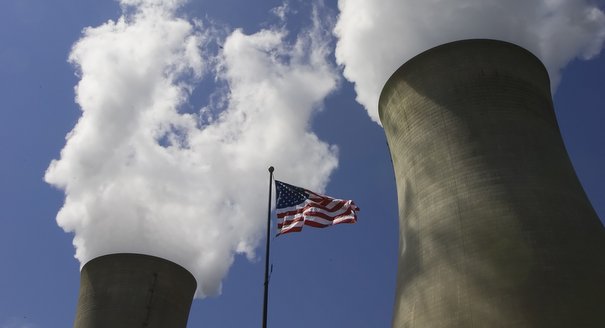
With the world fixated on lowering fossil-fuel emissions, now is the time for nuclear energy to come to the fore. But, it’s not working out that way: the nuclear option is fading as shifting electricity demands, mushrooming construction costs and frightening accidents give governments second thoughts.
Source: Mark News
In 1945, generating electricity was one of a number of potential applications of atom-splitting technology developed in a hurry by the United States to help win a world war. Nuclear power thereafter became a reality because of government support, public confidence that it would be cheap, and absence of serious misgivings about proliferation, safety, and waste management. Enough resources were invested in this idea to set up more than 400 nuclear power plants in 31 countries that now produce 11 percent of the world’s electricity.
Today, there are good reasons why nuclear power may continue to make advances worldwide. At the top of the list are expectations for economic growth linked to urbanization and greater electrification, and the consensus of virtually all nations that they need carbon-free sources to generate most of their power and mitigate dramatic climate change.
But a nuclear success story in coming decades is by no means assured, and it may not even be likely.
The big reason is that the demands on electricity supply systems will be very different than they were a generation ago when most of the world’s nuclear power plant projects were initiated.
In its heyday, nuclear power gained favor from governments, which allowed utility companies to include the capital costs in the rate base. Governments and consumers assumed the risk while power sales amortized the investments. In most places today, that’s history. Governments are deregulating power markets and introducing competition, thereby shifting risk from customers to company shareholders.
During the 1990s, investments shifted from nuclear to increasingly cheaper and abundant natural gas, and by 2002 gas-fired plants accounted for more than 80 percent of all new power plants built in OECD countries. In parallel, nuclear technology became a lot more expensive: A 1,000-MW power plant that in 2000 cost $1.5 billion might cost $10 billion today. All this was foreseen by Klaus Barthelt, the power engineering CEO for Germany’s biggest nuclear engineering firm, Siemens, in 1991: “The countries that can still afford our nuclear plants won’t need the electricity, and the countries that will need the electricity won’t be able to afford the reactors.”
With a few exceptions, Barthelt’s prediction remains true. For two decades the nuclear industry has hoped for a worldwide “nuclear renaissance” ushered in by the need to meet growing power demand using non-fossil fuels.
But most of the world is still waiting.
The market for new nuclear power in the Americas and Europe remains flat. Japan’s deep technology base didn’t prevent three reactors from melting down in 2011 as a result of the tsunami that inundated the country after an earthquake. For many years, the Fukushima accident will deter Japan and many less-endowed countries from making new nuclear investments. At a seminar held by the International Atomic Energy Agency to explain to potential “nuclear newcomer” countries what they need to set up safe and sustainable nuclear power programs, a delegate from Tanzania stated: “When I got here, my idea was to have a reactor operating in our country in maybe 10 -15 years. When the meeting was over, that timeline looked more like 20-30 years.”
The “nuclear renaissance” was to be driven in part by political directives responding to the climate change challenge. If nations penalize power generated by coal, gas and oil — fuels that account for 67 percent of the world’s electricity production — a shift back to nuclear power could happen. But the political impediments to governments taking this step are great. In the United States, for example, Republicans who will soon control the White House and both houses of Congress say they favor expanding nuclear power, but they are ideologically opposed to government intervention needed to tax carbon.
While nuclear power awaits government fixes, renewable energy technologies led by solar and wind power are jumping into the breach. They now provide a quarter of the world’s electricity. Their market penetration is currently favored by the same kind of policy stimuli that governments after World War II used to favor nuclear power.
So far, renewables cannot replace the world’s nuclear power plants. But their success may lead decision-makers not to commit to nuclear investments that might become stranded assets. As regulators and vendors will tell you, a nuclear investment requires a century-long commitment because of the trajectory for operation, decommissioning, and waste management.
The ultimate litmus test for nuclear power in this century is how it will respond to the forces of globalization. So far, the record is mixed. Globalization has favored procurement and safety standards. But the downsides could prove fatal. Government subsidies allow China to fend off pressures that set back nuclear energy elsewhere; in 2030, it may have the world’s biggest nuclear program. But Beijing also recently committed itself to electricity market reform. Depending on how far China goes that route, if it can’t control costs and risk, in 2030 its long-term nuclear outlook could look like America’s or Europe’s today.

Nonresident Senior Fellow, Nuclear Policy Program
Hibbs is a Germany-based nonresident senior fellow in Carnegie’s Nuclear Policy Program. His areas of expertise are nuclear verification and safeguards, multilateral nuclear trade policy, international nuclear cooperation, and nonproliferation arrangements.
Recent Work


Toby Dalton, Mark Hibbs, Nicole Grajewski, …
Mark Hibbs
Carnegie does not take institutional positions on public policy issues; the views represented herein are those of the author(s) and do not necessarily reflect the views of Carnegie, its staff, or its trustees.

The nuclear relationship between China and the United States is increasingly shaped by widening perception gaps rather than deliberate strategic design.

Tong Zhao

A look at why states without nuclear weapons are seeking naval nuclear propulsion, whether they can legally and technically deliver it, what it will cost them, and what responsible stewardship of the capability would look like.

Jamie Kwong
Congress should ask tough questions about the agreement’s more unique features and whether they advance U.S. interests or compromise them.

Jane Darby Menton
Nuclear and maritime communities face a long and challenging journey to deploy commercial nuclear applications at sea.
Jamie Kwong, Toby Dalton
A look at how public opinion influences the credibility of coercive nuclear threats,and how it enables and constrains strategies of nuclear coercion.

Lauren Sukin, Samuel Seitz