

Paper
James M. Acton, Ankit Panda
{
  "authors": [
    "James M. Acton"
  ],
  "type": "other",
  "centerAffiliationAll": "dc",
  "centers": [
    "Carnegie Endowment for International Peace",
    "Carnegie China"
  ],
  "collections": [
    "Korean Peninsula"
  ],
  "englishNewsletterAll": "ctw",
  "nonEnglishNewsletterAll": "",
  "primaryCenter": "Carnegie Endowment for International Peace",
  "programAffiliation": "NPP",
  "programs": [
    "Nuclear Policy"
  ],
  "projects": [],
  "regions": [
    "East Asia",
    "North Korea",
    "North America",
    "United States",
    "South Korea",
    "China",
    "Japan"
  ],
  "topics": [
    "Nuclear Policy",
    "Arms Control"
  ]
}
Source: Getty
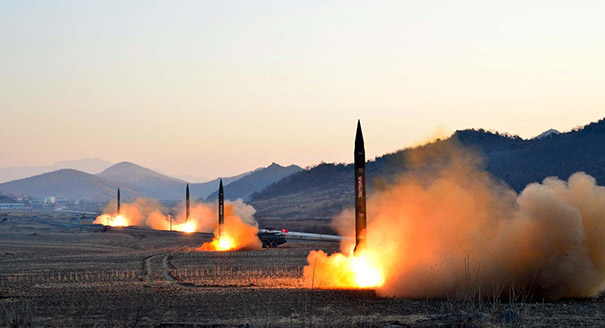
The North Korean nuclear crisis is far from over, and foreclosing escalation pathways is in the best interests of the United States, its allies, and Pyongyang.
Source: Foreign Policy
The time for denial is over. North Korea has — or will very shortly have — the capability to launch a nuclear weapon against the United States. In the coming decades, historians can assign blame. For now, it is the task of policymakers to ensure that historians will still be around in the future to dissect this failure.
While denuclearization should remain the international community’s formal goal, it is no longer a practical policy. A freeze on missile and nuclear testing, which I advocated only seven months ago, has lost value as North Korea’s capabilities have rapidly advanced. Analysts can happily theorize about a disarming preventative strike, but the risks — to both the United States and its allies — are so serious that no sane politician would authorize one. Instead, Washington should try to establish some basic rules of the road with a newly nuclear Pyongyang.
This article was originally published in Foreign Policy

Jessica T. Mathews Chair, Co-director, Nuclear Policy Program
Acton holds the Jessica T. Mathews Chair and is co-director of the Nuclear Policy Program at the Carnegie Endowment for International Peace.
Recent Work

James M. Acton, Ankit Panda
James M. Acton
Carnegie does not take institutional positions on public policy issues; the views represented herein are those of the author(s) and do not necessarily reflect the views of Carnegie, its staff, or its trustees.

Ahead of a tough winter for Ukraine, Donald Trump’s swing back toward Russia bodes ill. But instead of panicking, Kyiv’s European allies are focusing on action.

Rym Momtaz

Despite its flop at the box office, the film raises important questions for the climate community to answer.

Leonardo Martinez-Diaz

In an interview, Rozina Ali discusses her new book on the rise and manifestations of Islamophobia in the United States.

Michael Young

While the EU and European governments are embracing the much-lauded middle-power moment, this entails three difficult conundrums.

Richard Youngs

Europe is facing rising populism internally as well as external pressures from Russia, China, Turkey, and the United States.

Dimitar Bechev