

Commentary
Judy Dempsey
{
  "authors": [
    "Judy Dempsey"
  ],
  "type": "commentary",
  "blog": "Strategic Europe",
  "centerAffiliationAll": "",
  "centers": [
    "Carnegie Endowment for International Peace",
    "Carnegie Europe"
  ],
  "collections": [],
  "englishNewsletterAll": "",
  "nonEnglishNewsletterAll": "",
  "primaryCenter": "Carnegie Europe",
  "programAffiliation": "",
  "programs": [],
  "projects": [],
  "regions": [
    "Russia",
    "Middle East"
  ],
  "topics": []
}
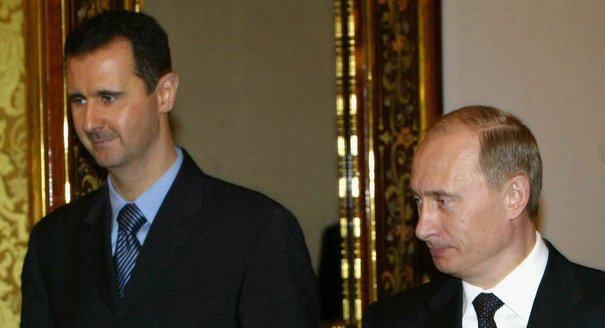
Source: Getty
Every week leading experts answer a new question from Judy Dempsey on the international challenges shaping Europe’s role in the world.
Every week leading experts answer a new question from Judy Dempsey on the international challenges shaping Europe’s role in the world.
The more time passes with the Syrian crisis escalating, the more Russia seeks a balanced role between the Assad regime on the one side and the Syrian opposition, the Arab League, and the international community on the other. However, no evidence exists to support the hypothesis that Russia is finally reining in Assad, particularly noting the latest developments of the Geneva and Cairo conferences on Syria.
The Russian stance on the Syrian crisis is determined by three key elements: the first is its close strategic, military, and economic interests with Syria, which remain guaranteed by Assad. The second is Russia's eagerness to be a counterweight to the "West" in the region, protect its interests there, and set itself as an un-ignorable player in its politics. The third has to do with reaffirming Russia's say in the international arena, especially with regards to the notions of "sovereignty" and "international intervention".
These explain what might seem contradictory in Russia's stance: On the one side vetoing intervention at the United Nations Security Council and backing Assad's regime in repressing its opposition, and on the other seeking to engage with the Arab League (importantly, March 2012’s five-point plan) and in trying to actively create and engage in widened international negotiations on Syria.
Viewed from the West, Russia’s Syria policy is quixotic at best. True, Russia has key military strategic interests in Syria. Above all, it strives to avoid the Libyan precedent in Syria, in which a military intervention legitimized on the grounds of the United Nation’s Responsibility to Protect initiative slid into a regime change mission featuring a UN-backed NATO intervention (coupled with Qatari boots on the ground in violation of United Nations Security Council resolution 1973). But if these are Moscow’s reservations, why does it not genuinely engage in a negotiation process aimed at a Yemen-like transition process in the country? Why does Moscow continue to hold onto Assad instead of acting as Saudi Arabia did in Yemen, starring as the principal mediator steering the course of the Syrian political transition?
Two reasons stand out. First and in view of its North Caucasian troubles, is the knee-jerk Russian fear of all things Islamist. The strength of the Muslim Brotherhood in Syria coupled with the chaotic nature of the Syrian opposition warn Moscow against any move away from Assad. Second, is the nagging worry that a political transition without Assad could give too much leeway for the West to steer the course of change to its liking.
Yet Russia must also appreciate that time is running out for the status quo. As Turkey and Syria dangerously engage in escalating brinkmanship and violence on the ground spirals out of control, Assad’s days are numbered. The window of opportunity for Moscow to remain ahead of the curve in shaping Syria’s future is rapidly closing.

Nonresident Senior Fellow, Carnegie Europe
Judy Dempsey is a nonresident senior fellow at Carnegie Europe
Recent Work
Judy Dempsey
Judy Dempsey
Carnegie does not take institutional positions on public policy issues; the views represented herein are those of the author(s) and do not necessarily reflect the views of Carnegie, its staff, or its trustees.

A summer of escalation in the Black Sea has hurt Ukraine economically and is exacerbating world food security. A truce is needed—as is a broader reframing of Europe’s Ukraine strategy.

Thomas de Waal

European Commission President Ursula von der Leyen is about to give her annual address on the state of the EU. Here’s what she won’t—but should—say.

Rym Momtaz

The EU’s responses to two recent incidents expose the gulf between European perceptions and capabilities. Unless the union can bridge that gap, it will never become a real geostrategic power.
Rym Momtaz

In supporting Europe’s far-right, MAGA and Russia both want the same thing: a weaker EU. Europe must defend itself without abandoning the openness these forces exploit.

Armida van Rij

As we close out another season of Strategic Europe, it is worth taking stock of the deep shifts underway.
Rym Momtaz