

Commentary
Evan A. Feigenbaum
{
  "authors": [
    "Evan A. Feigenbaum"
  ],
  "type": "legacyinthemedia",
  "centerAffiliationAll": "dc",
  "centers": [
    "Carnegie Endowment for International Peace",
    "Carnegie China"
  ],
  "collections": [
    "China’s Foreign Relations"
  ],
  "englishNewsletterAll": "asia",
  "nonEnglishNewsletterAll": "",
  "primaryCenter": "Carnegie Endowment for International Peace",
  "programAffiliation": "AP",
  "programs": [
    "Asia"
  ],
  "projects": [],
  "regions": [
    "North America",
    "United States",
    "East Asia",
    "China",
    "Southeast Asia"
  ],
  "topics": [
    "Economy",
    "Trade",
    "Security",
    "Military"
  ]
}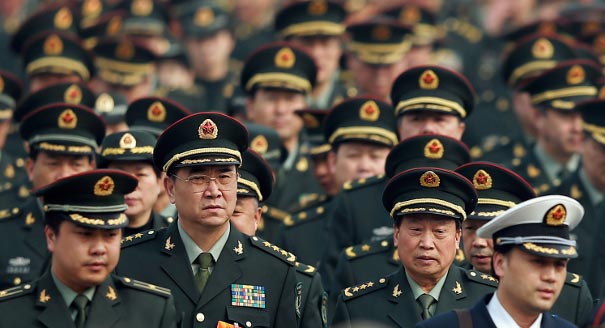
Source: Getty
Two difficult strategic challenges will test East Asia’s diplomats in coming years: first, the collision between economic integration and security fragmentation, and, second, the dominance of form over function in the institutions that could help to mitigate this debilitating dynamic.
Source: East Asia Forum Quarterly, Vol. 5 No. 2 April-June 2013
Evan A. Feigenbaum: Two difficult strategic challenges will test the region’s diplomats in coming years: first, the collision between economic integration and security fragmentation, and, second, the dominance of form over function in the institutions that could help to mitigate this debilitating dynamic.
The central strategic challenge in Asia is that economics and security are increasingly in collision. Put bluntly, two Asias, wholly incompatible, have emerged in stark relief. There is ‘Economic Asia’, the Dr. Jekyll—a dynamic, integrated Asia with 53 per cent of its trade now being conducted within the region itself, and a US$19 trillion regional economy that has become an engine of growth. And then there is ‘Security Asia’, the veritable Mr. Hyde—a dysfunctional region of mistrustful powers, prone to nationalism and irredentism, escalating their territorial disputes over tiny rocks and shoals, and arming for conflict.Amid slow growth in the United States and protracted austerity in Europe, intra-Asian demand will likely become a more central driver of regional growth. Already, China has become the top trade partner for many of Asia’s major economies, which increasingly provide economic related public goods to one another while pursuing pan-Asian agreements on trade, investment and technical standards. But long-term strategic intentions, especially Beijing’s, inspire deep anxiety. With the exception of China, all major Asian countries, though their economies are increasingly integrated within Asia, are tacking hard across the Pacific toward the United States for their security.
The region does not lack institutions that could help mitigate this dynamic. But regional groups in Asia mostly duplicate one another’s roles. They have too many members, and mostly lack functionality or a comprehensive template to measure and systematically assess results. They have developed habits of dialogue, but social interchange and political rhetoric dominate. Lingering suspicions and historical anxieties remain. Asian concerns about maintaining ‘face’ have typically meant that the most sensitive topics, from human rights to territorial disputes, are avoided. The ASEAN Regional Forum (ARF) is perhaps the best example of this. It is Asia’s leading security forum, and yet all of the potential sources of major conflict are mostly off the table.
A more effective and purposeful multilateralism would begin with lessons learned. Asia’s redundant existing mishmash reflects an underlying assumption that dialogue and process are beneficial in and of themselves. With most of the major groupings—ASEAN, ARF, APEC and so on—now decades in the making, groups need to emerge that can solve real problems by pooling real capabilities. So function will need to drive form, not the other way around. And function ultimately will need to be married to capacity, with those that have the greatest capacity playing the most significant roles. Asia’s major multilateral institutions have proved to be almost irrelevant to practical problem solving. It would be wise for a group of like-minded countries to think through a modest but substantive operational agenda for the next East Asia summit meeting to decide priority issues. Then, depending on the issue, leaders could ask that ARF or APEC, or another relevant body, follow up with practical actions. This would begin to inject greater relevance into regional institutions and more connectivity among them.
This piece was originally published in the East Asia Forum Quarterly.

Vice President for Studies
Evan A. Feigenbaum is vice president for studies at the Carnegie Endowment for International Peace, where he oversees work at its offices in Washington, New Delhi, and Singapore on a dynamic region encompassing both East Asia and South Asia. He served twice as Deputy Assistant Secretary of State and advised two Secretaries of State and a former Treasury Secretary on Asia.
Recent Work
Evan A. Feigenbaum
Evan A. Feigenbaum
Carnegie does not take institutional positions on public policy issues; the views represented herein are those of the author(s) and do not necessarily reflect the views of Carnegie, its staff, or its trustees.
A leak of Russian gas price data helps establish that China is paying Russia far less than Central Asian countries and Gazprom’s former European customers.

Sergey Vakulenko

China’s political future will be shaped between now and next October. As the Communist Party enters its intense “campaign season” to prepare for a major political transition in 2027, reading Beijing's actions and responses may become more difficult as domestic politics weigh on its behavior more than usual.

Damien Ma

The EU can impose sanctions but struggles to enforce them without the United States. With Washington increasingly disinterested in backing European interests, the bloc must now fend for itself.


Nicu Popescu, Tiago Antunes

Rubio’s recent visit brought welcome attention, but more capital requires governance changes that may be a hard sell for regional governments.

Jennifer B. Murtazashvili

America’s foreign-policy objectives have grown more demanding while Americans have demanded greater focus on their own affairs.
Stephen Wertheim