• Research
  • About
  • Experts
Carnegie India logoCarnegie lettermark logo
Technology
{
  "authors": [
    "Uri Dadush",
    "Shimelse Ali"
  ],
  "type": "other",
  "centerAffiliationAll": "",
  "centers": [
    "Carnegie Endowment for International Peace"
  ],
  "collections": [],
  "englishNewsletterAll": "",
  "nonEnglishNewsletterAll": "",
  "primaryCenter": "Carnegie Endowment for International Peace",
  "programAffiliation": "",
  "programs": [],
  "projects": [],
  "regions": [
    "Southern, Eastern, and Western Africa",
    "North America"
  ],
  "topics": [
    "Economy"
  ]
}
Other

Whither Africa?

After stagnating for decades, economic growth in Africa has accelerated, but maintaining this rapid growth is far from guaranteed. Policy makers must build on past successes and tackle tough reforms before the world’s poorest continent can make sustained economic progress.

Link Copied
By Uri Dadush and Shimelse Ali
Published on Mar 3, 2011

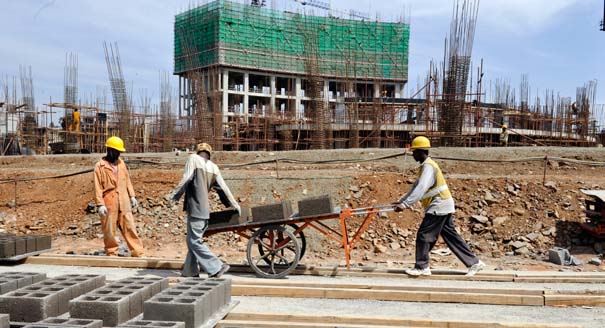
After stagnating for much of the postcolonial period, economic growth in Africa has accelerated since the mid-1990s. Improved terms of trade, better macroeconomic and education policies, and greater demand for services helped Africa’s annual GDP growth rate more than double to 4.6 percent from 1999–2008 compared to the previous decade. Impressively, GDP in African economies accelerated more quickly than that of developing economies in other regions.

To continue this growth, Africa must overcome numerous challenges. Africa suffers from low investment and savings rates, a lagging demographic transition as the continent’s high fertility rate creates a bulge in the number of young people requiring education, low productivity, and a low level of exports—even as export prices have increased.

Still, Africa also has a number of long-term growth opportunities. By developing ties with emerging economies such as China and India, Africa will be able to export more goods abroad, particularly as income and wages in those countries grow. The emergence of a middle class in Africa will also create more demand.

To ensure Africa successfully moves up the development ladder, policy makers must improve the continent’s governance and business climate, allowing it to compete successfully with other poor but increasingly dynamic developing regions. Specific steps include:

  • Improve the investment climate. Africa must take small steps—such as reducing the cost of registering and closing a business—and make fundamental reforms—such as strengthening the rule of law—to make the business environment more predictable. Improving trade logistics will also help Africa reap new opportunities as production processes become more globalized.

  • Raise agricultural productivity. Few sectors offer greater room for improvement than agriculture, as Africa has the lowest cereal yield per hectare of any developing region. Africa should use genetically modified seeds, complementary fertilizers, and more efficient farming to boost crop yields.

  • Invest in a skilled labor force. Policy makers must raise the quality of education—for example, through increasing enrollment in the sciences and improving skills such as numeracy and problem-solving—to close the widening innovation gap with other developing regions. Highly skilled workers make up the largest share of Africa’s emigrants. Adequate compensation, better job opportunities, a strong business climate, and easy access to information technology will help African economies retain skilled workers.

Africa’s continued—and accelerated—growth over the long term is by no means guaranteed. But if policy makers can build on their successes so far and tackle tougher second-generation reforms, they can help Africa become more competitive, improve productivity, and increase per-capita incomes well into the future.

Authors

Uri Dadush
Former Senior Associate, International Economics Program
Uri Dadush
Shimelse Ali
EconomySouthern, Eastern, and Western AfricaNorth America

Carnegie India does not take institutional positions on public policy issues; the views represented herein are those of the author(s) and do not necessarily reflect the views of Carnegie, its staff, or its trustees.

More Work from Carnegie India

  • Commentary
    The Impact of U.S. Sanctions and Tariffs on India’s Russian Oil Imports

    This piece examines India’s response to U.S. sanctions and tariffs, specifically assessing the immediate market consequences, such as alterations in import costs, and the broader strategic implications for India’s energy security and foreign policy orientation.

      Vrinda Sahai
  • Paper
    India-China Economic Ties: Determinants and Possibilities

    This paper examines the evolution of India-China economic ties from 2005 to 2025. It explores the impact of global events, bilateral political ties, and domestic policies on distinct spheres of the economic relationship.

      Santosh Pai

  • Commentary
    TRUST and Tariffs

    The India-U.S. relationship currently appears buffeted between three “Ts”—TRUST, Tariffs, and Trump.

      Arun K. Singh

  • Article
    Can Geopolitical Alignment Seal the India-EU FTA?

    This article argues that the geopolitical circumstances have never been more conducive, not merely for the early conclusion of the free trade agreement (FTA) between India and the EU, but also for crafting a substantive and comprehensive strategic partnership.

      Mohan Kumar

  • Source: iStock
    Commentary
    What’s Next for U.S. AI Policy?

    This commentary explores the likely actions of the Trump administration and driving forces on issues of deregulation, the United States’ leadership in AI, national security, and global engagements on AI safety.

      Shatakratu Sahu, Amlan Mohanty

Get more news and analysis from
Carnegie India
Carnegie India logo, white
Unit C-4, 5, 6, EdenparkShaheed Jeet Singh MargNew Delhi – 110016, IndiaPhone: 011-40078687
  • Research
  • About
  • Experts
  • Projects
  • Events
  • Contact
  • Careers
  • Privacy
  • For Media
Get more news and analysis from
Carnegie India
© 2026 Carnegie Endowment for International Peace. All rights reserved.