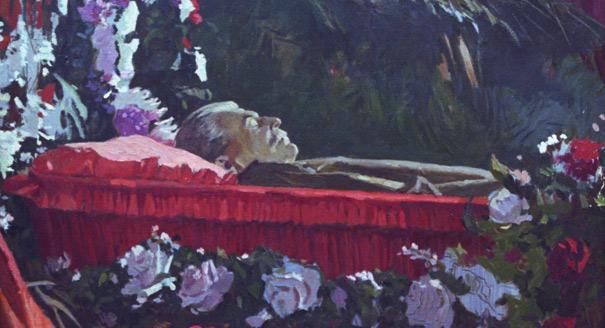
It is nearly sixty years since the embalmed body of Joseph Stalin was secretly removed from its display case in the mausoleum on Red Square and buried under the Kremlin walls. Yet the Soviet dictator, who was responsible for the deaths of millions of Soviet people, refuses to stay dead and buried.
In May 2021, 56 percent of Russians polled by the independent Levada Center agreed that Stalin was a “great leader”—double the figure in 2016, when the Stalinization of mass consciousness had already been a clear trend for several years.
The trouble is that the pantheon of Soviet gods has been obsolete since before the days of perestroika, but it has not been replaced by any new heroes. There’s always President Vladimir Putin, of course, but even he has lost half of his appeal as a great historical figure in recent years: back in 2017, 32 percent of Russians polled considered the president the most outstanding figure in Russian history, up there with the poet Alexander Pushkin, and outranked only by Stalin. Now, with 15 percent of the vote, he only just makes the top five, behind Peter the Great and just ahead of Yury Gagarin, the first man in space.
Attitudes to Stalin in Russia are intrinsically tied to the Soviet Union’s victory in World War II, over which Stalin presided, and which has become the sacred cornerstone of modern Russian identity. Now the Russian elites are privatizing that victory to shore up the position of the ruling regime. The Russian parliament has passed a new law making it illegal to equate the wartime actions of the Soviets with Nazi Germany. In July 2021, Vladimir Putin signed the document, which also prohibits denying the “decisive role” of the Soviet people in the victory over fascism.
To people outside of Russia, it might seem deeply shocking and incomprehensible that Stalin’s popularity is growing at such a pace. Yet it is an entirely natural consequence of the policy advanced and sponsored by the Russian state of historical amnesia and the literal rewriting of history. Even events that were never the subject of ideological or factual debate are suddenly starting to be contested. And as historical knowledge fails to be passed down among the general public, a new mythology is rapidly taking shape.
Just a few years ago, the idea of a state-owned news agency questioning well-known facts about the Katyn massacre—in which thousands of Polish officers were shot dead by the Soviets—would have been impossible: it seemed that the days of blaming the Germans were long over. Yet that is precisely what happened last year. Today, the limits of what is acceptable—both ethically and in terms of the treatment of facts—are expanding, and red lines are being trampled with impudence and abandon.
In a different article, the same state-owned news agency described time spent in the notorious Gulag prison camps as a “ticket to a better life.” Even in Soviet times, when historical discourse was very limited and being in possession of or distributing Alexander Solzhenitsyn’s book The Gulag Archipelago could land people in prison, no one in the official media would have dared to make that kind of judgment about the Stalinist meat grinder: there were universal ethical boundaries, invisible though they might have been.
The results of introducing this simplified version of history into the mass consciousness can best be seen in how Russians perceive the most important event for them in history: World War II. The legitimization of the current political regime and the unity of the majority of the nation hang largely on the memory of the war. Putin himself has effectively rehabilitated the secret protocol of the Molotov-Ribbentrop Pact, in which the Soviet Union and Nazi Germany agreed to carve up Eastern Europe between them, so that in the official version, it was nothing less than a “diplomatic triumph for the Soviet Union.” An episode that was a source of shame for Soviet ideologists and historians, that Soviet leaders including Mikhail Gorbachev denied and attempted to conceal to the last, has now become a matter of pride for the leadership.
In addition, a widespread idea has taken hold that the Red Army was “blindsided” by the suddenness of the invasion by Nazi Germany, and that the Soviet Union had not prepared for war in order to avoid provoking Germany. In fact, the German attack came as no surprise at all, and the fear of provoking the Nazis was Stalin’s own paranoia—though it did not stop him from preparing for war in his own particular way.
Indeed, Stalin’s preparations would prove to be disastrous for the Soviet Union. Back in 2005, 40 percent of a Levada Center poll respondents agreed that the leadership of the Red Army had been decimated by Stalin’s purges: the mass arrests within the military shortly before war broke out had remained common knowledge since perestroika. In 2021, just 17 percent of respondents agreed with the same statement. Twenty-three percentage points in sixteen years is a staggering degradation in Russians’ knowledge of their history.
The memory of repression has failed to become the glue of the nation that memory of the war has. For many Russians, it’s not just a nonessential part of their country’s history, it’s an ideologically controversial period. After all, those who work hardest to preserve the memory of the repression—the NGO Memorial—have been labeled “foreign agents” by the state.
When asked their opinion about Memorial’s “Last Address” project, in which commemorative plaques are put up on the buildings where victims of repression lived, just 17 percent of Russians polled expressed a negative attitude, but their motivations were symptomatic. The most common reasons given were “they were repressed for a reason,” along with “the buildings will look like cemeteries,” “I don’t see the point,” and “we don’t need that kind of memory.”
As a result, the “correct” memory of the war is being pitted against the “incorrect,” supposedly politically motivated memory of the repression, and the increasingly frequent acts of vandalism against the “Last Address” plaques stand testament to that. In the city of Yekaterinburg in June, unidentified people covered the plaques with stickers depicting symbols of Victory Day, the state-backed, increasingly bombastic public holiday celebrating the wartime victory. This is a literal illustration of the opposition between the two discourses dividing the nation—when they should unite it.
For now, instead, Russians are united by Stalin, whom 56 percent consider a great leader, and for whom respect is ever growing: from 21 percent of respondents in 2012 to 45 percent in 2021, after the controversial raising of the retirement age and the pandemic, which have dented Putin’s popularity. As disappointment in Putin grows, people return to the familiar figure of the wartime leader.
Stalin stands in for the lack of modern heroes, and overshadows all the most important historical events of the twentieth century, symbolically compensating for the failures, defeats, and setbacks of more recent years. In Russia, there can be no modernization without de-Stalinization.