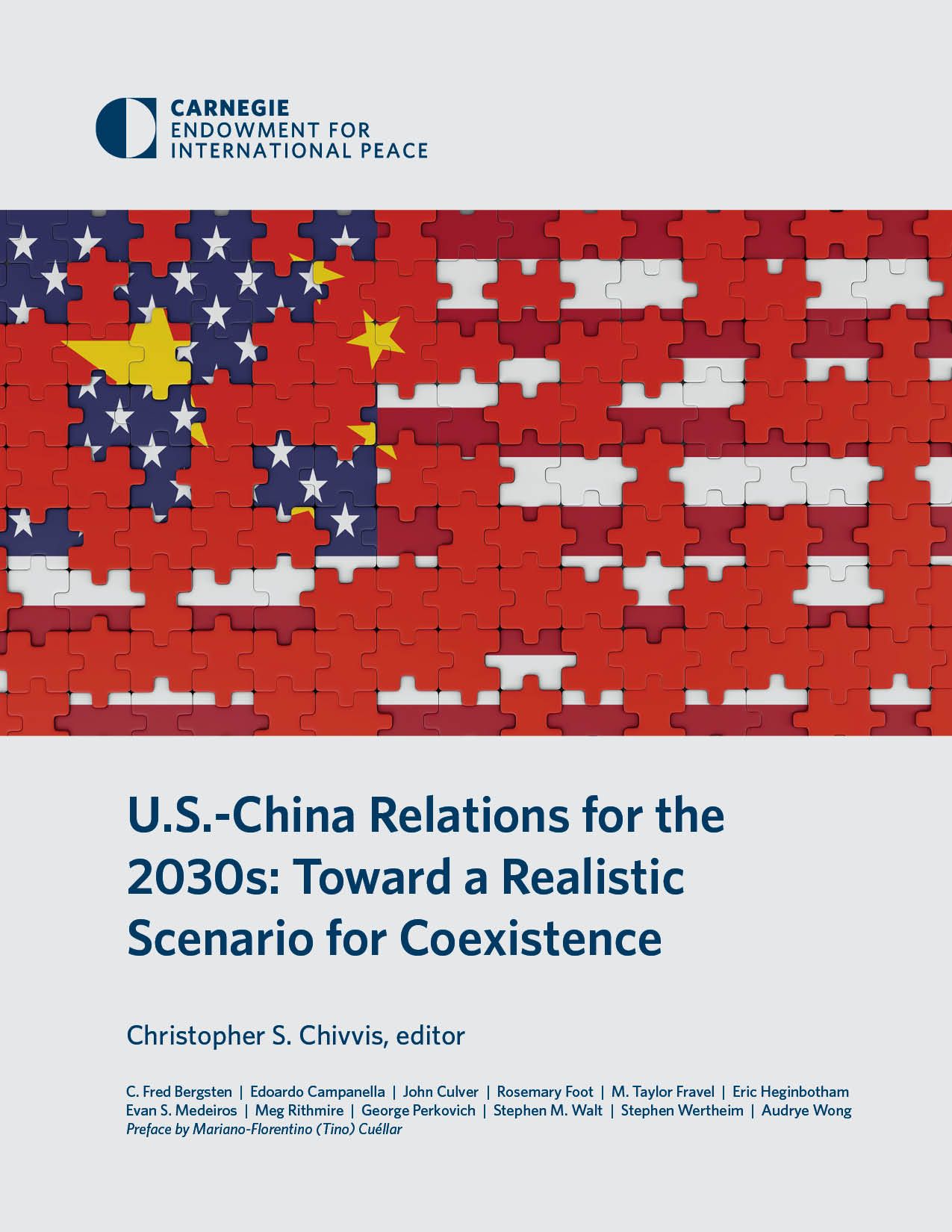
The list of frictions in the relationship between the United States and China is long and growing. Beijing is threatening Taiwan with its military maneuvering, has declared a no-limits partnership with Russia, has pursued a far-reaching conventional and nuclear arms buildup, and is using its coercive economic tools against U.S. allies and partners. The rule of the Chinese Communist Party has meanwhile grown more personalized under President Xi Jinping, which makes its foreign policy less predictable in some regards. The United States has responded with far-reaching economic measures aimed at countering China, measures that deny China access to advanced U.S. technologies, provocative visits by congressional leaders to Taiwan, a diplomatic initiative to strengthen U.S. alliances in Asia, and an arms buildup of its own. The consensus that once surrounded a strategy of deep engagement with China has collapsed, and one of the few policy issues that Democrats and Republicans agree on is being much tougher on China. Most recent strategic thinking about China has, accordingly, advocated a more aggressive U.S. approach, with a strong coercive military element and ideological dimension.
These trends can make it difficult to envision what a more stable and predictable relationship between China and America might look like. But doing so is extremely important. History teaches us that nations will take steps to protect themselves when they believe that conflict and war are likely or unavoidable, and that these steps often increase the chances of the conflict they seek to avoid—sometimes creating a self-fulfilling prophecy. Today, U.S.-China relations are following this pattern, reducing incentives for cooperation and creating spiral dynamics.
But there are still multiple scenarios for the future of U.S.-China relations, including ones that are realistic and attainable, and in which the two countries find a stable modus vivendi for coexistence and manage their frictions and conflicts without sliding into a major power war. This possibility is the subject of this volume, and this chapter sketches what such a scenario might look like between today and the mid-2030s economically, militarily, and when it comes to world order:
- Economically, the United States and China might be at rough parity, but a modus vivendi would still be possible. Although it would be preferable if trade and investment levels between the two powers remained robust, it is more important that political friction over trade and investment is reduced. Some degree of technological decoupling is unavoidable, but this could reach its limits by the next decade, reducing the tensions it has recently caused.
- A rough military balance in East Asia would provide a foundation for strategic coexistence. This new strategic reality would open the possibility of nuclear arms control. China would not, however, have developed the capability to challenge the United States’ military power globally, even as its global reach increases.
- Tensions between the United States and China over the shape of the twenty-first century world order would continue but would be reduced, and collaboration in some areas would be beginning. In a best-case outcome, Beijing and Washington would cooperate on global challenges where they share interests, such as climate, artificial intelligence norms, and global health.
The scenario involves a core geopolitical bargain in which the United States accepts China’s continued growth and development but works to balance its regional hegemony and receives reassurance from Beijing that it can be content without global preeminence. For its part, China shows that it does not seek to replace U.S. hegemony with a hegemony of its own, and that it can be satisfied with something approximating equality in East Asia combined with a greater global role—or at least recognizes that this is preferable to gambling on a war or trying to undercut the United States virtually everywhere. In this scenario, China is not intensifying efforts to change the territorial status quo in Taiwan by force, even though it is certain to retain its claim to the island and not to renounce the use of force altogether. Both sides meanwhile compete economically to maximize their national wealth, but they do so in a way that does not intentionally damage the other. Protective “scaffolding” in the form of military crisis-management procedures, arms control, and cooperation on at least some key issues of global governance helps to stabilize the relationship.
To be sure, this scenario will require changes on both sides, and these might never materialize. Trust is seriously lacking between Beijing and Washington, and this makes it much more difficult to pursue policies that move in the more positive direction of this scenario. Leaders in either nation might also just reject this scenario as too limiting of their national ambition and hope to achieve more, no matter the risks. China might be unwilling to make credible commitments to global restraint. The United States might be unwilling to accept any global role for China whatsoever. But the scenario should still be appealing today because it represents a realistic equilibrium, one that allows both sides to flourish in the context of a reduced risk of great power war.
The chapter begins with a brief overview of détente between the United States and the Soviet Union during the Cold War. That historical episode sets a useful precedent for what might be achievable between the United States and China in the next decade. Then, the chapter considers the economic, military, and world order aspects of a potential U.S.-China modus vivendi.
The Cold War Precedent
The détente period of the Cold War began in the late 1960s at a time when the enormous costs and risks of superpower war had become clear. This clarity was in part due to the fact that the Soviet Union had reached nuclear parity with the United States. The prospect of continuing the nuclear arms race looked costly and dangerous, especially in the wake of the Cuban Missile Crisis, which had almost ended in a history-altering nuclear war. American policymakers recognized that a cooling down in superpower relations was badly needed—and also desired by many Americans, who were weary from the war in Vietnam and the strain of the nuclear age. Then president Richard Nixon and national security adviser Henry Kissinger disliked the fact that West Germany, a key ally, had itself begun pursuing a cooling off with Moscow through its Ostpolitik. They hoped that détente would restore America to the driver’s seat in East-West relations and thwart Moscow’s emerging divide-and-conquer approach to western Europe. They also hoped (vainly) that Moscow could help deliver a ceasefire in Vietnam. For its part, Moscow shared Washington’s desire to reduce costs and concerns about nuclear war, and it also viewed détente as a chance to gain legitimacy and prestige.
A key factor that facilitated the emergence of détente was the reality that the geographical lines of superpower confrontation in Europe had become static, despite East-West hostility and the continued risk of nuclear war. Although a political conservative, Nixon had come to view the Soviet Union as a status quo power rather than the anti-capitalist revolutionary power that it professed—and many believed it—to be. This made negotiation with the Kremlin possible. As Nixon wrote in a letter to his defense secretary Melvin Laird, “We must recognize that the Soviet Union has interests; in the present circumstances we cannot but take account of them in defining our own. We should leave the Soviet leadership in no doubt that we expect them to adopt a similar approach toward us.” For Soviet leaders, it was now possible to negotiate with the United States as an equal, thanks to the progress they had made in building up their country’s nuclear arsenal.
Kissinger said that Nixon’s statecraft also aimed to “improve the possibilities of accommodations” with Moscow while increasing Washington’s diplomatic room for maneuver. Specifically, the aim was to reduce conflicts with the Soviets in marginal areas and create alternatives to conflict in the most important ones. Nixon thus announced in his inaugural address in 1969 that his would be an “era of negotiation.” The two sides then agreed to a set of “Basic Principles” that would guide their relationship and eventually signed landmark arms control agreements on missile defenses and nuclear weapons, as well as novel trade agreements that allowed Soviet grain to flow into the United States.
Some scholars discount the relevance of détente to U.S.-China relations today. They argue that Nixon and Kissinger’s efforts did not resolve the conflict with the Soviet Union once and for all. To be sure, American statecraft in this era was imperfect and impermanent. It is undeniable that U.S.-Soviet relations deteriorated when Soviet troops invaded Afghanistan during Jimmy Carter’s presidency, and even more early in Ronald Reagan’s. But to dismiss détente in this way is a superficial historical analysis. What Nixon and Kissinger set in motion was important not only in itself, but also to later efforts that helped bring about the end of the Cold War. It also reduced the threat of war throughout the 1970s.
Nixon and Kissinger’s statecraft has been fairly criticized on many fronts for its duplicity and sometimes blatant disregard for human rights, but the efforts that the United States made in these years to stabilize relations with the Soviet Union and thus lower the risk of superpower war were a real contribution to the well-being of the world. It is worth noting that by making the 1975 Helsinki Accords possible, détente also made possible a shared commitment to basic human rights on a global scale.
Key features that facilitated détente in these years included some level of domestic political support on both sides, a joint recognition that the potential for future gains through military means are limited, and an acknowledgment of a mutual interest in reducing the risk of war and the costs of constantly preparing for it. Whether such conditions will emerge in the next decade between the United States and China is uncertain. A major challenge that stands out between the détente period and the present is that whereas Washington and Moscow basically agreed about what constituted the status-quo in Europe by the late 1960s, the United States and China fundamentally disagree over what constitutes the status-quo in East Asia, and this is a significant obstacle.
U.S.-Soviet détente should nevertheless not be viewed as a strict roadmap for what détente between the United States and China must look like. A relaxation of tensions in U.S.-China relations might mirror U.S.-Soviet experience in some ways but is sure to have its own unique drivers. At a minimum, the détente of the 1970s is a reminder of the potential for positive change even in the most conflict-prone superpower relations.
Economic Relations
U.S.-China economic relations can be divided into three areas: first, relative economic scale, which is the most relevant for global geopolitics and is determined primarily by the overall size of each nation’s economy and its growth trajectory; second, the degree of economic interdependence between the two economies, especially through trade and investment; and third, the technology relationship, which has become increasingly challenging in recent years due in particular to the prevalence of dual use technologies.
Relative Economic Scale
One of the main reasons China has caused so much anxiety in Washington in the last decade is its surging economic heft and future potential. This growth has stoked fear in the hearts of many Americans—not just for economic but also for geopolitical reasons. Economic strength is a key determinant of national power in world politics, and if China were to greatly surpass the United States in national economic power, it could gain the resources for a realistic bid to impose its hegemony on the world. Were this to occur, a modus vivendi would be nearly impossible to achieve and the chances of hegemonic war between the United States and China would vastly increase. Fortunately, earlier forecasts that China was bound to greatly surpass the United States in economic power now look off the mark. It is of course difficult to make economic predictions for ten or twenty years into the future, but since the economic crisis caused by COVID-19, it seems more likely that the United States and China will be at rough economic parity for the foreseeable future. China will remain a major challenger to the United States, but it is far from certain that it will surpass the United States in economic power. This parity should make a modus vivendi less problematic than it might have been if China seemed on track to continue its previous high levels of economic growth through the 2030s and 2040s.
China’s economy has recovered from the sharp slowdown that it experienced as a consequence of COVID-19 and Xi’s response to it, but as of 2024, it still faces significant near and medium-term headwinds. These include a real-estate sector that is badly in debt, slowing productivity growth, an ongoing trade war with the United States that could expand to Europe, and a declining population. China’s Belt and Road Initiative once sat at the center of Beijing’s bid to extend its economic influence across Eurasia and globally, but it appears to have diminished in ambition as China’s partners have grown more skeptical and Beijing has felt the financial strain of its lavish spending. Xi remains focused on making China the world’s industrial superpower, but this will be difficult if Beijing cannot scale up domestic demand or convince the rest of the world to buy its high-end industrial exports on a large scale. Increases in domestic demand are possible, but necessary reforms are a long way off and it is unclear whether Xi will pursue them. Meanwhile, Xi’s continued emphasis on high-end manufacturing for export is creating a backlash against Chinese exports in many wealthy countries, as evidenced by recent U.S. and European tariffs on Chinese electric vehicles. In these conditions, the export-oriented model that sped China along the path toward economic success for decades will not produce the impressive levels of growth that China enjoyed in the past.
Most economists therefore predict that China’s average GDP growth will fall to a rate between two and five percent over the next two decades. The IMF, for example, forecasts that China’s economic output will gradually decline from five percent growth in 2024 to a little more than three percent in 2029. At these levels, China would probably surpass the United States by 2050, but only marginally—its GDP would be only 15 percent larger, for instance. This would not be a very substantial lead, especially when the demands of China’s much larger population and likely technological lag are taken into account. If China grows more slowly than forecasted, it will not surpass the United States at all unless U.S. growth also badly stalls. Only in the unlikely scenario where U.S. growth remains very low and China’s growth is very high would China’s GDP surpass U.S. GDP much sooner than 2050.
As a result, China’s prospects for amassing so much economic power that it can supplant America’s role in the world seem dimmer than they did a decade ago. More likely, the United States and China will continue to have roughly equal weight in the world economy at least in the next decade and very possibly well beyond that. The fact that China is unlikely to outshine America economically should, however, both diminish U.S. anxieties and cool unrealistic Chinese hopes that a new global dominion will emerge for Beijing. This does not, of course, mean that China’s economic power will recede, or that that frictions and challenges between China and the United States will go away. China will still be a rough economic peer to America, one that can and will confront American primacy for decades to come.
The Trade and Investment Relationship
The U.S.-China trade and investment relationship has become more and more fraught over the last decade now. It is poised to get even more contentious as long as Xi continues to dump China’s advanced industrial exports onto world markets. But it is nevertheless too soon to write off the possibility of continuing a mutually beneficial economic relationship. Even if the two economies decouple to a significant degree, this would not preclude a stable political relationship or cooperation on global public goods.
Washington has been critical of China’s protectionism, intellectual property practices, and state subsidies to key export industries for giving China unfair advantages and damaging U.S. prosperity. Xi’s “Made in China 2025” plan for massive industrial expansion, which was first announced in 2015, could still generate further protectionism in the United States and other major economies. The risk that U.S. capital investment in advanced manufacturing sectors in China furthers the People’s Liberation Army (PLA)’s acquisition of militarily-relevant advanced technology could also reduce momentum for economic integration.
But China’s illiberal economic practices and U.S. protectionism will not necessarily make decoupling inevitable. There is a scenario in which the trade frictions of recent years dwindle by the 2030s, and the U.S.-China trade war stabilizes. In this case, the level of bilateral trade would probably still be significant. Today, even with the higher tariffs imposed under Presidents Donald Trump and Joe Biden, bilateral trade remains important to both economies: the United States exported $154 billion in goods to China in 2022, making the country its third-largest export market for goods that year. U.S. investment remained high, with an annual average of $10 billion in outward flows of FDI between 2019 and 2022.
Both China and the United States have an interest in preserving much of their economic relationship. China needs the markets of the United States and U.S. allies to sustain consistent growth. Maintaining significant levels of U.S.-China economic exchange is also conducive to military restraint. As long as Beijing sees its economic future as linked to access to the U.S. economy and the economies of U.S. allies, it will be more reluctant to risk a sharp break, for example by invading or imposing a military blockade on Taiwan. And the United States, for its part, has more than a purely economic interest in maintaining some level of economic interdependence with China, even if this is not a guarantee against conflict.
If the trade and investment relationship dwindles substantially, a modus vivendi would be less likely but not foreclosed. Just as economic interdependence does not guarantee peace, it is not a requirement for peaceful coexistence. For example, the U.S.-Soviet relationship moved toward greater levels of economic exchange as part of détente, but their overall level of economic interdependence was far below that of the United States and China today.
The Technology Relationship
Competition over advanced technology is sure to remain an area of friction between the United States and China for years due to the impact of artificial intelligence, advanced biotechnology, quantum computing, and other technologies on national economic and military power. But technological competition need not become all-consuming. Frictions over sharing technology also could diminish as time passes and the United States and China settle into a new normal in which both sides accept that technology limitations are natural.
The Biden administration has introduced major export and investment restrictions aimed at limiting China’s access to U.S. technology. These primarily target advanced semiconductors that could be used for artificial intelligence or specialized military applications. The United States has promised to keep the number of highly restricted technologies very limited, but pressure to include limitations on more technologies is growing. As it does, China’s claims that the United States is aiming to undercut its economic growth will become more intense and credible, and reprisals from Beijing will be more likely.
This trend notwithstanding, it is not unusual for a nation to seek to protect its advanced technologies, especially in critical areas and for legitimate security interests. The United States employed export restrictions throughout the Cold War and post-Cold War era, after all. It often does not even share its most advanced technologies with close allies. Beijing should be able to accept this reality without viewing it as an unnatural or unfair assault on China’s national growth.
At the same time, U.S. restrictions are likely to decelerate over time as they reach the limits of their effectiveness. After all, the United States cannot entirely cut off China’s access to technology with such measures; it can only delay China’s acquisition of similar technologies. Technological knowledge lies on top of a foundation of scientific research, and China’s native research capabilities have grown substantially in the last decade—especially in applied fields relevant to economic growth and military capabilities. The marginal gain to U.S. security of new restrictions will therefore decrease over time as China increases its own capacity. Additional U.S. restrictions will naturally address technological areas decreasingly vital to national security and economic growth, such that the United States may reach a point at which additional restrictions no longer make sense. Those already in place are likely to remain, but the pace at which new ones are introduced is likely to decline over the next decade, reducing the bilateral friction that this has created in the last few years.
The Military Balance
The military balance between the United States and China will play a critical part in any coexistence scenario. It can be analyzed at three levels: the global military balance, the military balance in East Asia, and the nuclear-strategic balance.
The Global Military Balance
China has considerably expanded its military power over the last two decades, but the threat this poses to the U.S. global military footprint should not be exaggerated. Its navy has and will continue to have more ships than the United States does. The gap appears likely to grow; whereas the U.S. fleet will remain at around 290 ships for the next decade, China’s is expected to grow from 370 to 435 ships. As many naval experts have noted, however, the size of a fleet is not an accurate measure of its overall capability—the U.S. fleet is not only larger in tonnage (U.S. ships are heavier) but also widely regarded as more capable. Moreover, most of China’s fleet is concentrated in East Asia, so its size is more relevant to China’s power in that region than to the potential for Chinese global military power.
China’s efforts to secure naval basing around the world have also led many in Washington to fear that China will soon threaten America’s longstanding primacy on the high seas. There are good strategic reasons for Washington to monitor China’s basing, but its significance for Beijing’s global military posture can often be overstated. Currently, China has built only one military base outside Asia in Djibouti. It is seeking to establish more bases, primarily in the Indian Ocean, where it hopes to protect its access to energy from the Middle East, upon which it is dependent. It is true that the PLA Navy benefits from China’s global network of commercial ports for some of its logistics, but this network does not provide anywhere near the same level of capability that a network of military bases would.
Intent is also not capability. For China to expand basing at a level that would create a truly global navy with combat capability that could rival America’s would be extremely difficult and take decades. Building a reliable global infrastructure for naval logistics, let alone for an army or air force, requires a long-term and persistent effort, very favorable political conditions, and good luck. Britain built its global presence over more than a century, while America did so in large part as the consequence of victory in the Second World War, which was a uniquely propitious historical moment.
China’s navy may therefore be growing, but in a decade China will still have nothing comparable to the global military footprint the United States has acquired over the last seventy-five years, and which includes hundreds of thousands of ground forces deployed in dozens of countries, massive airpower in three major overseas regions, unprecedented naval basing rights and infrastructure, and far-reaching diplomatic and political supporting arrangements.
China’s navy could pose a threat to the United States’ capacity to operate around the world as freely as it does now, but only if it chooses to act in certain costly ways. For example, if China’s fleet behaves as it has behaved in the South China Sea and harasses and pressures other states globally, this would be a serious problem, even if it did not result in direct conflict with the United States. If Beijing wants to be seen as a constructive force for the global commons, it has an interest in using its global naval presence more benignly.
Chinese emplacements or deployments that open the United States to direct conventional attack would obviously create a new situation to which Washington would be forced to respond. These are imaginable if, for example, China makes significant inroads in Latin America. But this is less likely than is sometimes portrayed because the nations of the Western Hemisphere are highly susceptible to U.S. pressure should they venture too far down the path of close security ties to China. The tiny steps that some have made in this direction should not be uncritically extrapolated as straight-line projections into the future.
The Military Balance in East Asia
Finding a stable military balance in East Asia is the most difficult challenge for the United States and China in finding an overall modus vivendi for their relationship. During the Cold War, a rough nuclear and conventional military balance between East and West had emerged by the mid-1960s. With both sides bristling with arms, it was clear that neither had much to gain from starting a war. Flashpoints were stabilized through fortifications like the Berlin Wall. This balance helped to stabilize Europe and lay the ground for détente in the 1970s. An analogous balance will be very difficult to achieve in East Asia in the next several years, but it is possible the situation may be more balanced by the 2030s than it is today.
To begin with, it is hard to imagine differences over territorial issues around China, especially over Taiwan and the South and East China Seas, improving much. Unlike during the Cold War, there is no underlying agreement between the United States and China about what constitutes the status quo in the first place when it comes to Taiwan. Washington views the status quo primarily in territorial terms whereas China views it primarily in political terms. Beijing believes the political status quo on Taiwan is changing with U.S. encouragement such that the island’s permanent separation from the mainland is becoming more likely. In contrast, the prevailing view in Washington is that Beijing is threatening to change the territorial status quo through military force. This is hugely problematic and will take serious diplomacy and restraint on both sides to change.
It was at one time possible, at least theoretically, to envision a scenario in which the standoff over Taiwan would be resolved through the United States accommodating China’s desire for reunification through some kind of a grand bargain. Such a policy has no political support today, however, and pursuing it could end up emboldening China’s leadership into a more aggressive foreign policy elsewhere.
Deterrence that creates military parity must therefore be the basis of stability and a modus vivendi. By the mid-2030s, this is likely to be the reality. There are plenty of ways in which the United States or China could get the military balance in East Asia wrong and thus end up at war, but it is likely that military parity will be more clear in a decade than it is today. Enhanced U.S. military deployments in East Asia—such as the addition of the B-21 stealth bomber, more nuclear-powered attack submarines, more long-range missile stocks, enhanced command and control networks, dispersion, hardening of bases and key infrastructure, and other measures that the United States is putting in place—should help create a more stable balance. This balance will be reinforced by the enhanced capabilities of key allies such as Australia and Japan, and the implementation of a more effective national defense strategy by Taiwan.
It is also possible that by the mid-2030s, military crisis-management arrangements will be established that reduce the risk of accidental escalation. Granted, China has sometimes been reticent about establishing such procedures because it viewed instability as favorable to its regional aims. China’s record on this front is not encouraging. Whereas Washington’s experience of the Cold War inclines it positively toward such measures, Beijing has no such history to inform its military culture. Nevertheless, if the next decade sees an increase in military incidents—for example due to growing militarization of East Asia—this could encourage a more constructive approach from Beijing. Its agreement to reinvigorate communication channels at the Biden-Xi summit in November 2023 was a step in the right direction however, and with luck could result in functional crisis mechanisms by the mid-2030s.
In debates over political military strategy, it can be too easy to disregard the importance of reassuring adversaries. Nevertheless, adversaries must know that restraint on their part will be rewarded. Just as the United States fears emboldening Beijing through restraint, Beijing fears that restraint on its part emboldens Washington to encourage Taiwan to move to a permanent state of independence from the mainland, which would be unacceptable for Beijing. Washington can avoid, or at least reduce this perception, with a redoubled effort to reassure China that it does not support unilateral Taiwanese moves toward independence and does not seek to keep Taiwan permanently detached from the mainland. Doing so would reduce Beijing’s incentive to take military action against the island and mitigate its tendency to view U.S. policy through a worst-case lens. This might involve Washington taking greater care to avoid statements and actions that imply U.S. support for or openness to Taiwan’s independence or permanent self-rule, while reinforcing the U.S. commitment to its One China policy—or even returning to the past practice of publicly criticizing Taiwan if it shows signs of moving toward independence.
The Nuclear-Strategic Balance
When it comes to the growth of China’s military power, one development that many in Washington find especially disturbing is China’s plan to build a nuclear force of 1,500 operational nuclear warheads by 2035. This plan is clearly problematic from the standpoint of global nonproliferation. It will also make deterrence across the Taiwan Strait more challenging if China concludes that its large nuclear arsenal will give it more latitude for conventional military operations against Taiwan. At the same time, however, looking to the 2030s, China’s buildup could offer a silver lining. With a much larger nuclear force, China should have more confidence in the security of its second-strike capability (assuming the United States has not radically changed its own nuclear or nuclear-relevant conventional capabilities). Mutual vulnerability would thus be a reality, and Beijing is bound to see a greater benefit in strategic arms talks under these conditions.
Such talks might focus on numerical targets, but they might also be construed more broadly to include, for example, developing off-ramps and communication channels for managing a crisis, or other measures that reduce the likelihood of war. Talks of this kind would also generally add scaffolding to the relationship, as they once did for the United States and the Soviet Union in the 1970s under Nixon and the 1980s under Reagan.
If stability will inevitably require a measure of deterrence, it is also possible that by the mid-2030s, the arms race might be slowed simply because both sides see an interest in reducing costs. During the Cold War, the financial strains created by the conventional and nuclear arms buildup provided the foundation for arms-control agreements, which in turn helped to stabilize relations between the superpowers. Similar dynamics are easily imaginable between the United States and China.
World Order
A final area of major contestation between the United States and China consists of the rules, norms, and institutions that shape world order. Beijing has called for major reforms to the existing structures of global governance, and U.S. leaders have often warned that such reforms challenge or threaten the current world order altogether. In the system that China aspires to create, economic and social development is paramount, democracy and human rights take a back seat, Washington’s power in international organizations and the world economy is reduced, and its global alliances are weakened. This is a challenge to the United States for several reasons, but it does not add up to a bid to replace the U.S.-led order with a China-led order. It should be manageable if the U.S. pursues the right mix of diplomacy and openness to reforms.
China has articulated its long-standing preferences in recent years through three initiatives: the Global Development Initiative, Global Security Initiative, and Global Civilization Initiative. Its Global Development Initiative emphasizes its preference for economic development without political preconditions, Global Civilization Initiative attempts to make the case for a pluralistic world order in which different interpretations of human rights and democracy coexist, and its Global Security Initiative claims a preference for negotiation over the use of force in resolving international disputes. The Global Security Initiative also has a component that involves the export of police training and surveillance technologies that strengthen internal security, including for non-democratic regimes. In this regard, as well as in its critique of “blocs” as elements of world order, the Global Security Initiative reflects China’s fear that it is surrounded by a powerful system of U.S.-led democratic alliances that evince varying degrees of hostility to the rule of the Chinese Communist Party.
China’s proposals for an alternative world order thus reflect the real differences between itself and the United States in terms of values and interests, but they need to be taken seriously because they have the support of many nations that are poised to play an important role in the future of world order, including India, Indonesia, Brazil, South Africa, and Turkey. In part, they appeal to these emerging powers because Beijing promises benefits in the form of technology, financing, and trade for those who support its initiatives, but China’s initiatives also speak to longstanding concerns about the inequities in the existing world order that many emerging powers share.
China is not, however, about to replace the U.S.-led world order with one of its own, both because it does not necessarily seek to do so and because it would face serious obstacles if it were to try. It has sufficient power to criticize and complicate the U.S.-led order, but not enough to impose a comprehensive alternative vision of one—even if it can make inroads for its preferences in certain functional areas. Emerging powers support some of China’s initiatives partly because they reflect shared criticism of the existing system, not because they represent their preferred blueprints for future reforms. It also does not help Beijing’s case that it does not adhere to some of the principles that it proclaims, for example when it comes to the South China Seas. Meanwhile, Beijing’s attack on “bloc politics,” which clearly suits its interest in weakening Washington’s alliances, may be attractive to some emerging powers that aim to increase their power and influence in the international system, but not to America’s many allies who enjoy membership in these “blocs.” Nor has Beijing demonstrated that it can provide global public goods and resolve difficult problems of global governance such as mitigating climate change and preventing pandemics. Although China has made efforts to negotiate agreements between Iran and Saudi Arabia, Russia and Ukraine, and Israel and Hamas, the results have been lackluster.
Moreover, the differences between China and the United States on questions of global order can sometimes be exaggerated. After all, Beijing does not appear to seek, and there is no reason to believe that it seeks, to overturn the current international order and replace it with something radically different in all domains. Its objections to the current system of global governance are primarily about reducing U.S. structural power in that system and altering norms so that it can escape pressure to democratize and respect human rights. These are significant challenges to America but do not represent all-encompassing, non-negotiable differences with it.
With time and the right approach, the United States could defuse and mitigate the challenge that China is posing to the existing world order. This will require co-opting some of Beijing’s proposals into a program for reforming world order that also aligns with basic U.S. interests. It also requires providing emerging powers with alternatives to the financial and technological benefits they seek from China. Such an approach would demonstrate openness to strengthening the voice of large countries such as Brazil, India, and Indonesia in global institutions. It would probably also require a recognition that America’s emphasis on democracy as a foundation of world order does not always further its efforts to build a global coalition supporting the other rules and norms that it would like to see preserved, such as respect for Article 2 of the United Nations Charter and nonaggression in general. An emphasis on good governance and other U.S. priorities that are less controversial among emerging powers is compatible with such an approach.
Meanwhile, provided that they maintain robust diplomatic channels, it should also be possible for the United States and China to find ways to cooperate on major challenges of global governance, such as articulating norms for the use of artificial intelligence, managing and mitigating climate change, and strengthening global health response mechanisms. Cooperation on these issues would not only be good in itself; if effective and performed in good faith, such cooperation would also strengthen coexistence by providing scaffolding for it.
Conclusion
Moving toward the more stable U.S.-China relationship sketched above will be hard. There are no permanent solutions to the risks inherent in the relationship today. Nevertheless, without some vision of what a realistically better situation might look like, and some sense that it is achievable, it will be even more difficult for policymakers to steer a course around the many risks and pitfalls that lie ahead. Some of these are dire. America has many interests in the world, but one of the most vital is avoiding a war with China. China would almost certainly collapse under the strain of a war, but the United States and indeed world history would likely be greatly altered by the suffering a great power war would create. There are no guarantees that either side will muster the restraint and discipline needed to steer the relationship wisely, even if both desire to do so. But more improbable things have happened, including in U.S.-China relations, and it would be dangerous to rule it out.