

Other
Fiona Hill, Anatol Lieven, Thomas de Waal
{
  "authors": [
    "Anatol Lieven"
  ],
  "type": "legacyinthemedia",
  "centerAffiliationAll": "dc",
  "centers": [
    "Carnegie Endowment for International Peace"
  ],
  "collections": [],
  "englishNewsletterAll": "ctw",
  "nonEnglishNewsletterAll": "",
  "primaryCenter": "Carnegie Endowment for International Peace",
  "programAffiliation": "russia",
  "programs": [
    "Russia and Eurasia"
  ],
  "projects": [],
  "regions": [
    "Israel"
  ],
  "topics": [
    "Democracy",
    "Foreign Policy"
  ]
}
REQUIRED IMAGE
Source: Carnegie
Reprinted with permission from the Financial Times, July 15, 2002
When Bill Clinton was in charge of US foreign policy, he was often accused of "Wilsonianism" by his conservative critics. The phrase was drawn from President Woodrow Wilson's promotion of democracy, self-determination and international law during and after the first world war.
For these critics, it became a synonym for the alleged humanitarian idealism of the Clinton administration - particularly its naive confidence in America's ability to transform other societies. They argued that this philosophy resulted in costly and unnecessary overseas interventions, and the subjugation of US national interests to those of foreign states.
Since George W. Bush's speech last month calling for, among other things, the democratic reform of the Palestinian Authority and the democratisation of Iraq, some of these same commentators have lined up to praise his new "Wilsonianism". They have tried to elevate his remarks into a "Bush Doctrine" and to use the language of liberal international idealism in the service of their various goals.
As an intellectual, political and propaganda manoeuvre, this tactic is something of a tour de force. After all, it is hard to argue against democracy as a good in itself. The new approach wrong-foots liberal opponents of the administration's policies in the Middle East and elsewhere, and provides cover to Tony Blair and any other western leaders who could be persuaded to support a war against Iraq.
The approach also reflects some truths about conditions in both the Palestinian territories and Iraq. Many Palestinians have long been unhappy with the corruption and lack of democracy in the Palestinian Authority, while the horrors of Saddam Hussein's tyranny are notorious.
But there are many reasons to be wary. For one thing, the credibility of Mr Bush's "Wilsonianism" is undermined by the hostility of many in the administration to nation-building. This hostility has been reflected in relative political, military and financial indifference to Afghanistan now the Taliban and al-Qaeda's forces in the country have been defeated. The suspicion is that, once the Bush administration has used the pretext of creating democracy to smash a regime it dislikes, it will be uninterested in the future of that democracy.
As far as the Palestinians are concerned, Mr Bush's approach looks at best like an attempt to create the impression of an active US peace policy until Mr Hussein can be defeated, after which the US administration may perhaps take a genuine look at the peace process. At worst, the lack of a Palestinian democracy will be used as an excuse by the US and Israel for delaying indefinitely an end to Israeli occupation of the West Bank and the creation of a Palestinian state within legitimate and viable borders. The Israeli-Palestinian conflict will simply be allowed to continue.
This is certainly the intention of at least some advocates of the "Bush Doctrine". Among the first to argue that a Palestinian democracy is essential for a peace settlement was Natan Sharansky, Israel's deputy prime minister and housing minister. Mr Sharansky's party opposes the creation of the most basic conditions for a Palestinian state, and indeed contains advocates of the transfer of Palestinians from the West Bank - a policy that would amount to ethnic cleansing. How are the Palestinians supposed to make progress towards an exacting standard of democratic statehood under such conditions of military occupation and prolonged curfew, with the borders of the future state wholly undefined?
In the case of Iraq, the Wilsonian case for US intervention would appear much stronger. With some massaging of history, a few of the same arguments that justified western interventions in the Balkans and Sierra Leone can be applied to Iraq.
But a unilateral US war with Iraq would actually be a travesty of Wilsonian principles. While Wilson was certainly prepared to use US armed force in pursuit of his aims, the core of his internationalist philosophy was a commitment to the development of international institutions and international law. This is something for which the US nationalists who now misuse his name have open contempt.
In this regard, it is revealing to compare the cases of Kosovo and Iraq. While Nato acted in Kosovo without the approval of the United Nations, it at least had the approval of the great majority of states on Kosovo's own continent of Europe. Exactly the reverse would be the case with a US war against Mr Hussein - which is opposed by almost all Middle Eastern states except Israel.
Scepticism about the Bush administration's true commitment to the spread of democracy is strengthened by the tendency of the US right to support ruthless dictatorships when these are seen to serve US interests. American and Israeli hardliners speak of dictatorships (usually with specific reference to the Muslim world) as inherently treacherous and aggressive. But this is less a reflection of political philosophy than an accusation that Arab political culture is so low that no genuine compromise with Arab states or movements is possible.
This approach by the hardliners illustrates a fundamental flaw even in true Wilsonian thinking. The liberal belief that western democracy can be easily planted in every society has an unfortunate side-effect with echoes of the western imperial past. For if certain nations persistently fail to develop democracy - or what our ancestors would have called "western civilisation" - the assumption is that they must be somehow inherently inferior. They can therefore be legitimately conquered and reformed by superior civilisations.
In the past, such interventions were supposedly "for their own good"; but all too often, they turned out to be for the good only of their conquerors. They also produced repeated cycles of human tragedy. In recognising that the record of post-colonial states across the world has often been a frightful one, we should not forget that western imperialism too was often a deeply malignant force.
The writer is a senior associate of the Carnegie Endowment for International
Peace

Former Senior Associate
Recent Work

Fiona Hill, Anatol Lieven, Thomas de Waal
Carnegie India does not take institutional positions on public policy issues; the views represented herein are those of the author(s) and do not necessarily reflect the views of Carnegie, its staff, or its trustees.

After the chill in ties between 2020 and 2024 that brought India–China relations to their lowest point in several decades, the two countries have engaged each other afresh. This paper argues that there are predominantly four imperatives guiding India’s approach to China, and they exist in an order of priority.

Saheb Singh Chadha

This piece argues that India’s central challenge is not managing a single flashpoint but resolving the underlying tension between expansion and institutional coherency of the BRICS grouping.

Vrinda Sahai

A partnership between India, a country of subcontinental size, and Africa, a continent of fifty-four countries, may seem asymmetric until one notes that both are home to nearly the same number of people—1.4 billion. This essay spells out the existing challenges to the partnership, its optimal potential, and the possible pathways to realize it over the next quarter-century.

Rajiv Bhatia

The India–EU Free Trade Agreement (FTA) is shaping up to be one of the most consequential trade negotiations, both economically and strategically. But, what’s in the agreement, what’s missing, and what will determine its success in the years ahead
Vrinda Sahai, Nicolas Köhler-Suzuki
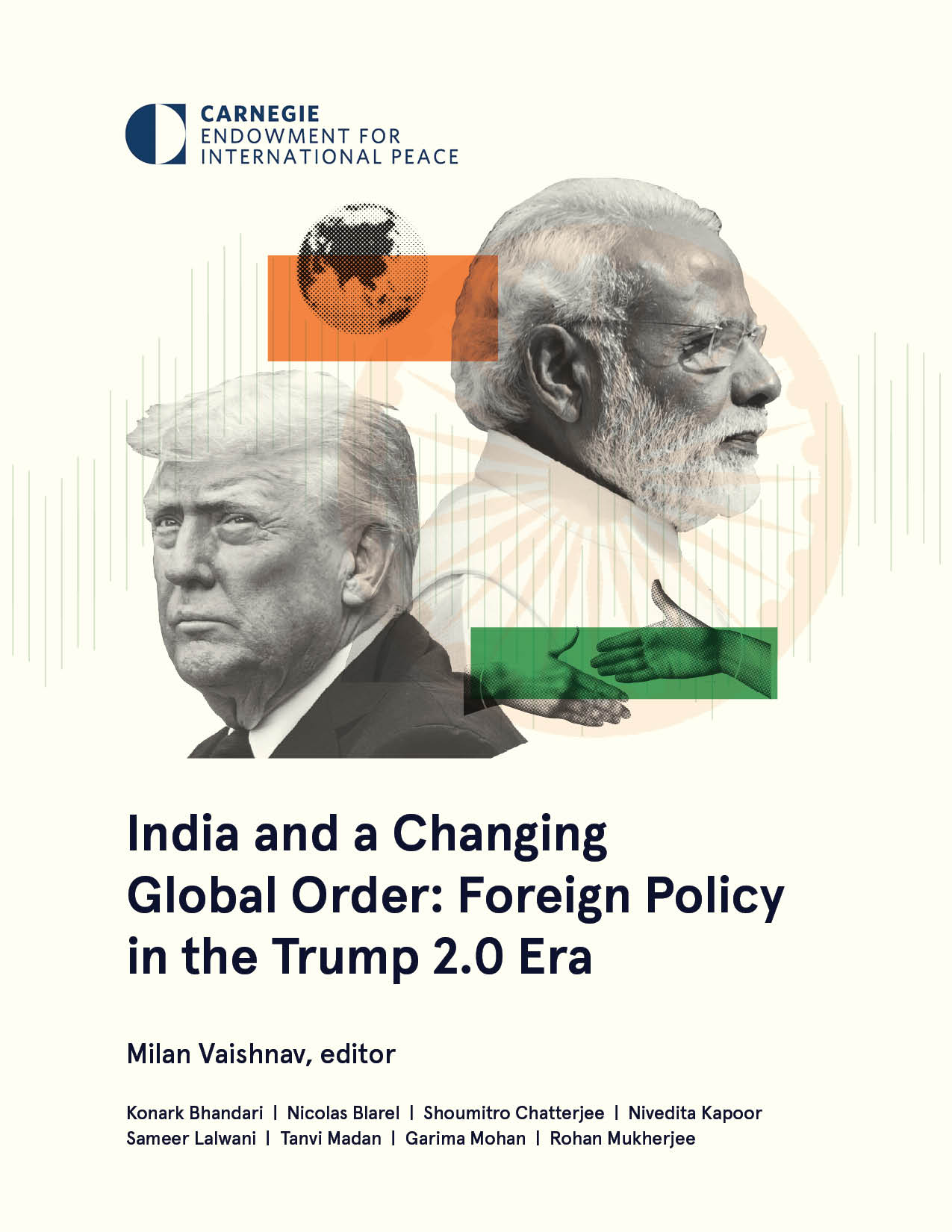
Trump 2.0 has unsettled India’s external environment—but has not overturned its foreign policy strategy, which continues to rely on diversification, hedging, and calibrated partnerships across a fractured order.



Milan Vaishnav, ed., Sameer Lalwani, Tanvi Madan, …