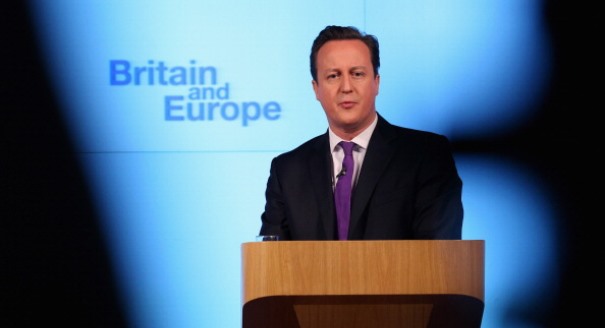
“Boycott” is the word that made it to the headlines in Poland last week. It is not due to fact that more and more authorities around the world (including the Polish President Bronislaw Komorowski) have been deciding not to visit the Winter Olympic Games in Sochi. The word grew to be immensely popular after British Prime Minister David Cameron used Poles as an example of people who abuse UK’s social help and proposed restricting the freedom of movement within the EU. What he caused is an (almost) united stance within the Polish society, basing their argumentation on various issues—from economic issues to even using the historic rhetoric explaining that London should remember about the role that Polish pilots played in the Battle for England.
What caused a certain outrage was, firstly, that back in December 2013 Prime Minister Cameron called opening the job market for Poles in 2004 by Tony Blair a mistake. He even worsened his own perception in Poland when in an interview for BBC he stigmatized Polish citizens as the ones abusing social help in the UK and taking child benefits for children who live in Poland (giving an example of how senseless it seems). Cameron underlined that there are several other countries in the EU that support his restrictions for immigration.
Obviously, it was a populist card played by Cameron to gain more votes in the British society during the upcoming elections. To achieve it, he suddenly introduced a new regulation which enables immigrants from the EU to gain social help firstly after three months upon their arrival in the UK. The declining support for the Conservative Party made Cameron aware that to maintain his function, he needs radical steps and a broader electorate. With these words and actions he is striving to gain the more nationalist Brits (and steal votes from the controversial but charismatic Nigel Farage’s UK Independence Party electorate). As the parliamentary elections in 2014 are rapidly approaching, the anti-immigrant note might be used more often. Indeed, in 2013 more than 60 percent of UK citizens saw immigration as a problem rather than an opportunity and more than 50 percent said there are “far too many immigrants” in their country.
What Cameron was probably not aware of was that his words would be a reason for great outburst of criticism not only in Poland but also in the EU. Polish Prime Minister Tusk, Foreign Minister Sikorski and the Solidarity icon Lech Wałęsa were among the personalities who harshly criticized Cameron for using a populist tone, attacking immigrants and/or stigmatizing Poles. Cameron’s European Parliament faction partners (Jarosław Kaczyński’s Law and Justice Party and Poland Together party) emphasized that cooperation within the political group might soon become more difficult. The Democratic Left Alliance leader—Leszek Miller—wrote a letter to former UK Prime Minister Blair and the Labor Party Leader Ed Miliband turning their attention to Cameron’s practices and calling them to oppose such rhetoric. The idea of one of the Polish People’s Party members to boycott the British hypermarket chain Tesco, became the most commented proposal on how to “punish” Cameron. For the first time in a while, the Polish political elite (with small exceptions) spoke with one voice to the outside world.
Poles brought European attention to the UK prime minister’s words. The Visegrád Group (Hungary, Poland, Czech Republic, and Slovakia) foreign ministers issued a statement in which they criticized Cameron’s selective approach towards the European freedom for movement of workers. The President of the European Parliament Martin Schulz (who is a candidate to become the new president of the European Commission) harshly disapproved with Cameron, while the European Parliament (which is an institution rather willing to further deepen the European integration) will debate on this issue on January 15 after a proposal made mostly by Polish MEPs. If a resolution is issued, it will give less tools for other countries with anti-EU-immigration sentiments (for example, the Netherlands) to push through laws that may hinder the basic freedoms of the European Community.
After the European Parliament elections in 2014, there will be definitely more “euro-skeptics” serving in that institution. The financial crisis might be a great time for conservatives in various EU countries to use nationalist cards (for example, the Alternative for Germany party, the Conservative Party in the UK, and increased popularity of Marine Le Pen’s National Front in France). It cannot, however, overshadow and destroy the great and safe body that has been built for the last several decades. While Cameron might have problems with the unity of his country (the independence referendum in Scotland), he should not destroy the unity that Europeans have been striving for during the Cold War. This is why Poles gained a stronger voice in Europe after Cameron’s words—they have showed that still believe in the EU. If the European Union is “united in diversity,” it should grow strong by proving it.
Paweł Dariusz Wiśniewski holds an M.A. in World Politics from the Moscow State Institute of International Relations, the Humboldt University of Berlin, and the Free University of Berlin. Formerly, he worked on the Eastern Partnership and Russia at the president of the European Parliament’s cabinet and at the Carnegie Moscow Center.