

Article
Garima Mohan
{
  "authors": [
    "Garima Mohan"
  ],
  "type": "other",
  "centerAffiliationAll": "",
  "centers": [
    "Carnegie Endowment for International Peace",
    "Carnegie India"
  ],
  "collections": [],
  "englishNewsletterAll": "",
  "nonEnglishNewsletterAll": "",
  "primaryCenter": "Carnegie India",
  "programAffiliation": "",
  "programs": [],
  "projects": [],
  "regions": [],
  "topics": [
    "Foreign Policy"
  ]
}
Source: Getty
The Indian Ocean, despite its geographical distance, has significant economic and strategic importance for Germany and Europe.
Source: Global Public Policy Institute
The Indian Ocean, despite its geographical distance, has significant economic and strategic importance for Germany and Europe. A majority of European sea trade transits through the Ocean, along with half of Germany’s sea-borne supply and two-thirds of all containers carrying German exports. The Indian Ocean is also Germany’s primary gateway to the Asia-Pacific markets, which receive the second largest share of German exports after Europe, constituting 18.5 percent of all exports. In addition to being a conduit for trade, the Indian Ocean Region (IOR) is a driver of growth itself, which has recalibrated the region’s economic importance for Germany and Europe. With their high growth rates, emerging markets in South Asia and East Africa are important investment destinations. Increasing regional integration, demand for maritime technologies and infrastructure, emerging ‘Blue Economy’, and untapped mineral and energy reserves in the Ocean offer several economic opportunities.
Related to its economic importance, maritime security in the Indian Ocean is of vital interest to Germany as well. As an exporting nation, it is highly dependent on unimpeded maritime trade routes in the Indian Ocean. In addition, the Indian Ocean contains strategic chokepoints including the Straits of Hormuz and Malacca through which 34 million barrels of crude oil and petroleum are transported per day towards Europe and Asia – constituting 61 percent of the global maritime oil trade. Germany’s dependence on these trade and energy sea-lines of communication (SLOCs) makes securing them necessary.
However, both economic opportunities in the region and the security of sea-lanes will be impacted significantly by changing dynamics in the Indian Ocean – particularly the increasing geopolitical and geo-economic competition. This study analyzes the most important developments in the IOR focusing on the changing security dynamics, economic shifts, and emerging multilateral arrangements. It investigates the opportunities and challenges these create for Germany and Europe, and outlines what German engagement in the Indian Ocean could look like.
Former Nonresident Fellow, Carnegie India
Garima Mohan was a nonresident fellow at Carnegie India. Her research focuses on the foreign and security policies of rising powers, particularly that of India, and on Europe-India relations.
Recent Work
Garima Mohan
Carnegie India does not take institutional positions on public policy issues; the views represented herein are those of the author(s) and do not necessarily reflect the views of Carnegie, its staff, or its trustees.

This piece argues that India’s central challenge is not managing a single flashpoint but resolving the underlying tension between expansion and institutional coherency of the BRICS grouping.

Vrinda Sahai

A partnership between India, a country of subcontinental size, and Africa, a continent of fifty-four countries, may seem asymmetric until one notes that both are home to nearly the same number of people—1.4 billion. This essay spells out the existing challenges to the partnership, its optimal potential, and the possible pathways to realize it over the next quarter-century.

Rajiv Bhatia

The India–EU Free Trade Agreement (FTA) is shaping up to be one of the most consequential trade negotiations, both economically and strategically. But, what’s in the agreement, what’s missing, and what will determine its success in the years ahead
Vrinda Sahai, Nicolas Köhler-Suzuki
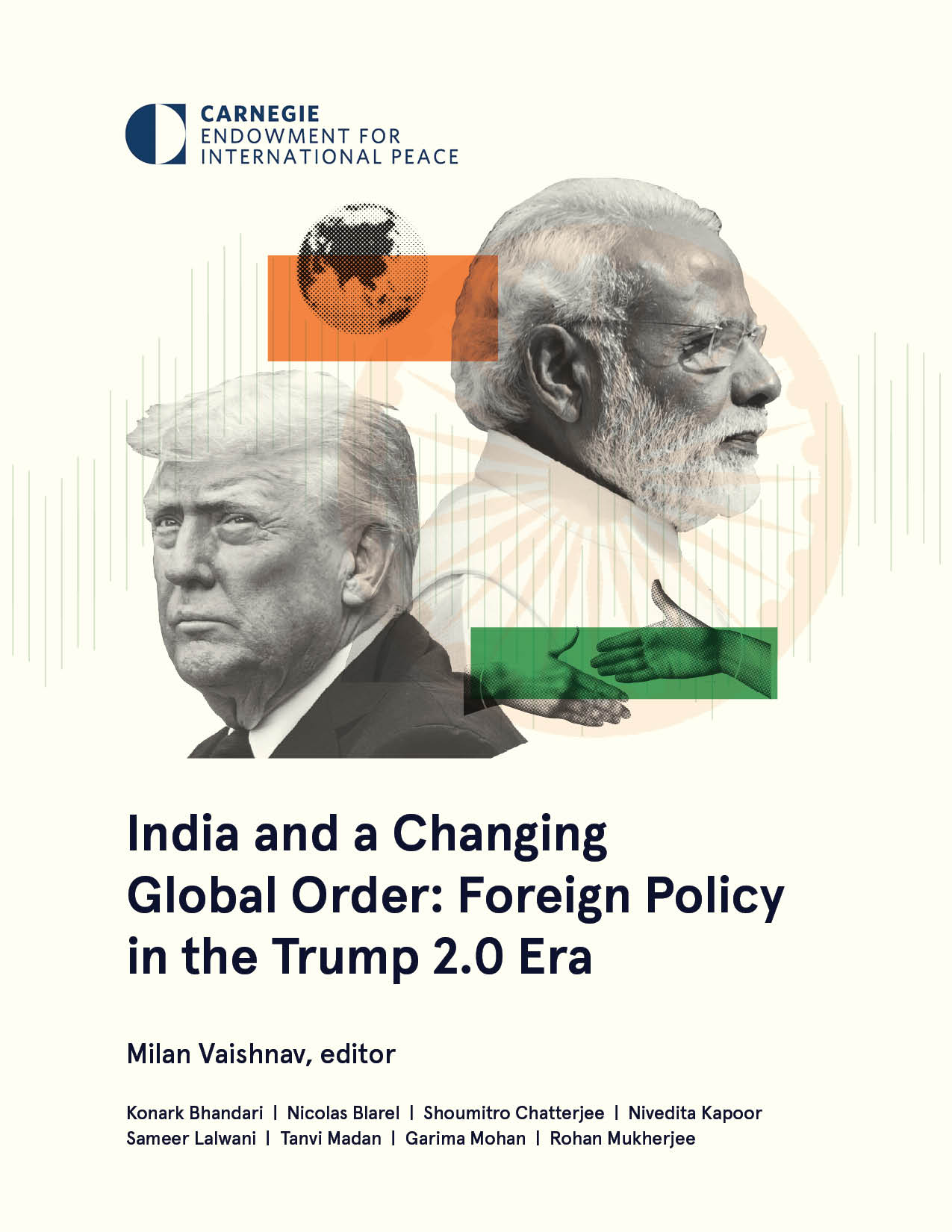
Trump 2.0 has unsettled India’s external environment—but has not overturned its foreign policy strategy, which continues to rely on diversification, hedging, and calibrated partnerships across a fractured order.



Milan Vaishnav, ed., Sameer Lalwani, Tanvi Madan, …

This piece examines India’s response to U.S. sanctions and tariffs, specifically assessing the immediate market consequences, such as alterations in import costs, and the broader strategic implications for India’s energy security and foreign policy orientation.
Vrinda Sahai