

Article
Dan Baer
{
  "authors": [
    "Dan Baer"
  ],
  "type": "legacyinthemedia",
  "centerAffiliationAll": "",
  "centers": [
    "Carnegie Endowment for International Peace"
  ],
  "collections": [
    "Coronavirus"
  ],
  "englishNewsletterAll": "",
  "nonEnglishNewsletterAll": "",
  "primaryCenter": "Carnegie Endowment for International Peace",
  "programAffiliation": "",
  "programs": [],
  "projects": [],
  "regions": [
    "North America",
    "United States"
  ],
  "topics": [
    "Foreign Policy",
    "Global Governance"
  ]
}
Source: Getty
Washington’s failure to lead in a moment of global crisis will have lasting effects on its stature in the world.
Source: Foreign Policy
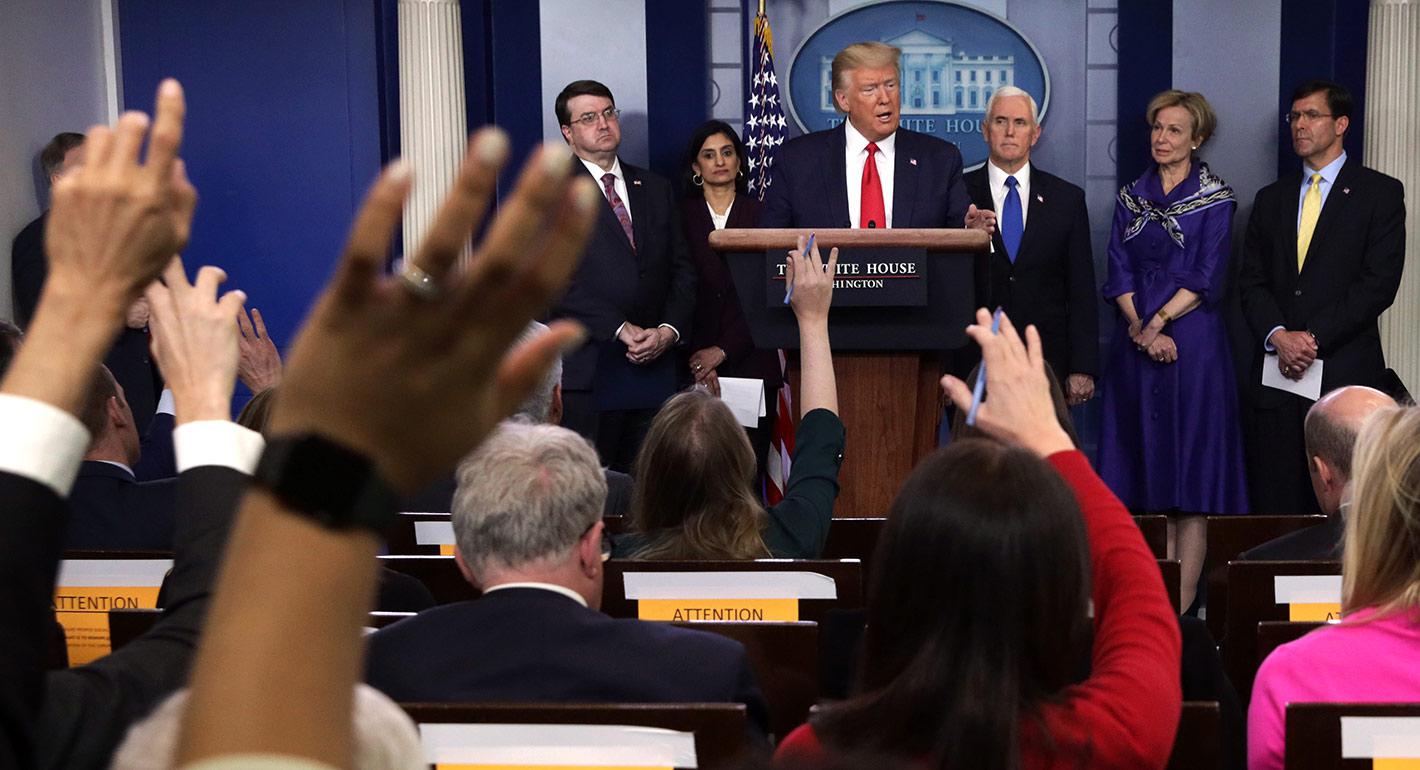
Last weekend, the German newspaper Die Welt reported that the administration of U.S. President Donald Trump had sought to entice a German company working on a coronavirus vaccine to move its research operations from Europe to the United States. According to an unnamed German official quoted by the Berlin-based paper, the Trump administration’s intent was to have the eventual vaccine “only for America.”
It’s still unclear what exactly happened. Was there an attempt to buy the company? With private money or public funds? Trump’s new acting director of national intelligence who remains ambassador to Germany, Richard Grenell, denied the report. Jens Spahn, the German health minister, confirmed it. It seems likely that there was some sort of overture—even if it is also likely that we don’t have all the facts. As former ambassador Steven Pifer observed on Twitter, while there once was a time when a story like this—the United States sneaking around the back of a close ally to steal medicine—would have seemed unthinkable, the past behavior of the Trump administration makes it seem entirely plausible.
The story is now out there, and there has been no small amount of hand-wringing over the damage that has surely been done to the image of the United States and the U.S.-German relationship: Imagine the reaction of the German people, who are dutifully following Chancellor Angela Merkel’s request to self-isolate in order to flatten the coronavirus curve, as they read that the U.S. president was trying to buy critical medical research with the hopes of using it only for his own country. Add this to the fact that in Italy, it is China, not the United States, that is delivering medical equipment and assistance as the Italian health system bends under the strain of the pandemic. And furthermore, that Trump last week announced restrictions on travelers to the United States from Europe without prior coordination with European partners or even a word of warning. Suffice it to say that the past week has marked a relative low point in trans-Atlantic relations.
The past week also underscores two consistent failings of Trump’s foreign policy: First, that the Trump administration is lousy at preserving the trust and goodwill that is essential to sustained, cooperative relationships with other governments. And second, that the coronavirus pandemic is laying clear the folly of Trump’s “America First” theory of foreign policy—and of other approaches to foreign policy, on both the left and the right, that are premised on the fiction that the welfare and interests of the United States can be protected and defended separately and apart from the welfare of the world.
What’s so disheartening about the idea that Trump might try to poach a vaccine for exclusive use in the United States is not the craven greediness of it; it’s that it so obviously misunderstands the nature of the threat this pandemic poses. Countries need to cooperate internationally to ensure that somewhere in the world—anywhere in the world—a vaccine is discovered as quickly as possible, and ultimately we need a vaccine to be globally accessible. It is plain stupid to think that hoarding medical research that could yield interventions that would treat or protect against a pandemic would actually serve U.S. interests.
The United States needs a functioning European economy. American farmers and businesses depend on trade with the rest of the world. U.S.-based multinationals depend on foreign workforces. Pandemics can cause instability and conflict that endanger American troops and interests overseas. The United States is a global power: The world depends on the United States, and the United States depends on the world.
The response to the coronavirus might have been more efficient if it had first appeared in a country that wasn’t authoritarian and didn’t suppress news about the virus in the early weeks. And it might have been more effective if the United States were helping to lead and coordinate the world’s response to the outbreak, rather than claiming for weeks that the virus was not going to affect it and therefore was nothing to be concerned about, before pursuing a set of policies that surprised the closest U.S. allies.
When I was in government, I often wanted to tell people that they couldn’t use the words “Marshall Plan” in meetings: It seemed like every meeting about a crisis somewhere in the world had one person who would say, “What we need is a Marshall Plan for [insert country or region].” And while that trope became frustratingly predictable, it of course reflected the fact that moments of great need can be moments of great opportunity for American leadership. For a generation or more, the Marshall Plan’s intent and effects had a lasting impact on the popularity of and trust in the United States across Europe. Trump’s mismanagement of the domestic coronavirus response has been dire. America’s failure to lead in a moment of global crisis will have lasting effects on its stature in the world.

Senior Vice President; Director, Europe Program
Dan Baer is a senior vice president of the Carnegie Endowment for International Peace and director of the Europe Program. Under President Obama, he was U.S. ambassador to the Organization for Security and Cooperation in Europe (OSCE) and he also served deputy assistant secretary of state for the Bureau of Democracy, Human Rights, and Labor.
Recent Work


Richard Youngs, Erik Jones, Dan Baer, …
Carnegie India does not take institutional positions on public policy issues; the views represented herein are those of the author(s) and do not necessarily reflect the views of Carnegie, its staff, or its trustees.

How is AI reshaping space security, creating governance challenges, and where does international diplomacy stand today?


Tejas Bharadwaj, Almudena Azcárate Ortega

After the chill in ties between 2020 and 2024 that brought India–China relations to their lowest point in several decades, the two countries have engaged each other afresh. This paper argues that there are predominantly four imperatives guiding India’s approach to China, and they exist in an order of priority.

Saheb Singh Chadha

This piece argues that India’s central challenge is not managing a single flashpoint but resolving the underlying tension between expansion and institutional coherency of the BRICS grouping.

Vrinda Sahai

A partnership between India, a country of subcontinental size, and Africa, a continent of fifty-four countries, may seem asymmetric until one notes that both are home to nearly the same number of people—1.4 billion. This essay spells out the existing challenges to the partnership, its optimal potential, and the possible pathways to realize it over the next quarter-century.

Rajiv Bhatia

The U.S.–India semiconductor cooperation story is well-stocked with top-level strategic intent. What remains unresolved, however, are some underlying challenges that will determine whether the cooperation actually functions. Three such friction points stand out.

Shruti Mittal