

Other
François Godement, Ashley J. Tellis
{
  "authors": [
    "François Godement"
  ],
  "type": "legacyinthemedia",
  "centerAffiliationAll": "dc",
  "centers": [
    "Carnegie Endowment for International Peace"
  ],
  "collections": [],
  "englishNewsletterAll": "asia",
  "nonEnglishNewsletterAll": "",
  "primaryCenter": "Carnegie Endowment for International Peace",
  "programAffiliation": "AP",
  "programs": [
    "Asia"
  ],
  "projects": [],
  "regions": [
    "East Asia",
    "China",
    "Western Europe"
  ],
  "topics": [
    "Foreign Policy"
  ]
}
Source: Getty
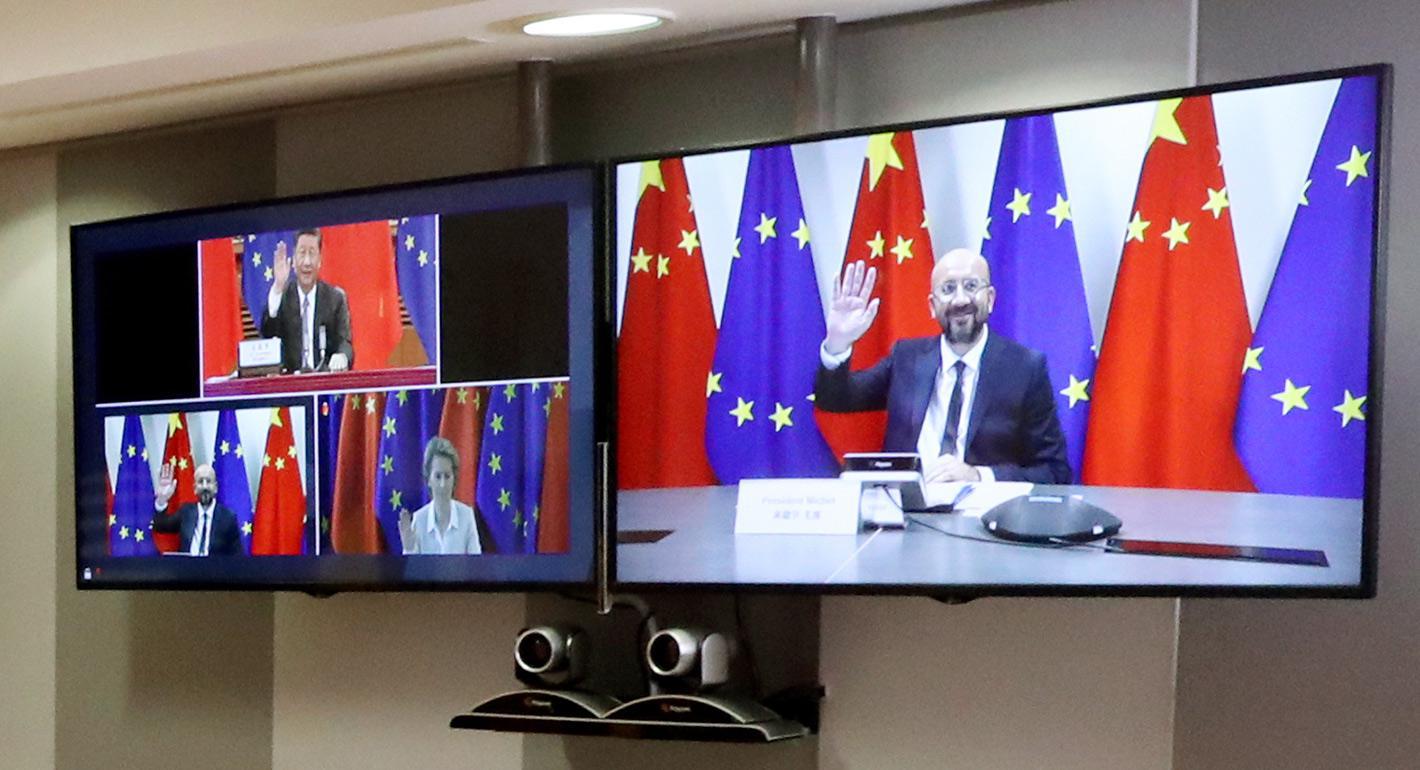
China’s diplomacy has entered a game of hide and seek with the European Union in preparation for another virtual summit on September 13-14 between Xi Jinping and EU leaders.
Source: Institut Montaigne
China’s diplomacy has entered a game of hide and seek with the European Union in preparation for another virtual summit on September 13-14 between Xi Jinping and EU leaders - Ursula von der Leyen, Charles Michel and Angela Merkel, since Germany chairs the Council this semester.
One should first note that Beijing did not blink an eye after von der Leyen and Michel gave a blisteringly critical press conference on June 22, concluding another summit that ended without a joint communiqué. No answer from Beijing was probably the best short-term tactic, since the list of European grudges is so long. Although technical negotiations on a potential investment agreement deal have continued, there is little report of any progress – save perhaps on technology transfers: that is an issue where China fears new restrictions, and it is therefore mostly a Chinese ask, not a European one. Market access, subsidies and SOEs are issues on which there is no sign of China intending to budge. Meanwhile, of course, European public opinion has greatly soured on China, for reasons known to all: Xinjiang, Hong Kong, military posturing or violence against several Asian neighbors, the denial of responsibility on Covid-19 and a crude "mask diplomacy", the attacks or threats on several European governments – this year, it is the Czech Republic and United Kingdom’s turn, but a dispute with Sweden also lingers.
It is against this background that Foreign Minister Wang Yi has just concluded a tour of China’s four main export destinations in Europe – Italy, France, the Netherlands and Germany, with Norway, a non-EU country thrown in. Oddly, it is on the last day of this tour that another coming trip – this time by Yang Jiechi, Wang’s predecessor and now Politburo member in charge of foreign policy, was announced, reportedly to Greece and Spain.
This article was originally published by Institut Montaigne.

Former Nonresident Senior Fellow, Asia Program
Godement, an expert on Chinese and East Asian strategic and international affairs, was a nonresident senior fellow in the Asia Program at the Carnegie Endowment for International Peace.
Recent Work
François Godement, Ashley J. Tellis

François Godement, Abigaël Vasselier
Carnegie India does not take institutional positions on public policy issues; the views represented herein are those of the author(s) and do not necessarily reflect the views of Carnegie, its staff, or its trustees.

After the chill in ties between 2020 and 2024 that brought India–China relations to their lowest point in several decades, the two countries have engaged each other afresh. This paper argues that there are predominantly four imperatives guiding India’s approach to China, and they exist in an order of priority.

Saheb Singh Chadha

This piece argues that India’s central challenge is not managing a single flashpoint but resolving the underlying tension between expansion and institutional coherency of the BRICS grouping.

Vrinda Sahai

A partnership between India, a country of subcontinental size, and Africa, a continent of fifty-four countries, may seem asymmetric until one notes that both are home to nearly the same number of people—1.4 billion. This essay spells out the existing challenges to the partnership, its optimal potential, and the possible pathways to realize it over the next quarter-century.

Rajiv Bhatia

The India–EU Free Trade Agreement (FTA) is shaping up to be one of the most consequential trade negotiations, both economically and strategically. But, what’s in the agreement, what’s missing, and what will determine its success in the years ahead
Vrinda Sahai, Nicolas Köhler-Suzuki
Trump 2.0 has unsettled India’s external environment—but has not overturned its foreign policy strategy, which continues to rely on diversification, hedging, and calibrated partnerships across a fractured order.



Milan Vaishnav, ed., Sameer Lalwani, Tanvi Madan, …