• Research
  • About
  • Experts
Carnegie India logoCarnegie lettermark logo
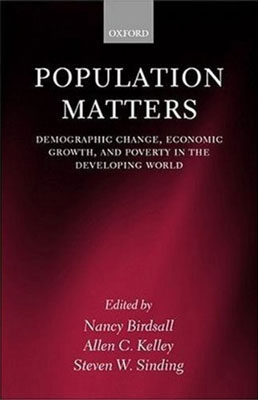
Population Matters: Demographic Change, Economic Growth, and Poverty in the Developing World
Book

Population Matters: Demographic Change, Economic Growth, and Poverty in the Developing World

The effect of demography on economic performance has been the subject of intense debate in economics for nearly two centuries. In recent years opinion has swung between the Malthusian views of Coale and Hoover, and the cornucopian views of Julian Simon.

Link Copied
By Nancy Birdsall, Allen Kelley, Stephen Sinding
Published on Sep 27, 2001

Additional Links

Table of Contents

Source: Carnegie

The effect of demography on economic performance has been the subject of intense debate in economics for nearly two centuries. In recent years opinion has swung between the Malthusian views of Coale and Hoover, and the cornucopian views of Julian Simon. Unfortunately, until recently, data were too weak and analytical models too limited to provide clear insights into the relationship. As a result economists as a group have not been clear or conclusive.

This volume, based on a collection of papers that heavily rely on data from the 1980s and 1990s and on new analytical approaches, sheds important new light on demographic-economic relationships, and it provides clearer policy conclusions than any recent work on the subject. In particular, evidence from developing countries throughout the world shows a pattern in recent decades that was not evident earlier: countries with higher rates of population growth have tended to see less economic growth. An analysis of the role of demography in the 'Asian economic miracle' strongly suggests that changes in age structures resulting from declining fertility create a one-time 'demographic gift' or window of opportunity, when the working age population has relatively few dependents, of either young or old age, to support. Countries which recognize and seize on this opportunity can, as the Asian tigers did, realize healthy bursts in economic output. But such results are by no means assured: only for countries with otherwise sound economic policies will the window of opportunity yield such dramatic results. Finally, several of the studies demonstrate the likelihood of a causal relationship between high fertility and poverty. While the direction of causality is not always clear and very likely is reciprocal (poverty contributes to high fertility and high fertility reinforces poverty), the studies support the view that lower fertility at the country level helps create a path out of poverty for many families.

Population Matters represents an important further step in our understanding of the contribution of population change to economic performance. As such, it will be a useful volume for policymakers both in developing countries and in international development agencies.

To order a copy of this book, please contact Oxford University Press at: book.orders@oup.co.uk 

About the Authors

Nancy Birdsall

Former Senior Associate

Allen Kelley

Stephen Sinding

Authors

Nancy Birdsall
Former Senior Associate
Allen Kelley
Stephen Sinding
EconomyTrade

Carnegie India does not take institutional positions on public policy issues; the views represented herein are those of the author(s) and do not necessarily reflect the views of Carnegie, its staff, or its trustees.

More Work from Carnegie India

  • Commentary
    The Impact of U.S. Sanctions and Tariffs on India’s Russian Oil Imports

    This piece examines India’s response to U.S. sanctions and tariffs, specifically assessing the immediate market consequences, such as alterations in import costs, and the broader strategic implications for India’s energy security and foreign policy orientation.

      Vrinda Sahai

  • Paper
    India-China Economic Ties: Determinants and Possibilities

    This paper examines the evolution of India-China economic ties from 2005 to 2025. It explores the impact of global events, bilateral political ties, and domestic policies on distinct spheres of the economic relationship.

      Santosh Pai

  • Commentary
    TRUST and Tariffs

    The India-U.S. relationship currently appears buffeted between three “Ts”—TRUST, Tariffs, and Trump.

      Arun K. Singh

  • Article
    Can Geopolitical Alignment Seal the India-EU FTA?

    This article argues that the geopolitical circumstances have never been more conducive, not merely for the early conclusion of the free trade agreement (FTA) between India and the EU, but also for crafting a substantive and comprehensive strategic partnership.

      Mohan Kumar

  • Article
    A Path Out of Tunisia’s Economic Crisis

    President Kais Saied has won a second term in office, but his country is facing a host of problems that necessitate urgent reforms, above all preventing the possibility of a financial meltdown. 

      Ishac Diwan, Hachemi Alaya, Hamza Meddeb

Get more news and analysis from
Carnegie India
Carnegie India logo, white
Unit C-4, 5, 6, EdenparkShaheed Jeet Singh MargNew Delhi – 110016, IndiaPhone: 011-40078687
  • Research
  • About
  • Experts
  • Projects
  • Events
  • Contact
  • Careers
  • Privacy
  • For Media
Get more news and analysis from
Carnegie India
© 2026 Carnegie Endowment for International Peace. All rights reserved.