

Commentary
Nathan J. Brown
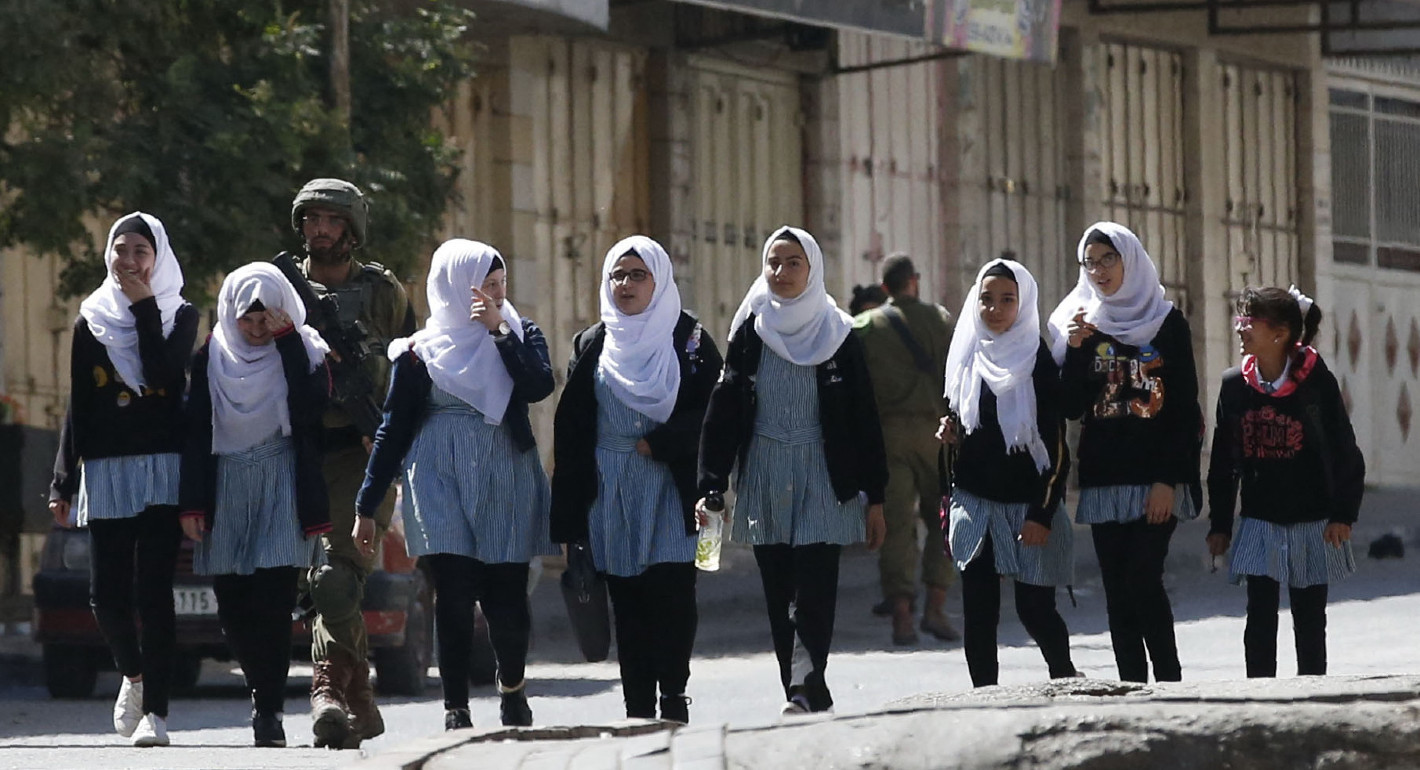
Source: Getty
Young people in Palestine are accused of being ignorant of their past. But the truth may be that they are more aware of their present than anyone else.
Palestinian youth are a foreign country; they do things differently there—not because they reject politics, but because the political institutions around them no longer function. But the implications for diplomacy and politics have not sunk in, especially regarding the structures that have upheld Palestinian political life over many decades but are now in severe decay.
Long before October 7, 2023, Palestinian institutions were soldiering on without commanding respect or loyalty, without exercising moral authority or leadership, and without ensuring compliance—except, at times, through brute force. Regardless of how current political and diplomatic maneuvering plays out, these institutions are unlikely either to collapse outright or to regain their footing. Instead, they will survive without regaining relevance, leaving most Palestinians to fend for themselves in the growing governance gaps they leave. The Palestinian Authority (PA)—a body built on the two legs of international diplomacy and democratic legitimacy—has lost its ability to stand on either. It continues through inertia and lack of alternatives.
The Palestinian Authority—a body built on the two legs of international diplomacy and democratic legitimacy—has lost its ability to stand on either.
That is the reality many younger Palestinians have grown up with, internalized, and learned to navigate. The events of the past two years have not created this condition; but the post–October 7 period has embedded it far more deeply. Only outsiders can afford to avert their gaze. Palestinian elders tend not to contest these realities but are far more likely to hearken back to history (such as the first intifada); others cling to older structures and leaders, though often in a spirit of resignation.
Institutional decay and the generational chasm together pose profound challenges for those who seek to speak in the name of Palestine. And they loom just as large for diplomats who hope to resolve—or even merely manage—conflict. Over the long term, these trends may reveal themselves as a Pyrrhic victory for Israeli leaders who exert decisive control over Palestinians’ lives, by steadily eroding any long-term potential for a different relationship between the two peoples.
I have reached these conclusions after tracing the trajectory of Palestinian politics and making periodic visits to Palestine over more than three decades. For much of that time, many officials—across different settings—resisted acknowledging these creeping realities, partly because they were inconvenient and partly because they pointed toward politically unpalatable conclusions. So today, what is obvious to many Palestinians can still be disturbing or shocking for outsiders. But even that resistance has weakened in recent years. I no longer feel that I am swimming against a stream of sunnier international analysis. Yet I still do not sense that the depth and implications of the changes have begun to inform external analysis. Only in internal Palestinian discussions do some seem to appreciate the emerging realities.
My visits to the West Bank in August 2023 and December 2025—both of which heavily focused on youth—brought home to me what is more difficult to grasp at a distance: the seriousness of the generational challenge and the extent to which younger Palestinians have internalized a political reality that observers still tend to treat, if they acknowledge it at all, as provisional and easily reversible.
Younger Palestinians never speak in a single voice except, to my hearing, about two things: First, nobody else listens to them; and second, nobody else speaks for them. That can be jarring to those of their elders who labored so hard to build and then rally around structures and movements to assert a unique and authoritative Palestinian voice in world affairs. But if youthful alienation frustrates elders, it can completely fly over the heads of international observers wondering who is likely to be next at the head of the table while barely noticing how many have fled the room.
Younger Palestinians never speak in a single voice except, to my hearing, about two things: First, nobody else listens to them; and second, nobody else speaks for them.
I will not attempt to fill the gap by speaking or advocating for them, but I will try to convey to readers what I have heard.
The Palestinians I have met are not a random selection: I have visited the center and north of the West Bank, where interlocutors tended to be educated (most were current or recent students at the secondary or post-secondary levels). As such, they often had the language skills and training to access information widely—and did so with voracious appetites. Indeed, one of the most striking differences I notice between younger and older generations is how comfortable many youth have become in reading and speaking English (so much so that I generally now leave my serviceable but inelegant Arabic behind in most conversations) and how global many of their cultural references are.
But for all their participation in global culture, younger Palestinians are also acutely aware of their immediate surroundings—an environment in which all institutions and leaders have failed them. On both a global and a local level, they feel unrepresented and unheard.
The body that Palestinians came to call the Palestinian National Authority in the 1990s has long seemed to live up to none of the three parts of its name—it holds little authority; it has no national project to offer; and its top officials are unable to serve Palestinian interests. Indeed, the term “Palestinian National Authority” itself has faded into the past. Internationally, it has always been referred to as the “Palestinian Authority,” and its leaders now ambitiously prefer the “State of Palestine.” For Palestinians, it is simply “the Authority”—even though whatever authority it has left is not moral. The problem is not only at the top. Acute fiscal crisis and inefficiency mean that basic social services such as education function poorly: With teachers only partially paid and Israeli actions shifting throughout the West Bank, classes are as often online as in person.
Leaders command little respect and are seen as distant, unresponsive, and too aged; for example, the minister of youth and sports is in his seventies. What some Palestinians have referred to as their revolution—the rise of the factions and of the Palestine Liberation Organization in the 1960s and 1970s—is a distant memory. I have witnessed a series of conversations in which an older figure speaks of that period or either of the intifadas (of the 1980s and 2000s) while younger ones simply tune out. One Palestinian relayed this wry observation: “The best thing about the revolution is that it was led by youth. The worst thing about the revolution is that they are still there.”
One Palestinian relayed this wry observation: “The best thing about the revolution is that it was led by youth. The worst thing about the revolution is that they are still there.”
The disengagement with leaders and history is not simply personal but institutional—factions seem to inspire little loyalty or identification. New members do join, and Fatah certainly has a presence in public life. But others tend to view those who join the factions as doing so for opportunistic or family reasons (such as belonging to a leading Fatah family or wanting an official job). And even younger members do not show strong loyalty to the leadership or interest in factional ideology. (Hamas is present in the West Bank, but any formal expression of the organization is quickly quashed, generally by the Israelis.)
And the distrust is global. Local “corruption” and international “hypocrisy” seem to be two sides of the same coin. International discussions of the PA periodically allege “corruption”—but from my observation, the word emerges only when it becomes politically convenient for diplomats to express shock that the Ramallah leadership is aged, authoritarian, and using public office for private gain. Those accusations are forgotten or given superficial treatment when Palestinian leaders prove useful, when a slightly younger figure from the same group is identified as an alternative, or when Palestinians are pressed to make a new concession.
In domestic parlance, “corruption” refers not just to pilfering public funds but to a leadership that was not chosen and is unable to do much except protect its own perquisites. In discussions in the West Bank, I observed that my younger interlocutors often saw leadership as both structurally and personally flawed—and as propped up only because of its international usefulness.
The mistrust in “international law” and “international society” is near total and universal. Perhaps the angriest comments I heard expressed a sense of abandonment and hypocrisy. Young Palestinians have an awareness that, at a global level, there has been some supportive popular mobilization since October 2023. But they see that so far, it has translated into no change on the ground.
In short, for West Bank youth, Palestinian leaders and institutions and international society have nothing positive to offer and do not hear their voices. I do not include Gazans in this analysis. I have not visited Gaza since 2012, and the death, destruction, and trauma that have lasted over two years (attenuating but not stopping in recent months) are for me quite literally unimaginable. Nothing in my training or expertise gives me the ability to offer political analysis of their likely reactions. My best guess is that the customary questions about leadership, structure, strategy, and even “the day after,” when they are posed internally, will take unanticipated answers.
When youth are asked what they want, there is a striking pattern in their answers. Sometimes slogans of the past (“Palestine from the river to the sea” or “free Palestine”) were heard, generally with no specificity. Others were strikingly absent (“Palestinian state” or even “a secular democratic state”). Some previously taboo options—emigration, even a “blue passport” (in reference to Israeli citizenship)—were mentioned just as often.
Yet by far the most common phrase I heard from young Palestinians bypasses all political slogans and programs: “normal life.” When I pressed for details, I heard strikingly personal desires: to travel without restriction, to speak and socialize freely, to live securely. This vision of escaping from the most pernicious form of politics was shared among various ideological camps and factions.
The most common phrase I heard from young Palestinians bypasses all political slogans and programs: “normal life.”
There is not a total retreat into the personal; just the opposite. The horizon is distant and hazy and—more troubling—there is no clear path leading there. So there is no crystallization around a single vision of the future: Is there one state or two? Are Palestinians joining Israel or replacing it? Young Palestinians do not see anything like the economic prosperity and peace that some outsiders suggest will take the edge off any nationalist and political agendas. Not only are jobs and economic growth not emerging, but a personal focus does not involve leaving all politics and nationalism behind.
For all the darkness, prevailing ideas in Palestine do not consist of total despair—they are predicated on the slowness of time, not the absence of hope. The quest for normality is not apolitical, but it is not attached to any clear or preexisting program. The closest alignment is with the “rights-based approach” that has gained traction over the past decade, especially among activists outside Palestine. But among Palestinians, I rarely heard such external activism mentioned in much detail. Nor were the specific phrases popular outside Palestine (with the partial exception of “settler colonialism”) used in internal discussions.
For all the darkness, prevailing ideas in Palestine do not consist of total despair—they are predicated on the slowness of time, not the absence of hope.
There are two other notable trends in political discussions among youth in the West Bank. First, talk is not centered around any particular personality or group of persons; indeed, it is almost anti-personalistic. One young person responded that the biggest problem for Palestinians is “chairs”—the idea that those who sit in positions of political authority simply do not change. The figure sometimes touted by outsiders as a possible fresh face and unifying figure—Marwan Barghouti—is not even a distant memory for many younger Palestinians. There is, to be sure, a campaign to position him as such a figure, and it has some enthusiastic youthful participants whose efforts seem dedicated and sincere. But perhaps more symptomatic of the disengagement with potential leaders was the room of blank faces I saw when Barghouti’s name came up in one discussion two years ago; the silence was broken when someone asked for clarification: “Is that the guy who is in jail?”
Second, fear is a major constraint. Face-to-face discussions seem fairly frank and free, but the reasons for fear of any public expressions (especially on social media) are fivefold: First, the PA itself has a record of suppressing dissident voices. Second, Israel regularly conducts raids in Palestinian cities and even universities. Third, social media platforms are widely believed to suppress Palestinian national sentiments. Fourth, social pressures make some views too unpopular to voice. And finally, there is open concern that political speech may lead to visa rejections for those who wish to travel.
In the West Bank, young people speak fairly freely but post much more carefully. What do they actually do? Most strive to live as close to their proclaimed vision as possible: They seek to live a normal life. And that is difficult.
But they devise ways of coping with the difficulties. If they can articulate few national strategies and are far more able to say what others (the “international community” most commonly) should do, that does not amount to passivity or disengagement; it is normalization, not resignation. When traveling within or between cities, they rely on Telegram as a politically savvy version of Waze—marking not construction zones and rubbernecking but closed checkpoints, settler attacks, or ongoing raids to avoid. They can avoid censorship on social media by using emojis or synonyms.
Life patterns adjust to make the abnormal normal. One young person told me, “When I travel abroad, my parents do not worry. If I go from Nablus to Ramallah, they are always calling and texting to see where I am.” As a metaphor, another pointed to Kafr ‘Aqab, a neighborhood between Jerusalem and Ramallah that was annexed to the Israeli municipality of Jerusalem after 1967 but left outside the wall built two decades ago. As a result, there is no governing authority, allowing rampant building by Palestinians caught by restrictions in seemingly impossible positions (such as families in which one member has Jerusalem residency but another does not) to operate daily in a political and security environment that is deeply hostile to daily life.
One young person told me, “When I travel abroad, my parents do not worry. If I go from Nablus to Ramallah, they are always calling and texting to see where I am.”
But if most find ways to navigate the restrictions on movement, the uncertain and deteriorating economic situation, the strikes and school closures, and the social and legal costs of speaking one’s mind, that does not mean that they view those tactics as an acceptable outcome. And that explains why in the absence of leadership, strategy, and even viable national (as opposed to individual) tactics, there is often strong support for those who do take action—regardless of what they do. Those who reject or show little interest in ideological programs or factional politics still evince support for small-scale attacks such as those conducted by the “Lions’ Den.” October 7 is remembered in public discussion (even by those who loathe Hamas) generally positively—not as an act of violence to be glorified, but as a surprise that restored a sense of agency and visibility. Many seem to hesitate before voicing reservations about Hamas’s actions in public. The attacks of that day are seen not as the beginning of a war (as they are generally described in Israel and often internationally) but as a response to decades of repressive occupation, one that put Palestinians back on the global map. (In private discussions, I heard far more mixed opinions and received no pushback when I voiced my own harsh evaluation of the attacks.)
This is not the flourishing of civil society—at least if that term means formal organizations outside the state. There are such organizations, both local (youth clubs, charitable groups) and national (human rights monitors), generally born in earlier eras. Most continue in somewhat weakened form. Some still provide arenas for discussion and gathering. But if discussions are rich, formal organizing is not much in evidence—a marked contrast with the two intifadas, where unions, grassroots organizations, and political factions played a major role.
Where does this odd amalgamation of alienation with engagement, atomization with activism come from? Why do young people in the West Bank talk so freely among themselves but do so little collectively?
Much stems from their interpretation of the world around them, which is difficult to contest—indeed, the futility of formal politics has become in part an intended policy outcome by Israel’s current leadership. The problem is not that younger Palestinians are ignorant of their past, as their elders sometimes claim, but that they are much more aware of their present than anybody else.
The futility of formal politics has become in part an intended policy outcome by Israel’s current leadership.
There has been intermittent international discussion of the implications of the collapse of the PA. That discussion has always overlooked that the PA collapsed long ago as a viable national project in the eyes of most Palestinians; it survives as an umbrella for public services, local administration, and some policing. And that is how young Palestinians encounter it: as a set of schools overseen by a Ministry of Education; as a set of municipalities overseen by a Ministry of Local Government and elected local councils; and as a set of security bodies and agencies that issue identity cards and register life events.
In trips to Palestine over the years, I have observed that youth experience three features of the PA that are sometimes overlooked by outsiders. First, the administration functions less well with each passing year. Schools now meet only part-time; teachers and other civil servants receive only a portion of their salaries; whatever security Palestinian forces can provide for store owners against shoplifters hardly compensates for the security they cannot provide against Israeli raids in cities or settler attacks on villages. Second, the PA is linked to no state-building project or even viable national strategy. And finally, the PA’s structures are not merely divorced from such a project but thoroughly integrated into a political structure (the “occupation” that figures so prominently in political discussions) of Israeli dominance. Palestinian identity cards are coordinated with Israel and are in both Arabic and Hebrew; Israel pressures other governments to make changes in Palestinian textbooks (leading to a sense among younger Palestinians that their education has been censored); security “coordination” between Israeli and Palestinian security bodies is ongoing.
And these features of young Palestinians’ political world (sometimes exaggerated among them but always with a considerable degree of truth) are summed up in the word “corruption.” Senior leaders are exempt from (and may even profit from) the realities that afflict the lives of younger Palestinians, and their partial exemption is based on the support of the same outside states who call for “revitalizing” or “reforming” the PA. International talk of “reform” thus makes little sense and is heard by supposed Palestinian beneficiaries—if at all—as conditioning support for Palestinians on changes to meet Israeli demands or to overcome obstacles fostered by the same international actors demanding reform.
But here it must be noted that the cynicism of youth actually does not go far enough: Not only has the Palestinian leadership’s dream of statehood been robbed of all meaning, but efforts also are afoot to undermine all remaining structures of Palestinian national life. The reality that may be emerging—what I have termed “Palestinians without Palestine”—is not a mere byproduct of venality or stalled diplomacy but a sustained effort by powerful Israeli actors to vanquish structures and repudiate processes that treat Palestinians as a national group. There is no other way to see the attacks on the United Nations Relief and Works Agency (UNRWA); the efforts to dismantle refugee camps in the West Bank; the labeling of prominent nongovernmental organizations as terrorist groups; the rhetorical equation of the PA with Hamas; and—perhaps above all—the slow fiscal strangulation of the PA by the Israeli Ministry of Finance and the dismantlement of Oslo-era arrangements for Areas B and C along with incursions into Area A.
Not only has the Palestinian leadership’s dream of statehood been robbed of all meaning, but efforts also are afoot to undermine all remaining structures of Palestinian national life.
So, yes, the PA collapsed long ago in terms of its original mission (in the eyes of its founders) of paving the way for a Palestinian state alongside Israel. Its institutions continue but are hollow. They function at best to preserve claims, delay (but not avoid) irreversibility, and maintain records, rather than to govern effectively or offer a better future. Legitimate leadership and responsive governance have disappeared. There is little basis for the unspoken assumption—prevalent among so many would-be external actors—that Palestinian politics is paused rather than fundamentally reconfigured.
Over the long run, a situation in which people are active, angry, and atomized does not seem stable; how it will resolve is not clear. What is clear is that the dismantling of “Palestine” has removed the basis for much domestic politics and international diplomacy.
International policy discussions often focus on crises not only because they are pressing but because policymakers can point to discrete problems and immediate solutions. But the problems afflicting Palestinians are not merely a crisis. They form a long-term, generational challenge. And in this regard, analysts should recall not merely John Maynard Keynes’s often-quoted aphorism, “In the long run we are all dead,” but his full statement: “The long run is a misleading guide to current affairs. In the long run we are all dead. Economists set themselves too easy, too useless a task if in tempestuous seasons they can only tell us that when the storm is past the ocean is flat again.”
The problems afflicting Palestinians are not merely a crisis. They form a long-term, generational challenge.
I have argued since October 7, 2023, that the search for a masterful “day after” plan missed what was happening and what was likely to occur; for almost two decades before that, I suggested that policy discussions should move in a different direction. Can anything be done to move things toward a trajectory that offers harbor from the current and coming storm and allows those with constructive ideas to take the helm when the tempest has passed?
There are both international and domestic steps that could open up better long-term possibilities. With regard to global actors, perhaps the best things outsiders could do are: First, fight to increase the space for Palestinian actors to organize (reverse the attack on UNRWA, protect civil society organizations, or invigorate democratic structures at both the grassroots and national levels). Second, shift from playing a game of favorites (who should succeed PA President Mahmoud Abbas) and pariahs (who should be shunned) toward measuring all steps by whether or not they advance the individual human rights and collective national rights of all inhabitants of Israel and Palestine.
There are, of course, international legal standards and processes on offer to guide, coordinate, and facilitate such efforts. Continuing to treat Palestine as a law-free zone—and those standards and processes as a distraction from diplomacy—always depended on the credibility of diplomacy to address gross power imbalances. And that credibility vanished decades ago.
Domestically, it is difficult to envision any path that does not restore some vitality to Palestinian civil and political society, which would require that Palestinians be able to express their voices. Perhaps the most recent such movement in a more vital direction came in 2021 with anticipated national elections that were canceled when they augured outcomes displeasing to the leadership (a split Fatah; a rising Hamas). A hung parliament in 2021 would have produced a very different kind of politics, however—one in which Palestinian political actors would have started the process of cultivating their constituencies, negotiating their divisions, and—maybe—allowing new voices to be heard. Were professional associations, unions, local governance bodies, and national political structures to participate in truly open balloting, the voices of youth might be translated into votes for new alternatives.
Such efforts likely would not pay off fully for a generation, but they would deliver to the children of today’s youth a set of problems that could be managed more justly than the ones young Palestinians have come to know so well.

Nonresident Senior Fellow, Middle East Program
Nathan J. Brown, a professor of political science and international affairs at George Washington University, is a distinguished scholar and author of nine books on Arab politics and governance, as well as editor of five books.
Recent Work
Nathan J. Brown
Nathan J. Brown
India’s traditionally neutral position in the Middle East has ended with the landmark Israel visit. The future balancing of India’s westward pivot will be determined by a new regional order led assertively be Saudi Arabia, and one which sees Iran as enemy number one.
Bilal Baloch