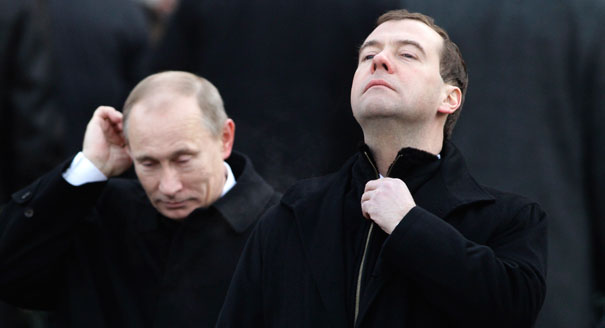
Russian President Dmitry Medvedev’s announcement of new initiatives for improving the investment climate in Russia and reducing corruption demonstrates his readiness to run for a second term.
Medvedev Up, Putin DownPresident Dmitry Medvedev effectively kicked off his re-election campaign by deepening a rift within the ruling tandem.
At a meeting on modernization in Magnitogorsk, Medvedev continued in the spirit of recent policy papers sharply critical of the political system by announcing that the investment climate in Russia is worsening and by introducing a range of concrete proposals for improving it. By doing so, Medvedev seized the initiative from Prime Minister Vladimir Putin and openly encroached upon his authority, particularly with the bold announcement that ministers who sit on the boards of directors of state-owned corporations will replaced with independent directors.
By announcing his initiatives and giving such tight deadlines for their fulfillment, Medvedev placed Putin in a difficult position. If the government manages to meet those demands, credit will go to Medvedev. If it fails, the Russian business community and the West will likely blame the government, not Medvedev. He also announced that costs for state tenders would be cut by 15 percent while retaining the overall volume of orders — a clear attempt to address the problem of corruption in state tenders, which Kremlin control department head Konstantin Chuichenko said totals about 1 trillion rubles ($35 billion) each year.
Of course, Putin could simply ignore Medvedev’s statements, but that would amount to the dissolution of the tandem long before next year’s presidential election, which would hardly be in Putin’s interests.
In comparison, Putin’s recent actions appear far less convincing. These include Putin’s statement to the Presidium that the 2008 decision to substantially increase the tax burden on business was justified and his meaningless meeting with the leaders of the team that developed the Strategy 2020 document on the day before Medvedev publicized his initiatives.
Much worse, however, was Putin’s claims that he was unaware of a separate exclusivity agreement between AAR and TNK-BP when he blessed the $7.8 billion share swap between BP and Rosneft with so much fanfare in January. This makes Putin look bad and creates the impression that he is making poor and hasty decisions.
Medvedev’s initiatives have a distinctly electoral character. The main one is streamlining the rules regulating business, effective in 2012. By offering what amounts to a contract to those businesses, Medvedev is effectively launching his re-election bid. The fact that the proposals carry strict time deadlines and that Medvedev’s economic adviser Arkady Dvorkovich has said that progress on the initiatives will be discussed at the International Economic Forum to be held in St. Petersburg in June only underscore that intention.
In a single stroke, Medvedev not only tossed out a bone to his potential electorate but deprived Putin of the opportunity to campaign as a modernizer in deeds, not only in words. Medvedev is thereby demonstrating his desire and readiness to run for a second presidential term. At the very least, should he step down, he will remain an independent political player who can not only talk but also act.
Carnegie India does not take institutional positions on public policy issues; the views represented herein are those of the author(s) and do not necessarily reflect the views of Carnegie, its staff, or its trustees.
On January 12, 2026, India's "workhorse," the Polar Satellite Launch Vehicle, experienced a consecutive mission failure for the first time in its history. This commentary explores the implications of this incident on India’s space sector and how India can effectively address issues stemming from the incident.
Connecting real-world AI use cases across sectors such as health, education, agriculture, and livelihoods can help policymakers, innovators, and institutions align around a shared goal. This article looks at a framework ensuring that AI works for everyone.
This piece examines India’s response to U.S. sanctions and tariffs, specifically assessing the immediate market consequences, such as alterations in import costs, and the broader strategic implications for India’s energy security and foreign policy orientation.
Pacific Island Countries are at a pivotal moment in their digital journeys. Across the region, there is growing recognition of digital transformation as a key driver of economic growth, resilience, and global connectivity.
This article looks at the progress of the Semiconductor Laboratory fab modernization plan based on publicly available documents, and potential learnings for future upgrades to government-owned fabs and India’s larger semiconductor ecosystem, especially regarding the use of refurbished equipment.