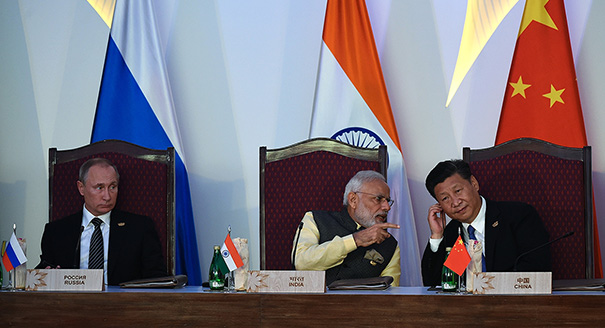
The 17th summit of the Shanghai Cooperation Organization (SCO) in Astana will see the block include India and Pakistan as formal members. With China and Russia as its founding partners, the SCO now includes major players in continental Eurasia. Will the SCO become an important forum for coordinating the great powers’ interests in Eurasia? Or will it collapse under the burden of mutual mistrust between member states? Carnegie’s scholars examine how Moscow, New Delhi, and Beijing are looking at the SCO now.
Alexander Gabuev
Chair of the Russia in the Asia-Pacific Program, Carnegie Moscow Center
From China’s standpoint, the enlargement of the SCO is not a desirable outcome but a compromise that Beijing can live with. From the moment of the SCO’s foundation, Beijing has viewed the organization as a first testing ground for promoting China’s interests through a multilateral platform in which China was the strongest, but not the single strong player. The SCO was viewed as a first step toward a Sino-Russian condominium in Central Asia, in which Beijing and Moscow could create a regional order that would benefit both powers and could be accepted by the countries of the region. In order to get there, China was promoting the creation of the SCO’s free trade area (FTA) and a joint development bank.
However, Beijing soon discovered that Moscow was reluctant to embrace this vision. The Kremlin was worried that China would use the SCO FTA and the development bank to promote its own agenda and to buy influence in Central Asia at Russia’s expense. Having exhausted the SCO track, China has started to engage Central Asian countries on a bilateral basis without any checks from Moscow, and soon learned that this approach has plenty of advantages. In addition, in 2013–2014 Beijing started to create China-centered multilateral institutions like the Asian Infrastructure Investment Bank (AIIB) and broad initiatives like the Belt and Road, which don’t have a regional focus but include Central Asia, so the SCO as a tool grew increasingly irrelevant for China’s strategy.
That’s why Beijing has wisely decided that resisting Russian pressure to include India into the organization has no point, and has finally agreed to SCO enlargement on the condition that Pakistan, its major partner in South Asia, will be on board too. The SCO headquarters are located in Beijing, and the organization has Shanghai in its name—it’s a big enough symbolic trophy to keep China pleased.
Paul T. Haenle
Director of the Carnegie–Tsinghua Center for Global Policy
Chinese President Xi Jinping will attend the 17th annual Shanghai Cooperation Organization summit in anticipation of China’s chairmanship of the security organization next year. Following China’s convening of the G20 summit last September, the Belt and Road Forum in May, and the upcoming BRICS summit in the fall, China’s chairmanship of the SCO in 2018 will mark the next in a series of important opportunities for Xi Jinping to promote China’s reputation as a leader on the global stage. As the United States shifts away from multilateralism, China is eager to take a more active role in international institutions and global governance reform. The SCO, which overlaps with many of the key areas of the Belt and Road Initiative (BRI)—particularly now that Pakistan is a member—could serve as a security complement to the ambitious economic-focused BRI. But just as the BRI is leading China to become more entangled in regional geopolitical security challenges, the SCO’s two new members, India and Pakistan, will also complicate the organization’s cohesion and ability to reach consensus.
C. Raja Mohan
Director of Carnegie India
The current flux in Eurasian geopolitics limits New Delhi’s prospects in the Shanghai Cooperation Organization and creates new problems for India. Among the reasons for the Indian interest in joining the SCO were the fear of the unipolar moment after the collapse of the Soviet Union and the desire to reconnect with the historically close inner Asian spaces. The quest for multipolarity saw India draw closer to Moscow and Beijing in shaping the regional environment. Two decades later, though, the rise of China, the deepening strategic partnership between Moscow and Beijing, and a transformed India-United States relationship have fundamentally altered the context of India’s interest in the SCO. China’s rise has begun to constrict India’s room for maneuver in the subcontinent, Asia, and the Indian Ocean. Unlike in the past, Moscow may not be willing to help New Delhi balance Beijing. Becoming a full member of the SCO does not really solve India’s most important strategic problem—the assertion of China’s power.
Prime Minister Narendra Modi, however, sees the utility of the SCO in dealing with two of India’s immediate national priorities—counterterrorism and connectivity. Here again India is likely to be disappointed. The sources of terrorism in India lie in Pakistan, and the SCO is unlikely to be of much assistance in addressing it, given the all-weather friendship of Pakistan’s armed forces with Beijing and its new outreach to Moscow. Rather than assist India on counterterrorism, the SCO could become a pressure point on India to negotiate with Pakistan on the Kashmir question. On connectivity, too, the SCO is unlikely to be of much help. What limits India’s connectivity with inner Asia is Pakistan’s reluctance to open its territory for overland transit and normalize trade relations with India. New Delhi’s SCO pickings, therefore, are likely to be meagre. Worse still, New Delhi might also have to fend off new pressures from Beijing and Moscow, which might find it convenient to see the question of South Asian terrorism being linked to the Kashmir dispute.
Dmitri Trenin
Director of the Carnegie Moscow Center
Enlarging the Shanghai Cooperation Organization to include India and Pakistan makes sense for Russia as it seeks to position itself in the geopolitical context of Greater Eurasia. Moscow’s strategic goal is to embed China in a web of friendly arrangements and thus to alleviate Beijing’s propensity to act unilaterally. With India as a full member of the SCO, there will be three great powers in the organization, diluting China’s dominance in the group.
The entry of Pakistan serves another Russian purpose: expanding SCO membership to include all players in continental Asia, as well as providing better regional cooperation on Afghanistan. Iran is another candidate favored by Moscow, although its accession can only happen when the UN Security Council sanctions imposed on Tehran are fully lifted. For Russia, accomplished diplomacy and usable military capabilities are a comparative advantage, partially compensating for its relative economic weakness. Moscow’s recent actions in Syria and the Middle East testify to that.
The Shanghai group has been enlarged before, when Uzbekistan was admitted to it in 2001. The present enlargement, however, is on a totally different scale and fraught with many serious issues, including the rivalry between India and China and the continuing enmity between India and Pakistan. Thus, it represents a major challenge to Russian diplomacy. If Moscow rises to the occasion, it can create a useful platform for managing international order across Greater Eurasia. If it fails to do so, the SCO will become dysfunctional, with the rivalries and enmities on the continent running unchecked.