In Russia, unusually, officials have blamed their own nationals for the spread of the new coronavirus.
“Many who went to [the French ski resort of] Courchevel brought back a suitcase of viruses back with them,” Moscow Mayor Sergei Sobyanin said right at the start of the epidemic.
On March 25, President Vladimir Putin announced a “non-working week” aimed at slowing the spread of the virus. Many businesses were forced to stop production, though the state did not compensate them in any way for this enforced shutdown. The unpopular decision was blamed on tourists for gallivanting around the world at the height of a pandemic and bringing it back to Russia.
In his address to the nation, Putin spoke evasively of “non-working days” rather than a lockdown or quarantine measures, which conveniently created an excuse to unleash a new wave of accusations. Soon, people having picnics and barbecues were being blamed for the subsequent introduction of a strict lockdown in Moscow and other regions.
These accusations clearly had a social subtext. The tourists returning from Italy and Courchevel were wealthy Russians and hipsters who allegedly, in pursuit of pleasure, were prepared to risk the lives of their less affluent and more patriotic fellow citizens. The reckless barbecuers, in contrast, were simple folk incapable of understanding the severity of the situation and the importance of the recommendations to stay at home.
A dividing line was also drawn between Moscow and the regions. Hotels around the country closed almost as soon as the “non-working week” was announced, but that didn't stop many people from believing that people from the capital were flocking to the regions and bringing the virus with them. People in Kostroma had the idea of burning an “effigy of a Muscovite,” while in Ryazan, residents petitioned the governor to close the region’s borders to people from the capital.
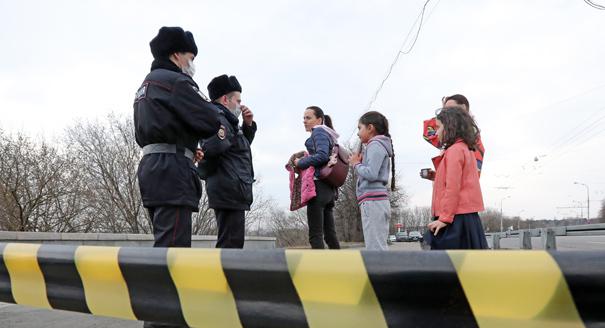
In tactical terms, the authorities have won, but as a result they have obtained not just social distancing, but social alienation. Different parts of Russian society blame each other. Those who supported strict social isolation weren’t only outraged by the barbecuers, but also by anyone doing sport, as well as parents out with their children, to the point where people informed the police. Those who opposed the lockdown were furious with its supporters on the grounds that it was destroying the economy. Meanwhile, the state stayed out of it, and looked for new scapegoats.
The state’s response to complaints that it is not doing enough to support business was to drive a new wedge: officials and state media have started suggesting that business dealings are often murky, and therefore don’t deserve support. The search for guilty parties has resulted in Russian society viewing lockdown measures not as a medical necessity, but as punishment, and an unfair one at that: for other people’s transgressions.
In its quest for short-term tactical advantages, the Russian leadership is destroying something it spent years building up. Previously, the Kremlin feared a schism in society, and only singled out tiny groups of alleged blasphemers and traitors. That aside, the state tried to paper over the cracks by suppressing ethnic issues and regional patriotism. It built a loyal pro-Putin majority in which everyone was essentially the same and in agreement with everyone else and with the state on matters of principle.
Right now, the state itself is shattering that majority into minorities pitted against one another. Each of those groups would like the authorities to support it and punish its opponent, but for the state, choosing one group means losing the support of the other.
The consequences of this policy are already becoming clear. When Putin announced the end of the “non-working days” on May 11, everyone was unhappy. Some feared that the lockdown was being lifted too early, when the number of coronavirus cases was still growing rapidly. Others questioned the point of the lockdown, if it could be lifted at the height of the outbreak. It’s not surprising that Putin’s approval rating had reached a new record low even before May 11.
Now the presidential administration is faced with the difficult task of remolding a loyal majority that will support the Kremlin’s plans for constitutional reform—including changing the law to allow Putin to run for the presidency again in 2024—during a nationwide vote on the issue. The previous unity was formed during a time of economic growth and high ratings. The situation now is quite different. Financial handouts won’t be enough to patch up the tears: there isn’t enough money for everyone, and offering support to some groups over others could deepen the divisions.
Worse still, the mood of anger against the authorities is proving to be a more effective unifying factor. The sharp decline in the economy, the selective nature of compensation and problems obtaining it, and the inconsistent and illogical introduction and then lifting of lockdown measures could all help to unite the most diverse social groups in their unhappiness.
The remaining fragments of the former pro-Putin majority don’t correspond to the parts used to assemble that majority twenty years ago. The jigsaw puzzle of Russian society could be put back together by opponents of the current regime, but society has apparently forgotten how to come together on its own. Even the Kremlin’s latest big project—the merger of the Arkhangelsk and Nenets regions, the first such merger in twelve years—is being carried out by pitting residents of those regions against each other. Each region is being led to expect a rosy future at the expense of its neighbor: Arkhangelsk is being promised revenues from Nenets oil, while the Nenets regions has been told that the Arkhangelsk budget will support it while oil prices are low.