
• Research
  • About
  • Experts
Carnegie India logoCarnegie lettermark logo
Technology
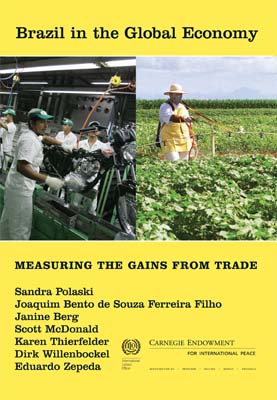
Brazil in the Global Economy: Measuring the Gains From Trade
Report

Brazil in the Global Economy: Measuring the Gains From Trade

Despite holding a leading position in world trade negotiations, Brazil will benefit little from increased trade. Policy makers face acute challenges as the country struggles to generate sufficient employment and improve labor incomes.

Link Copied
By Ms. Sandra Polaski, Joaquim Bento de Souza Ferreir, Janine Berg, Scott McDonald, Karen Thierfelder, Dirk Willenbockel, Eduardo Zepeda
Published on Mar 31, 2009

Additional Links

Full TextTexto Integral

The Brazilian economy has experienced sustained growth since 2000, after several turbulent decades. The country’s engagement with the global economy has played a largely positive, if secondary, role and Brazil has assumed a leading position in world trade negotiations. At the same time, the country has struggled to generate sufficient employment and improve labor incomes. Unemployment hovers at about 8 percent, and of those who work, slightly more than half do so informally. Average earnings today are lower than in the mid-1990s.

Brazilian policy makers face complicated challenges as they try to grow the economy in ways that will generate better livelihoods and incomes. The current global economic downturn is likely to make these tasks even more difficult. The purpose of this study is to contribute to the knowledge base upon which the Brazilian government and public, as well as the international community, evaluate the policy choices the country faces in the realm of trade. It employs computable general equilibrium models of the global and Brazilian economies to simulate a range of possible trade agreements, and explores the effects of these changes on the Brazilian economy, including its sectors, workforce, and households.

Overall, this study shows that the impact of increased trade on the Brazilian economy will be very small, even from a new global agreement at the World Trade Organization or from a very ambitious free trade pact with the largest developing countries. In addition, Brazil will expose its economy to stronger effects from other global policy shocks, such as world price volatility, as it opens its markets. After a careful analysis of the benefits and costs of trade liberalization and specific trade policy choices, increased global economic engagement may still be seen as beneficial for the Brazilian economy. However, it is important in policy debates that the nature and costs of structural adjustment be taken into account and that the pattern of trade achieved serves the country’s long-term development goals.

Authors

Ms. Sandra Polaski
Former Senior Associate, Director, Trade, Equity and Development Program
Sandra Polaski
Joaquim Bento de Souza Ferreir
Janine Berg
Scott McDonald
Karen Thierfelder
Dirk Willenbockel
Eduardo Zepeda
Former Senior Associate, Trade, Equity and Development Program
Eduardo Zepeda
North AmericaSouth AmericaEconomy

Carnegie India does not take institutional positions on public policy issues; the views represented herein are those of the author(s) and do not necessarily reflect the views of Carnegie, its staff, or its trustees.

More Work from Carnegie India

  • Commentary
    The Impact of U.S. Sanctions and Tariffs on India’s Russian Oil Imports

    This piece examines India’s response to U.S. sanctions and tariffs, specifically assessing the immediate market consequences, such as alterations in import costs, and the broader strategic implications for India’s energy security and foreign policy orientation.

      Vrinda Sahai
  • Paper
    India-China Economic Ties: Determinants and Possibilities

    This paper examines the evolution of India-China economic ties from 2005 to 2025. It explores the impact of global events, bilateral political ties, and domestic policies on distinct spheres of the economic relationship.

      Santosh Pai

  • Commentary
    TRUST and Tariffs

    The India-U.S. relationship currently appears buffeted between three “Ts”—TRUST, Tariffs, and Trump.

      Arun K. Singh

  • Article
    Can Geopolitical Alignment Seal the India-EU FTA?

    This article argues that the geopolitical circumstances have never been more conducive, not merely for the early conclusion of the free trade agreement (FTA) between India and the EU, but also for crafting a substantive and comprehensive strategic partnership.

      Mohan Kumar

  • Source: iStock
    Commentary
    What’s Next for U.S. AI Policy?

    This commentary explores the likely actions of the Trump administration and driving forces on issues of deregulation, the United States’ leadership in AI, national security, and global engagements on AI safety.

      Shatakratu Sahu, Amlan Mohanty

Get more news and analysis from
Carnegie India
Carnegie India logo, white
Unit C-4, 5, 6, EdenparkShaheed Jeet Singh MargNew Delhi – 110016, IndiaPhone: 011-40078687
  • Research
  • About
  • Experts
  • Projects
  • Events
  • Contact
  • Careers
  • Privacy
  • For Media
Get more news and analysis from
Carnegie India
© 2026 Carnegie Endowment for International Peace. All rights reserved.