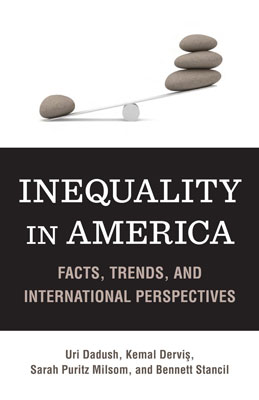
Inequality in America: Facts, Trends and International Perspectives
Tackling the worst effects of inequality requires increased investment in crucial public goods, including education, a more progressive and simplified tax system, and increased international cooperation to avoid a race to the bottom.
Link Copied
By Uri Dadush, Kemal Dervis, Sarah Puritz Milsom, Bennett Stancil
Published on Jul 10, 2012
Source: Brookings Institution Press, 2012
A bedrock American principle is the idea that all individuals should have the opportunity to succeed on the basis of their own effort, skill, and ingenuity.—Federal Reserve Chairman Ben Bernanke
Income inequality has been on the rise since the late 1970s, but the economic and financial crisis of 2008 instigated an unemployment epidemic that dramatically compounded this problem in the United States and catapulted the issue to the center of debate. There is wide agreement across the political spectrum that high inequality is contributing to undesirable circumstances such as stagnant household income, rising poverty rates, and increased borrowing and debt, though there is much less agreement on remedies.
Inequality in America provides a snapshot of the issues posed by the growing concentrations of income, focusing on the United States but drawing on international comparisons to help set the context. The authors examine the economic, technological, and political drivers of inequality and identify worrying trends associated with its rise. They demonstrate how specific factors have exacerbated income inequality, including technological change, international trade, changes in labor market participation, and the increasing role of the financial sector. Their clear and concise exposition makes the issues surrounding income distribution accessible to a wider public.
As they write in the conclusion: “We have argued that tackling the worst effects of inequality and re-establishing a measure of equal opportunity requires increased investment in crucial public goods: first, education; second, a more progressive and simplified tax system; and third, increased international cooperation to avoid a race to the bottom. Education, tax, and other such policies are pursued by other highperforming advanced countries and can be shaped for the United States in a way that is fully consistent with an efficient and competitive American economy.”
Former Senior Associate, International Economics Program
Dadush was a senior associate at the Carnegie Endowment for International Peace. He focuses on trends in the global economy and is currently tracking developments in the eurozone crisis.
Kemal Dervis
Sarah Puritz Milsom
Bennett Stancil
Former Research Assistant, International Economics Program
Carnegie India does not take institutional positions on public policy issues; the views represented herein are those of the author(s) and do not necessarily reflect the views of Carnegie, its staff, or its trustees.
On the last day of the India AI Impact Summit, India signed Pax Silica, a U.S.-led declaration seemingly focused on semiconductors. While India’s accession to the same was not entirely unforeseen, becoming a signatory nation this quickly was not on the cards either.
This piece examines India’s response to U.S. sanctions and tariffs, specifically assessing the immediate market consequences, such as alterations in import costs, and the broader strategic implications for India’s energy security and foreign policy orientation.
This paper examines the evolution of India-China economic ties from 2005 to 2025. It explores the impact of global events, bilateral political ties, and domestic policies on distinct spheres of the economic relationship.
On July 30, 2025, the United States announced 25 percent tariffs on Indian goods. While diplomatic tensions simmered on the trade front, a cosmic calm prevailed at the Sriharikota launch range. Officials from NASA and ISRO were preparing to launch an engineering marvel into space—the NASA-ISRO Synthetic Aperture Radar (NISAR), marking a significant milestone in the India-U.S. bilateral partnership.