

{
  "authors": [
    "Kevin Rudd",
    "Douglas H. Paal"
  ],
  "type": "event",
  "centerAffiliationAll": "dc",
  "centers": [
    "Carnegie Endowment for International Peace"
  ],
  "collections": [],
  "englishNewsletterAll": "asia",
  "nonEnglishNewsletterAll": "",
  "primaryCenter": "Carnegie Endowment for International Peace",
  "programAffiliation": "AP",
  "programs": [
    "Asia"
  ],
  "projects": [],
  "regions": [
    "North America",
    "United States",
    "East Asia",
    "China",
    "Southeast Asia"
  ],
  "topics": [
    "Economy",
    "Trade",
    "Security",
    "Military",
    "Foreign Policy"
  ]
}
A New Strategic Roadmap for Sino-American Relations
Tue, April 2nd, 2013
Washington, DC
China’s 12th National People’s Congress has concluded and Xi Jinping assumed the presidency of a country that is at a domestic crossroads and is simultaneously a rising international power. Competing narratives speculate that Xi could be a more militarist or nationalist leader, a leader facing tremendous demands for both renewed economic and political reform, and someone who is a product of the system and ultimately doomed to protect it.
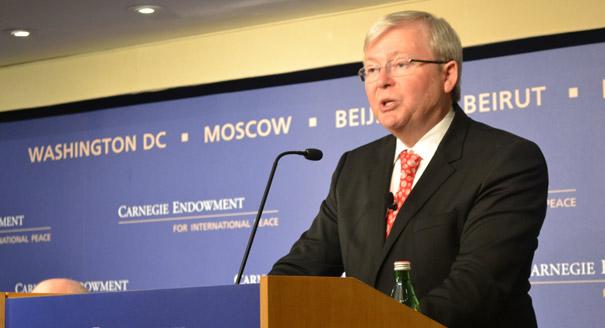
Former Australian prime minister Kevin Rudd believes this is a moment when the United States should seize the initiative to steer the narrative in a productive direction. Rudd joined Carnegie’s Douglas H. Paal to offer an outlook on the future of the Asia-Pacific region, and provide a new strategic roadmap for Sino-American relations.
Carnegie India does not take institutional positions on public policy issues; the views represented herein are those of the author(s) and do not necessarily reflect the views of Carnegie, its staff, or its trustees.
Event Speakers
Kevin Rudd
Douglas H. Paal
Distinguished Fellow, Asia Program

Paal previously served as vice chairman of JPMorgan Chase International and as unofficial U.S. representative to Taiwan as director of the American Institute in Taiwan.