

{
  "authors": [
    "Judy Dempsey",
    "Caroline de Gruyter",
    "Kadri Gürsel",
    "Stefan Lehne",
    "Milan Nič"
  ],
  "type": "event",
  "centerAffiliationAll": "",
  "centers": [
    "Carnegie Endowment for International Peace",
    "Carnegie Europe"
  ],
  "collections": [
    "EU Integration and Enlargement"
  ],
  "englishNewsletterAll": "",
  "nonEnglishNewsletterAll": "",
  "primaryCenter": "Carnegie Europe",
  "programAffiliation": "",
  "programs": [],
  "projects": [],
  "regions": [
    "Middle East",
    "Europe"
  ],
  "topics": [
    "EU",
    "Migration"
  ]
}
Migrants vs. Natives and the Death of Europe’s Liberal, Secular Consensus
Tue, June 14th, 2016
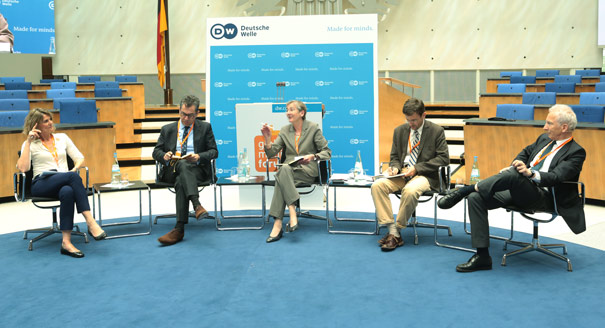
Deutsche Welle Global Media Forum, Bonn
Relentless scenes of desperate migrants gambling their lives in the hope of making it to Europe have become so commonplace that the initial outpouring of compassion toward refugees and the worst humanitarian crisis of our time has turned into outright ambivalence. This vast exodus of people arriving to Europe, most from Syria, has tested the union’s moral ground to the limits.
What could have been a collective triumph for the EU has now become a collective failure: Europe has turned inwards. One after the other, European member states are caving to growing public sentiment that "enough is enough." Politicians eager to exploit a narrative of fear and terrorism have found vindication—sadly, not without some merit. Yet the flow of desperate souls fleeing war-torn countries bordering the EU and beyond will not abate. Whatever stopgap measures that member states devise—be it a disastrous attempt at equitably distributing incoming migrants in European countries, or paying countries like Turkey to continue absorbing an ever-increasing number migrants—this crisis will rattle Europe’s foundations to the core.
What is at stake goes to the very heart of what it means to be European: a community of shared values, moral universalism, and liberal and secular consensus. The spillover effects of this massive displacement of people are testing the EU’s convictions and capacities at home and in third countries on issues as diverse and complex as people and arms smuggling to countering violent extremism and discrimination. With so much on the line, what are the possible scenarios that could play out for Europe in the next months and years to come? What are the different perspectives driving the debate—and the policy response—that must be taken into account?
Video
Podcast
Photos

Judy Dempsey
Judy Dempsey is a nonresident senior associate at Carnegie Europe and editor-in-chief of the Strategic Europe blog.
Caroline de Gruyter
Caroline de Gruyter is the European affairs correspondent at NRC Handelsblad.
Kadri Gürsel
Kadri Gürsel is a journalist at Al-Monitor and Diken and the chair of the International Press Institute Turkish National Committee.
Stefan Lehne
Stefan Lehne is a visiting scholar at Carnegie Europe.
Milan Nič
Milan Nič is the research director at the GLOBSEC Policy Institute.
Carnegie India does not take institutional positions on public policy issues; the views represented herein are those of the author(s) and do not necessarily reflect the views of Carnegie, its staff, or its trustees.
Event Speakers
Nonresident Senior Fellow, Carnegie Europe

Judy Dempsey is a nonresident senior fellow at Carnegie Europe
Caroline de Gruyter
Caroline de Gruyter is the European affairs correspondent for the Dutch newspaper NRC Handelsblad.
Kadri Gürsel
Senior Fellow, Carnegie Europe

Stefan Lehne is a senior fellow at Carnegie Europe in Brussels, where his research focuses on the post–Lisbon Treaty development of the European Union’s foreign policy, with a specific focus on relations between the EU and member states.
Milan Nič
Central European Policy Institute