

Article
This piece argues that India’s central challenge is not managing a single flashpoint but resolving the underlying tension between expansion and institutional coherency of the BRICS grouping.
Vrinda Sahai
{
  "authors": [
    "Thomas Graham, Jr."
  ],
  "type": "testimony",
  "centerAffiliationAll": "dc",
  "centers": [
    "Carnegie Endowment for International Peace"
  ],
  "collections": [],
  "englishNewsletterAll": "ctw",
  "nonEnglishNewsletterAll": "",
  "primaryCenter": "Carnegie Endowment for International Peace",
  "programAffiliation": "russia",
  "programs": [
    "Russia and Eurasia"
  ],
  "projects": [],
  "regions": [
    "Caucasus",
    "Russia"
  ],
  "topics": [
    "Trade"
  ]
}
REQUIRED IMAGE
Source: Carnegie
Jamestown Foundation Conference, Washington, DC, June 9, 1999
For the past decade, reform, economic and political, has dominated discussion first of the Soviet Union and then of Russia. Russian President Yeltsin and his successive Prime Ministers have stressed their commitment to reform; Western governments, particularly the Clinton Administration, have made assisting Russia's transition to democracy and a market economy the centerpiece of their policy. Through all the zigs and zags of Russian domestic politics and economic performance, the Administration has - until quite recently - assured us that Russia was making steady, albeit at times slow, progress in economic reform and democratization. In September 1997, Deputy Secretary of State Strobe Talbott went so far as to declare that Russia was at "the end of the beginning" of its journey toward becoming a "normal, modern state." "It may be," he said, "on the brink of a breakthrough."[1]
We all now know how off the mark that prediction was. The financial collapse of last August shattered all illusions about Russia's trajectory. It marked the failure of the West's policy of the past seven years, the end of the grand liberal project of rapidly transforming Russia into a normal market economy and democratic polity. Debate, both in Russia and the West, naturally turned to the question of what went wrong and who was to blame. And, in that guise, the question of reform has continued to frame discussion of Russia.
But August should have raised another issue, one that, well into the next century, will have greater consequences for U.S. strategic interests than the question of reform: the fate of Russian power. Although talk of Russian weakness is now commonplace, little thought has been given to the consequences of long-term weakness. But arguably we are witnessing a geo-political and geo-economic shift of historic dimensions, one in which Russia will become less and less an actor in world affairs, while running the risk of becoming an object of competition among more advanced and dynamic powers. This shift, if it indeed occurs, will have far-reaching consequences for all the regions bordering on Russia and thereby for our global strategic interests. It is only prudent that we begin to contemplate a world without Russia.
Many will take exception to this notion. The prevailing opinion in the West is that Russia, as former Russian Foreign Minister Kozyrev once put it, is doomed, by virtue of its size, geographic location, economic potential, and cultural legacy, to be a Great Power. And the only question is whether that power will be wielded by an anti-Western, authoritarian regime or a pro-Western, democratic one.
But a look at Russia over the past quarter of a century reveals a country in secular decline, while analysis of the present underscores just how formidable, prolonged, and uncertain a project rebuilding Russia will be, even under the most favorable domestic and international circumstances. Those circumstances are, however, rapidly changing in ways that do not augur well for any early improvement in Russia's international standing and prestige.
Secular Decline
To begin with, secular decline. In the intense focus on the travails of post-Soviet Russia, there is a tendency to forget that Russia's decline began at least a quarter of a century ago, ironically at the very moment the Soviet Union had attended nuclear parity with the United States and billions of petrodollars had begun to flow into the country as the result of global energy crises. The Brezhnev era was at best a "period of stagnation," as Gorbachev later declared. The problems, if not their full gravity, were well-known to both Western and Soviet analysts at the time.[2]
The reasons for the decline lay both in the fundamental flaws of Soviet political and economic structures and in specific, misguided policies. As we all know, the Soviet system proved incapable of dealing with the demands of the information-technological revolution, which was gathering momentum in the 1970's. Brutal coercion may have been capable of industrializing the Soviet Union in the 1930’s and repression may have been compatible with industrial growth thereafter, but they became counterproductive when progress came to depend on creativity, innovation, and initiative, as it did with the advent of the information age. The rigidities and incentive system of the Plan increased the risks and downsides of adopting new technologies. The closed nature of society retarded an appreciation of the depth of the Soviet Union's problems, the articulation of innovative solutions, and the diffusion of new technologies. And the rejection of "bourgeois" economics deprived the leadership of the tools, such as economic indicators, to measure the country's economic performance and the instruments, such as, monetary and fiscal policies, to halt or reverse the decline.
At the same time, the system bred corruption and disrespect for the law. A "shadow economy," or underground market, became essential to filling the gaps in the Plan and providing the consumer goods and services demanded by an increasingly urbanized and sophisticated population. But it also generated mafias and fed corruption at all levels.[3] As Martin Malia has written, "since this underground market was created by, and responded to, genuine social needs, not crass 'speculation,' it to some degree involved the whole population; thus everyone was criminalized in some measure, for everyone had to have a little 'racket' or 'deal' in order to survive. … So everyone was always guilty of something, and an indispensable activity was stigmatized and stunted."[4]
By the end of the Brezhnev era, the signs of decay were everywhere. CIA figures of that time showed the GDP growth rate had fallen from 5.1% in 1966-1970 to 2.3% in 1976-1980. Some Russian economists have suggested that the rates were actually 2 percentage points lower. Thus, it is likely that by the end of the Brezhnev period, GDP growth was negative.[5] Public health had deteriorated to such an extent that the leadership simply suppressed information on health conditions.[6] The leadership had grown corrupt and cynical, and the population apathetic.
In the face of widespread socio-economic decay, the Brezhnev leadership squandered scarce resources on a vast military buildup and foreign adventures rather than invest them in modernizing industry, rebuilding much-neglected industrial and agrarian infrastructure, or repairing a dilapidated health system. In the 1970's, the Soviet Union intervened in regional conflicts in Africa, the Middle East, and Central America. The imperial adventures eventually ended in tragedy in Afghanistan, where a misguided intervention led to a prolonged conflict and ultimate defeat. That, as much as anything else, raised profound doubts, both at home and abroad, about Moscow's military capabilities, strategic vision, and political will and judgment.
The external expansion and oil wealth - along with the United States' crisis of confidence in the aftermath of Vietnam and Watergate - masked the slow, steady erosion of Soviet power in the 1970's. Nevertheless, even then, the generation of Soviet leaders that would take over in the mid-1980's - Gorbachev, Ryzhkov, Ligachev, Yakovlev, Shevardnadze - recognized the pervasive rot and was determined to restore the country's vitality. In a major speech in December 1984 before he assumed power, Gorbachev argued that radical steps were necessary to ensure that the Soviet Union entered the next millennium "as a great and prosperous power." [7]
In the broadest terms, Gorbachev's reform effort contained three facets: Glasnost' was intended to invigorate Soviet ideology; perestroyka, to revitalize the economy; demokratizatsiya, to modernize the political system. In the end, however, they did not save the Soviet Union; they only accelerated its demise, each in its own way.
By the time of the putsch in August 1991, the country Gorbachev had set out to revive was in a shambles. That his effort ended in failure was almost foreordained, for revitalizing the Soviet system was an impossible task. Indeed, by 1988, Gorbachev himself and his advisors seemed to have realized that they would have to abandon the Soviet system in fact, if not in name, if the country was to enter the next century as a viable state; hence, the embrace of glasnost', perestroyka, and demokratizatsiya. These processes, however, weakened the state, undermined economic performance, and strengthened separatist and nationalist tendencies. All that threatened the country's unity, to which Gorbachev remained firmly committed. Thus, he faced a choice he did not want to make, between the reform necessary to maintain Soviet power and the Union threatened by that very reform. By refusing to choose, Gorbachev sealed his fate.
Yeltsin was prepared to make that choice, as we know, in favor of reform. His and his advisors' logic was simple. The necessary reform would never be undertaken if they tried to harmonize their program with the other, more conservative non-Russian republics. Yeltsin articulated that position in an address before the Russian legislature in October 1991:
Yeltsin and his advisors, however, did not have a detailed or well-conceived strategy for reforming Russia. The most thought went into the economic component, where the goal was to break the state monopoly over the economy, to privatize much of the country's economic assets, to monetize the economy, to integrate Russia into the global economy, and thereby to lay the basis for the emergence of a strong market economy. But even here much of the detail was lacking, as one of the Russian Government's foreign advisors of the time has written.[10]
As we all know, the past seven and a half years have been rocky, and the financial collapse of last August put an end to the grand liberal project of rapidly building a market economy and democratic society. A passionate debate has erupted over what went wrong and why, and who is to blame (less energy has been devoted to the other accursed question of Russian history, what is to be done?). But there can be no doubt that Yeltsin's policies have not produced the long-sought and long-promised recovery. Russia remains a country in decline.
At some level, we all appreciate the depth of changes in Russia's status. But some matters bear repetition, for they underscore how profound this loss has been and how devastating it has been to Russians' psyches.
To be sure, the nature of the decline, its pace, and its impact on the Russian people, both materially and psychologically, have changed over time. What began as the agony of a moribund system has transformed into the deterioration of a misguided or incomplete reform effort. The pace has quickened since the breakup of the Soviet Union, largely because tinkering with the system gave way to conscious dismantling of it without proper thought or sufficient energy being devoted to creating new institutions. And the impact has changed, in part because heightened expectations of the first years after the Soviet breakup have been far from fulfilled. The key point is, however, that Russia has been on the downward slope for a quarter of a century, the decline has accelerated since 1991, and the end is not in sight.
Fragmentation and Succession
The decline has fueled, and been fueled by, the fragmentation, erosion, and degeneration of state power, both political and economic, over the past dozen years. Fragmentation is a complex process, with multiple causes beyond socio-economic deterioration. In part, it has been the consequence of conscious policy decisions first by Gorbachev and then by Yeltsin to modernize the Russian economy and political system by dismantling the hypercentralized Soviet state. In part, it has been the result of global trends, especially in telecommunications and information technology, that have tended to diffuse power worldwide. And, in part, it has been the by-product of bitter inter-elite rivalries and governmental disarray in Moscow that have eroded the state's capacity to govern effectively and allowed ambitious regional leaders to seize greater power locally and aggressive businessmen to appropriate vast assets across Russia.
As a result, Moscow now has only a minimal capacity to mobilize - or extract - resources for national purposes, either at home or abroad. It no longer reliably wields power and authority, as it has traditionally, through the control of the institutions of coercion, the regulation of economic activity, and the ability to command the loyalty of or instill fear in the people.
Moscow does not fully control the institutions of coercion nominally subordinate to it. Military commanders are known to cut deals with regional and local governments in order to ensure themselves uninterrupted supplies of energy and provisions. Some military garrisons are supported with money from local entrepreneurs. Military officers and MVD and FSB officials routinely moonlight to earn extra income - or to cover for unpaid wages. As a result, the loyalty of the military and security forces to the central government - even of the elite units around Moscow - is dubious. This does not mean that they would carry out the will of local leaders - there is little evidence that they would - but rather that they would not necessarily defend the central government in a crisis.
Similarly, Moscow does not manage a reliable countrywide financial and monetary system. Last August the financial system finally collapsed, as a consequence of Moscow's inability to collect taxes and its effort to cover the budget deficit through foreign borrowing and the issuance of various domestic debt instruments that amounted to little more than a massive pyramid scheme.[17] The ruble remains the national currency, but the overwhelming majority of commercial transactions, up to 75 percent by some estimates, take place outside the monetized sector, in the form of barter or currency surrogates.[18]
Finally, for the first extended period in modern Russian history, the state is neither feared nor respected. The lack of fear is evident in the pervasive tax and draft evasion, as well as in such mundane matters as the widespread non-observance of traffic regulations. The lack of respect is evident in the general disregard for national holidays and monuments and the profound public distrust of high-ranking government officials and central government institutions, repeatedly recorded in public opinion polls.[19] Kremlin intrigue feeds cynicism about the state, while Yeltsin's deteriorating health, both physical and mental, reinforces pervasive doubts about the state’s strength and will.
Moscow's weakness is now generally recognized in the West, and much attention has been focused on regional governors and presidents and the leaders of major financial-industrial groups, or the so-called "oligarchs," as the real holders of power. This view, however, tends to exaggerate the role of these figures. Governors and presidents may be the most powerful men at the regional level, but their power is limited by local elites, much as Yeltsin's is constrained by national and regional elites. The mayors of administrative centers, especially if popularly elected, and the heads of major enterprises, particularly if they provide the bulk of funds to the regional budget, often act as effective counterweights to governors or presidents. The electoral cycle from September 1996 through February 1997 provided a graphic illustration of these limits: Incumbents won only twenty-four of fifty elections.[20] Similarly, the oligarchs have been facing growing competition from regional businessmen for well over a year. The financial meltdown of August and the ensuing economic turmoil only further undermined their positions outside Moscow and forced many to downsize their empires and some out of business.[21]
Thus, the weakening of power in Moscow, contrary to widespread impressions in both Russia and the West, has not created strong regions. Rather, the situation is better summed up as follows: "Weak center - weak regions." That is, the striking feature of the Russian political and economic system is the absence of concentrations of power anywhere in the country capable alone of controlling the situation or of creating a coalition for that purpose. In this sense, Russia has become "feudalized". [22]
The erosion of state power has been accelerated in recent years by an intense succession struggle, which will end at the earliest with the transfer of power to Yeltsin's successor. Analysts differ on when it began in earnest, but most would agree it was well underway by the time of the financial collapse last August. In fact, it commenced much earlier, in late 1995, when the Communists, after an impressive showing in the Duma elections, appeared on the fast track to victory in the presidential elections the following June.
There is no need to review Yeltsin's dramatic come-from-behind victory. Much has already been written on that score. [23] Suffice it to say, Yeltsin's reelection should have removed the issue of succession from the political agenda for two to three years. And it would have had it not been for his precarious health. We now know that Yeltsin suffered a life-threatening heart problem between rounds of the presidential elections. In the fall, he underwent quintuple coronary by-pass surgery. Since then, his absences from active politics have increased in both frequency and duration, despite repeated assurances from Kremlin spokesmen and doctors that nothing is seriously wrong with his health.
Yeltsin's health now lies at the heart of Russian politics, a source of great uncertainty that complicates the calculations of would-be successors and aspiring power brokers. According to the Constitution, should he leave office prematurely for any reason, the Prime Minister would serve as acting President for three months, during which elections would be held for a permanent successor. As a consequence, would-be successors have to be prepared to run at a moment's notice, while making preparations for elections in mid-2000, should Yeltsin serve out his term. In many instances, the exigencies of short- and long-term campaigns contradict one another. Many candidates, including Krasnoyarsk Governor Lebed and Moscow Mayor Luzhkov, have suffered at least tactical loses for "false starts" in the presidential campaign. Likewise, the power brokers face the problem of needing a candidate for both a sprint and a marathon. Often, however, that means backing - or wavering between - two or more candidates, whose interests do not necessarily overlap.
In addition, Yeltsin's dubious health turns the prime ministership into a central field of battle, with deleterious effects for the smooth functioning of the government. The possibility of patronage, command over an executive apparatus with lines into every region, and the chance that one will become acting president all make the Prime Minister a key figure in the succession drama. Since 1996, all prime ministers have been viewed as successors, including both Chernomyrdin and Primakov, who had obvious political weight, as well as Kiriyenko, however implausible that might seem in retrospect. The new prime minister, Sergey Stephashin, is already being viewed as a potential successor, particularly by people close to privatization architect and current RAO YeES chairman Chubays, who felt uncomfortable with the earlier field of candidates. To a large degree, the rapid turnover in prime ministers over the past year and a half is a reflection of the sharpening succession struggle.
The turnover is also a consequence of the political instincts and insecurities of Yeltsin, who insists that he will serve out his term and pass power to a successor who will preserve his legacy. There is more than concern about his legacy at work, however. As numerous commentators have noted, Yeltsin is profoundly jealous of his prerogatives as President and deeply resents any suggestion of a campaign to succeed him. This makes the job of the Prime Minister almost untenable. Because of Yeltsin's frailties, any prime minister is compelled to assume greater responsibility and authority, even to encroach on presidential prerogatives, if only to keep the government at a minimal level of efficiency and coherency and to represent Russia with dignity abroad. This inevitably enhances his attractiveness as a presidential candidate, which in turn raises the risk that Yeltsin will come to see him as a rival.
Assuming the responsibility without provoking Yeltsin's ire is a line no prime minister has been able to toe for long. Yeltsin fired both Chernomyrdin in March 1998 and Primakov more recently in large part because they appeared too presidential. And he did this with a seeming lack of concern for the consequences for Russia's development. Chernomyrdin was fired at just the moment that the country needed governmental stability and strong leadership to deal with the mounting pressures of a global financial crisis, which finally overtook Russia five months later. Likewise, Primakov was fired just as he was beginning to push through the Duma key legislation required by the much needed loan agreement with the IMF.
As has so often been the case in Russian history, power now takes precedence over policy. The uncertainties about succession - and its far-reaching consequences for concrete individuals, including the question of physical survival for some - only concentrates the focus on power. Not surprisingly, the victim is Russia, for no one is prepared to risk the tough, unpopular measures needed to address the country's deepening ills. This situation can change only with Yeltsin's departure.
The experience of the past twenty-five years has put Russia in an unenviable position. Secular decline leaves Moscow with fewer resources to bring to bear on the problems facing Russia. Fragmentation reduces its capacity to use those decreasing resources effectively. And the succession struggle saps its will to deploy them vigorously. What does this portend for Russia's future, both in the short, medium, and long runs? At a minimum, that rebuilding Russia is going to be longer and more arduous than many observers - and certainly Western governments - thought just a few years ago.
Short-Term Muddle or Worse?
In the short run, in the midst of a bitter succession struggle, the best possible outcome is muddling through. That was apparently Primakov's judgment when he was appointed Prime Minister last September. Although his critics accused him of lacking a long-term economic strategy - and Yeltsin himself gave that as one primary reason for dismissing him[24]- most observers give him credit for stabilizing a very difficult economic and political situation over the past winter. And in this he defied the doomsayers.
If the latter had been correct, Russia would already be stuck in a vicious hyperinflationary cycle, the economy would be in a free fall, and the dispossessed middle class would be protesting in the streets of Moscow and other major urban centers.[25] This has not happened, in large part because Primakov, Central Bank Chairman Gerashchenko, and First Deputy Prime Minister Maslyukov (who oversaw marcoeconomic policy) proved more adept at managing the politics and economics of a period of turmoil than most observers thought possible. Inflation is down to 2-3 percent a month, not the 40-50% some people were predicting. The ruble to dollar rate is about 25 to 1, not 100 to 1. The Government managed to negotiate a deal with the IMF, although it is not clear that it could have pushed the necessary legislation through the Duma to satisfy the IMF's conditions. And there are some indications that industry is recovering from the depths of last year's crisis as a devalued ruble has allowed it to increase exports and to fill the gaps left by the sharp drop in imports.[26]
To be sure, too much should not be read into this uptick in industrial production. Growth resulting from devaluation is short-term and not self-sustainable. Fundamental changes - including tax policy, commercial law, and law enforcement - are needed to achieve sustainable growth, and rapid movement in these areas is hardly likely before the presidential elections. And it should not be forgotten that devaluation not only buoyed industrial production, but also precipitated a sharp decrease in real incomes for the Russian people: Real per capita income is down 27% from last July.[27] Stepashin will do well if he can prevent the situation from deteriorating significantly from the one he inherited. He almost certainly will not launch any bold initiatives to accelerate "reform". In fact, the structure of his government and his public pronouncements suggest he is not planning any radical departures from Primakov's policies.
As a result, the outlook remains bleak, with another 4-5% decline in GDP likely this year. And conditions could turn much worse for reasons beyond Moscow's control (e.g., a resumption of decline in world commodity prices, a major industrial accident) or because of bad policy (Will the government continue to be able to resist pressure for greater monetary emissions to gain votes as the elections approach?). Even then the decline is unlikely to approach the doomsday scenarios of last fall.
If the economy muddles along, Russia will conduct its parliamentary and presidential elections under relatively stable conditions. Can these elections produce a governing coalition capable of drafting and implementing a coherent socio-economic program that addresses the country's pressing needs? The most that can be said this far in advance is that this possibility cannot be ruled out and that it probably has greater chances of occurring than most observers think. Why?
First, the strength and potential of the Communist Party have been greatly exaggerated. Their current prominence is something of a fluke, the result of the electoral law and radical divisions among their opponents that translated a 22% plurality in the party-list voting and a slightly higher rate of success in the single-mandate districts into control of over one-third of the Duma deputies. In addition, the mass media tend to portray the conflict between the Communists and the authorities (the President, Presidential Administration, and, to a lesser extent, the Government) as the essence of Russian politics, ignoring the vast segment of the political spectrum that supports neither side. That too exaggerates the Communists' influence. (Why the media builds up the Communist threat is another matter. The key media are tightly linked with the authorities: Russian Television, for example, is state owned; Russian Public Television is dominated by Berezovskiy, who has close ties to Yeltsin's daughter Tatyana Dyachenko, and NTV is owned by Gusinskiy, who also close to various administration and government officials. These media realize that the authorities are deeply unpopular. They likely believe, as they did in 1996, that only by polarizing society do they and their allies in government stand any chance of holding on to power. They want to run against the Communists precisely because they understand the Communists enjoy limited public support.)
For the past three years, the Communists have repeatedly demonstrated their inability or unwillingness to capitalize on the public's discontent or deteriorating socio-economic conditions. Tensions within the party are intensifying, and there is much discussion of the Communists running in three separate blocs in the next Duma elections. Thus, while they have a stable electorate - around one-quarter of the total - their internal divisions could split their vote and reduce their number of seats, much as happened to the democrats in the 1995 elections. Finally, the Communists have very little room to expand their base: Seventy-four years of communism thoroughly discredited them in the eyes of the most non-Communist voters. Much as was the case in 1995, the size of their faction in the next Duma will be a function not so much of their own skills as of the ability of their opponents to put personal ambitions aside and unite for electoral gain.
Second, the experience of 1995 and the developments of the past year will likely winnow down the major competitors for Duma seats and create broader electoral coalitions. In the democratic camp, those who have been associated with the ruinous policies of the past few years - for example, Chubays, Gaydar, and Nemtsov, leaders of Right Cause (Pravoye delo) - have little popular appeal, and the field has been abandoned to Yabloko. In the center, Chernomyrdin's Our Home is Russia is no longer a serious electoral force, despite its large Duma faction. Even a successful role in resolving the Kosovo crisis by Chernomyrdin is unlikely to revive its flagging fortunes because he remains closely associated with the failed socio-economic policies of the past. Luzhkov's Fatherland stands to pick up much of Chernomyrdin's losses, while gaining support in nationalist quarters. A recent poll gives Yabloko and Fatherland 15% and 13% of the vote, respectively, and the Communists 23%. Zhirinovskiy's party, at 5%, is the only other party that crosses the 5% threshold.[28] If these figures hold until the Duma elections, if Fatherland and Yabloko cooperate in the single-mandate districts as they have promised to, and if the Communists divide their vote - three big ifs - then together Luzhkov and Yavlinskiy could dominate the next Duma.
Third, the deputies elected in single-mandate districts will win because of local factors, not because of party affiliation. As before, they will tend to be non-ideological and pragmatic, in part because the voters themselves are looking for practical solutions to their problems.[29]
Fourth, the political elite as a whole has learned much during the last three to four years. That the Primakov Government did not pursue the ruinous policies many observers expected they would is compelling evidence that the elites understand how little room for maneuver they actually have if they want to retard further decline, let alone rebuild Russia. This increases the chances that the new deputies as a group, even those elected from party lists, will be more professional, more pragmatic, and less ideological than the current corps.
Last, unlike the 1996 presidential elections, the next ones are likely to be won by a pragmatic coalition builder rather than by an ideologue (Yeltsin's campaign in 1996 was framed as an ideological choice between the past and the future). The two ideologues in the race - Communist chairman Zyuganov and Yabloko leader Yavlinskiy - stand little chance of winning election because of their inability to move beyond their core constituencies toward the political center. Moreover, both appear loath to accept any responsibility for conditions in the country, preferring to criticize the government rather than play a constructive role in it.
Who that coalition builder will be is an open question. Primakov was a leading contender until he was sacked, and Lebed's star has faded as he gets bogged down in Krasnoyarsk intrigue. Luzhkov appears to be the front runner, although the Kremlin is certain to try to build Yeltsin loyalist Stepashin into a credible candidate. The odds would appear to be against the emergence of a new figure, but a year in Russia, as we know, is an eternity. It would be foolish to rule out the emergence of a dark horse.
Of course, Russian election polling remains a shaky enterprise this far in advance of elections, and much remains uncertain, from Yeltsin's health to the longevity of the Stepashin government to the probability of a Belarus-Russia union. Any number of unforeseen events could have a dramatic impact on the timing, conduct, and outcome of the elections, and even on the question of whether the elections are held: While unlikely, an extra-constitutional transfer of power - or retention of power by Yeltsin - cannot be ruled out categorically. A catastrophic deterioration in socio-economic conditions would almost certainly discredit the entire ruling elite, from anti-Western Communists and ultranationalists to pro-Western democrats, and clear the field for new, radical forces on both ends of the spectrum or a new charismatic leader. None of this - with the possible exception of Yeltsin's earlier departure - is likely to improve the chances of Russia achieving a sustainable recovery in the short-run. And Yeltsin's early departure would only if it put presidential before the Duma elections, thereby increasing the chances that the new president would have sufficiently long coattails to carry a dominant bloc of his allies into the new Duma.
As we focus on presidential and Duma elections, we should not forget the regional leaders, who form ex officio the Federation Council, the upper house of the Federal Assembly. They have great potential to shape the policies of the national government over the next several years. They are seeking to play a central role in the Duma elections: two regional electoral blocs have already formed - the Voice of Russia under Samara Governor Titov and All Russia under the tutelage of St. Petersburg Governor Yakovlev and Tatarstan President Shaymiyev; others may be on the way.[30] Whether they will work together to pursue common interests, whether they will work cooperatively to build an effective federation or seek to extract even greater powers from it, remains to be seen. But their actions will provide clues as to the direction of center-regional relations, which will be key to Russia's development over the medium term.
Concentrating Power
The question for the next decade is whether power will be concentrated and, if so, where. Broadly speaking, there are three possibilities: (1) power continues to erode, (2) power is reconcentrated in Moscow (or less likely in another single center), and (3) power is concentrated in several regions.
If power continues to dissipate, Russia is on its way to becoming a "failed state," that is, a dysfunctional state incapable of carrying out the core functions of a modern state, such as defense, preservation of domestic order, maintenance of a monetary system, tax collection and income redistribution, and provision of minimal social welfare standards. [31] This is not the most likely outcome, but bears careful consideration because of the challenges it would pose to the United States and the rest of the world (more below).
If power is concentrated in Moscow (or another single center), Russia would be repeating its historical pattern of the past four hundred years, in which recentralization follows a period of weakness, drift, and chaos. Historically, recentralization has been a response in large part to foreign threats; it has always enhanced the authoritarian elements in the political system. It is likely to be no different today. In a country as vast and diverse, geographically, economically, and culturally, as Russia, that is, in a country that appears naturally inclined toward a decentralized form of government, defense against foreign foes can be the only justification for a rigid, unitary state. And tighter political controls are the only way to enforce recentralization, particularly given regional leaders’ desire for more local autonomy.
Despite the erosion of state power and the obvious weakness of the central government, it is still probably true that there are more levers of hard and soft power in Moscow than anywhere else in Russia. Moscow remains the transportation and communications hub of the country: it is still the country's spiritual center. Economically, Moscow elites dominate the economy; by various estimates, up to 80% of all Russian capital is concentrated in Moscow.[32] It has been the disarray and disunity in Moscow that has fueled regional autonomy, and presumably more discipline there would shift the balance away from the regions. So for any would-be centralizer the first task would be to unite and discipline the Moscow elites and then turn to reasserting Moscow's prerogatives over the rest of the country. It would take several years - and perhaps much violence - to accomplish this task, but it is hardly an impossible mission. Of all the current presidential candidates, Luzhkov is the most likely to move in this direction.
Recentralization would ultimately create a more orderly Russia, but the cost is unclear. Much would depend on how great the resistance to recentralization would be. A civil war would obviously accelerate the country's decline in the short run, raise the risk of foreign intervention, and complicate the task of rebuilding Russia. Recentralization through the political process would reduce the costs, and it could initially yield a significant uptick in the economy.
Even under the most favorable circumstances, however, a recentralized Russia's recovery would be long and difficult. At a minimum, a more authoritarian state would likely allocate greater resources to military and security purposes, a step that would reduce urgently needed investment in basic economic infrastructure and new production. That in turn would slow the pace of recovery, but it would not preclude it. In addition, a recentralized, more authoritarian state might choose to interfere more aggressively in economic decision-making and control more strictly ties with the outside world - as past Russian governments have. Such steps would reduce the likelihood of a sustained recovery and steady modernization, primarily because Russia needs both money and technology from abroad to fuel both processes. On balance, recentralization is likely to produce only a slow, fitful recovery at best.
Unlike recentralization, the concentration of power in several regions outside Moscow would mark a radical break with Russian history, provide the opportunity for building a genuine federation, and probably offer the best hope for a sustained recovery. Such a development would be more in tune with the diversity of Russia. It could accelerate socio-economic recovery, as regions became laboratories of reform, seeking to build institutions and implement policies appropriate for their specific conditions. This process, to be sure, would produce winners and losers, but presumably the winner regions would have demonstration effect. Thus, over time, recovery would spread across Russia.
Strong regions would not inevitably raise the risks of Russia’s breaking up. What is noteworthy about Russia today is just how little separatist sentiment there is, outside of a few places in the North Caucasus. This situation is unlikely to change over time for several reasons. As polls consistently demonstrate, the overwhelming majority of the population and elites want to live in a Russian state. Common history, culture, and customs, a sense of a shared destiny, bind the country together even as economic links decay. With the break up of the Soviet Union, Russia became one of the most ethnically homogenous states in Europe (ethnic Russians compose over 80% of the population, compared to just over 50% of the Soviet population), and it is exceedingly rare for such states to disintegrate. Finally, most regional elites are seeking, not independence, but greater autonomy within a larger Russia and want Moscow to perform functions, such as defense, which they know they cannot perform adequately on their own.[33]
Moving in this direction will require increased cooperation among regional leaders. To date, however, competition, not cooperation, has marked these relations. Rather than develop solid ties with one another, regional leader have focused on their ties in Moscow. They prefer to spend their few days each month in Moscow as Federation Council members not on legislating but individually lobbying government officials and businessmen for funds for their regions. They have focused on signing bilateral treaties with Moscow delineating powers suited to their own situations, rather than on developing a uniform set of rules governing federal relations. This has led to the creation of what is commonly called an "asymmetric federation." This focus on relations with Moscow is understandable given that most regions depend on transfers from Moscow to meet their budgetary needs and that they must compete aggressively for the dwindling funds Moscow can allocate.[34] But it slows down the development of a stable, flexible federal system.
Attitudes could slowly be changing, however. In the current debate over the dismissal of the Procurator General, the Federation Council, in a rare show of unity and concern over its prerogatives, has defied Yeltsin by refusing to agree to the firing. In addition, as noted above, regional leaders are actively building electoral blocs for the upcoming Duma elections. Whether they will nominate one of their own for President is at this point unlikely - judging by press accounts, they appear to be looking for a patron among leading Moscow politicians - but, if they did, it would carry great symbolism for the country's future.[35] At the same time, if the next president indeed turns out to be a coalition builder, that would enhance the status of regional elites and encourage the building of a federal system.
Finally, building a federation from the bottom up could lead to the peaceful augmentation of Russia through the voluntary accension of regions from other former Soviet states. Like Russia, all these countries are suffering from weak government; all are experiencing their own forms of fragmentation and erosion of power. Should Russia appear to be rebuilding itself in a way that guarantees considerable local autonomy while promising the benefits of economies of scale, many regions might be tempted to join it, especially in Belarus, eastern Ukraine, and northern Kazakhstan, which enjoy considerable historical, ethnic, and cultural ties to Russia. Such a federation could build a prosperous domestic economy while creating the capability to project power into neighboring regions, especially the former Soviet republics.
Absolute or Relative Decline?
Over the long run, the question is whether Russia will return as a major power. In broad terms, Russia can move along one of two paths for the next generation: (1) continued decline, which a confrontational foreign policy would only accelerate, and (2) slow recovery, facilitated by the avoidance of major conflicts abroad, which is possible under both the recentralization and federalization scenarios described above.
Continued decline eventually leads to state failure. The severity of the consequences of such a development for the rest of the world would depend largely on how abrupt the decline was. The more abrupt, the more severe and destabilizing, because the world would have less time to prepare. But the nature of the problems would remain the same. State failure would greatly increase the risks of Russia's breaking up, of the erosion of any non-proliferation regimes, of catastrophic industrial and ecological accidents a la Chernobyl. It would destabilize neighboring regions, particularly the fragile states of the CIS, and it could encourage Great-Power intervention to stabilize the situation or to seize control of the country's rich resources. Moreover, a Russia in decline would be more apt to play the spoiler role in world affairs, simply as a way of demonstrating that it continued to matter, no matter what the long-term consequences for itself. Such a Russia, for example, is more likely to support rogue regimes around the world or to use its veto in the UN Security Council to thwart U.S. initiatives.
These matters have received widespread attention, in part because Russia's current weakness is already sufficient to raise concerns. But less public attention has been paid to the tectonic shift in geo-politics that such a development would entail and the consequences of that shift for how the United States manages its global policies.
Russian state failure would necessitate, for example, reappraising Russia's role in the United Nations. That institution can function effectively on security issues only when it roughly reflects the real balance of power, as it did during the Cold War. As Kosovo has recently demonstrated, the United States already has an incentive to circumvent the United Nations because of Russia's veto, coupled with a perception - at least before the conflict started - that Russia had little ability to influence the course of the conflict. A growing incongruity between Russia's voice and its power will only serve to undermine the United Nations in the long run, unless its voice is reduced to its potential to affect outcomes, that is, if it is deprived of its veto. But how can that be done, when Moscow would have a veto over whether to deprive it of its veto and surely would fight aggressively to hold on to one of its few remaining levers of global influence? In short, Russian weakness threatens the integrity of the United Nations.
There would also be considerable opportunity costs associated with Russian state failure, as Russia would be lost as a power that could help manage the rise of China in East Asia, stabilize Central Asia, and consolidate Europe and manage its emergence as a world power.
In Asia, a healthy Russia, along with Japan and South Korea, is critical to managing the rise of China. The collapse of Russia's power in its Far East would give China unimpeded access to the riches of that region or spark a destabilizing contest for them among China, Japan, South Korea, and the United States. Similarly, a strong Russia could help stabilize Central Asia and the Caspian Basin, in part by moderating Turkish, Iranian, Pakistani, and Chinese ambitions. Continued Russian withdrawal will encourage sharper competition, which will tend to retard the consolidation of independent states in these regions. Finally, Russia's economic deterioration has adverse consequences for these regions, where national economies are still closely tied to Russia.
Even in Europe, continued Russian decline creates significant complications. Russian power, we should remember, has been an important factor in building support for integration within Europe, and it could help moderate the national ambitions of key European states as integration deepens and moves eastward in the next century. In addition, a strong, healthy Russia would help temper the inevitable growth in competition between the United States and a new Europe, as the latter develops a more assertive economic, political, and foreign policy identity. A tripolar structure including the United States, Europe, and Russia is potentially more stable than a bipolar structure including only the United States and Europe.
So continued decline will present the West, and the United States in particular, with a host of short- and long-term problems. Recovery will surely reduce their severity, but it will not necessarily eliminate them. For what is all too often forgotten in discussions of Russia's recovery is the rest of the world. Even if Russian GDP began to grow at 3-4% per annum - and Russia is not there yet - Russia would still be falling behind. Indeed, what is striking is that, for the first time in the modern era, Russia (or more precisely the former Soviet Union) is totally encircled by more dynamic states and regions.
To the east, China is quickly rising as a major power with vast economic and military potential, demographic vitality, and unsatisfied regional ambitions. Despite the crisis of the past year, South Korea remains a robust society of tremendous economic and significant military potential. Japan is already an economic heavyweight and its current hardships pale in comparison to Russia’s. To the South, the Islamic world is in a state of ferment. Militant fundamentalism is a growing political force and threat to Moscow's influence in Central Asia and the Caucasus, as well as Muslim regions within Russia. To the west, European integration in all its dimensions is slowly proceeding, but largely without Russia. The growing economies of these surrounding areas will eventually translate into greater military power as well, overcoming whatever lead Russia might have at the moment.
As Russian leaders' repeated demands that they be treated as a Great Power demonstrate, Moscow is not going to accept its diminishing international status gracefully. This will be especially true if Russia begins to recover, but continues to fall behind the United States, Europe, and key Asian powers. The attention now focused on Aleksandr Gorchakov, Russia's Foreign Minister of the mid-nineteenth century, is indicative of Moscow's mood. Gorchakov is being lauded for a foreign-policy approach that seems well suited to Russia's current situation. Despite Russia's stunning defeat in the Crimean War and its deep domestic troubles, Gorchakov - or so the Moscow consensus portrays him - pursued an active, multipolar policy that both maintained Russia's prestige as a major European power and, more importantly, created a breathing space for it to rebuild internally.[36] In other words, acting like a Great Power created the conditions for Russia to rebuild the economic basis needed to back Great-Power pretensions.
Primakov, as Foreign and Prime Minister, took a Gorchakovian approach, with broad elite support. Consequently, that approach will assuredly survive his departure. It will undoubtedly slow the erosion of Russia's prestige in the short run - as Moscow's involvement in the diplomatic effort to resolve the Kosovo crisis illustrates. It could have some influence, although far from decisive, on the hierarchy of power center in the first half of the next century - the United States, Europe, China, and Japan. But it is unlikely to reverse Russia's relative decline or rebuild its Great-Power status. The exigencies of economic growth in the twenty-first century, simply put, will be radically different from those of the mid-nineteenth.
Despite Russia's evident strategic weakness, the prevailing opinion in the West is that it will reemerge as a Great Power in the not too distant future. Because of this belief, the West is willing to accord Russia a greater role in world affairs than any objective assessment of its current power and potential would warrant. Russia's enhanced participation in G-7 deliberations, although its economic and financial system falls far short of G-7 standards, and the West's earnest efforts to involve Russia in the resolution of the Kosovo crisis, although it has no demonstrated leverage over Serbian leader Milosevic, both underscore this paradox. Part of the reason for this deference lies in the afterglow of the Soviet Union's superpower status and the inevitable lag of perception behind objective change in the distribution of power. Another part lies in the West's fascination with Russia's ability throughout the modern era to compete militarily with the other Great Powers despite its socio-economic backwardness. Yet another part lies in the recognition that Russia has emerged from other periods of strategic weakness to reclaim its Great-Power status and that those who have underestimated its power - such as Napoleon in the nineteenth or Hitler in the twentieth century - have paid a heavy price. And a final part lies in the presumption that, even in its weakened state, Moscow is capable of doing great mischief if it so desires.
Russia, however, continues on its downward trek to middle-power status. It would already be there, if it were not for its nuclear arsenal. To be sure, even as a middle or lesser power, Russia will continue to draw the attention of the world's leading powers because of its strategic location, its vast natural resources, and its possession of weapons of mass destruction and the technology and material to build them. But, in a radical departure from the past three hundred years, Russia matters increasingly more for the nature of the territory it occupies than for Moscow's ability to mobilize the country's resources to project power abroad.
As we contemplate Russia's future, we should not forget one great lesson of history: Great Powers rise and fall; some states disappear forever. The slow decline of France and Britain and the collapse of the Austro-Hungarian and Ottoman Empires in this century are only recent examples. Russia's current decline may well be only temporary, but the rapid pace of change in the modern world and political, economic, and military trends in Europe and Asia at the very least raise the possibility that it may be permanent. And for that reason it behooves us to think through seriously and systematically the possibility of a world without Russia.
Notes:
1 Address at Stanford University, Stanford, California, September 19, 1997. Text available at http://www.state.gov/www/regions/nis/970919talbott.html.
2 See, for example, the articles in Soviet Economy in the 1980's: Problems and Prospects, Selected Papers submitted to the Joint Economic Committee, Congress of the United States, Parts 1 & 2, Washington, U.S. Government Printing Office, 1983.
3 On crime and corruption during the Soviet period, see Arkady Vaksberg, The Soviet Mafia, New York, St. Martin's Press, 1991. On the second economy, see Gregory Grossman, "The 'Second Economy' of the USSR," Problems of Communism 26 (September-October 1977), pp. 25-40.
4 Martin Malia, The Soviet Tragedy: A History of Socialism in Russia, 1917-1991,New York, The Free Press, 1994, p. 370.
5 See Ed A. Hewett, Reforming the Soviet Economy: Equality versus Efficiency, Washington, DC, The Brookings Institution, 1988, Table 2-3, p. 52; and Malia, The Soviet Tragedy, pp. 362-3.
6 Murray Feshbach, "Issues in Soviet Health Problems," in Soviet Economy in the 1980's, Part 2, pp. 204-207.
7 For a concise description of the state of the Soviet Union at the time of Gorbachev's rise to power, see Seweryn Bialer, The Soviet Paradox: External Expansion, Internal Decline, New York: Vintage Books, 1987, pp. 57-80. The Gorbachev quotation is from M.S. Gorbachev, Izbrannyye rechi i stat'i, Vol. II, Moscow: Politizdat, 1987, p. 86.
8 On Gorbachev's policies, see Archie Brown, The Gorbachev Factor, Paperback edition, Oxford: Oxford University Press, 1997, pp. 140-154, 160-211, and n3, p. 346.
9 Sovetskaya Rossiya, October 29, 1991.
10 See Anders Aslund, How Russia Became a Market Economy, Washington, The Brookings Institution, 1995, p. 64.
11 Data on GNP is drawn from the World Bank’s World Development Indicators, 1998, Table 1 (http://www.cdinet.com/DEC/wdi98/wdi/pdf/tab1_1.pdf); and A. Illarionov, ed., Rossiya v menyayushchemsya mire, Moscow: Institute of Economic Analysis, 1997 Tables 4.3.1 & 4.5.1.
12 See Vladimir Popov, "Vyvoz syr'ya - eto ne stydno," Ekspert 41 (November 2, 1998) (http://www.expert.ru).
13 See "''Ekspert-200'. Yezhegodnyy reyting krupneyshikh kompaniy Rossii," Ekspert 38 (October 12, 1998) at http://www.expert.ru.
14 For details on Russia's health crisis, see Nicholas Eberstadt, "Russia: Too Sick to Matter?" Policy Review 95 (June/July 1999) at http://www.policyreview.com/jun99/eberstadt.html. The quotation is found on p. 4 of the Internet version.
15 Alexei G. Arbatov, "Military Reform in Russia: Dilemmas, Obstacles, and Prospects," International Security 22/4 (Spring 1998), pp. 83-85.
16 See comments by then Minister of Defense Rodionov as reported in Krasnaya zvezda, February 25, 1997, p. 1 (FBIS-SOV-97-038, February 25, 1997) and Interfax, February 7, 1997 (FBIS-SOV-97-026, February 7, 1997).
17 Central Bank of the Russian Federation, "Osnovnyye napravleniya yedinoy gosudarstvennoy denezhno-kreditnoy politiki na 1999 god," Kommersant-Daily, December 8, 1998. See Internet text at http://www.mosinfo.ru:8080/news/kd/98/12/toc.html, pp 3-6.
18 According to a study of over 200 enterprises by the Interdepartmental Commission on Balances of the Federal Bankruptcy Service, nearly three-quarters of their earnings are in the form of barter or promissory notes, that is, they lie outside of the monetized sector. See "Zhizn’ vzaymy," Ekspert No. 8 (March 2, 1998), p. 13.
19 Yu.A. Levada, "Vlast' i obshchestvo v Rossii glazami obshchestvennogo mneniya," in N.A. Zorkaya, ed., "Vlast' i obshchestvo": Resul'taty reprezentativnogo oprosa zhiteley Rossii: Analiz i materialy, Moscow: The Moscow School for Political Studies, 1998, pp. 11-25.
20 See Michael McFaul and Nikolay Petrov, eds., Politicheskiy al'manakh Rossii 1997, Vol. 1, Moscow: Moscow Carnegie Center, 1998, pp. 117-118, 271, 279-281.
21 See Aleksandr Malyutin, "Oligarkhi na zimov'ye," Kommersant-Vlast' 20 (May 25, 1999) (http://www.mosinfo.ru:8080/news/kdv/99/05/toc.html).
22 See Samuel P. Huntington, Political Order in Changing Societies, Paperback edition, New Haven and London: Yale University Press, 1971, pp. 148-176.
23 For a concise analysis of the campaign, see Michael McFaul, Russia's 1996 Presidential Elections: The End of Polarized Politics, Stanford, CA: The Hoover Institution Press, 1997.
24 See text of Yeltsin's speech dismissing Primakov in "Boris Yel'tsin: Chto zhe proizoshlo?!" Kommersant-Daily, May 13, 1999, at http://www.mosinfo.ru8080/news/kd/99/05/toc.html.
25 See for example Anders Aslund's remarks at the Carnegie Endowment for International Peace, Panel Discussion on "Russia in Turmoil.," Washington, DC, October 1, 1998. Transcript can be found at http://www.ceip.org/programs/ruseuras/turmoil.htm.
26 See George Pavlov, Julia Shvets, and Peter Westin, "The Financial Sector is Dead: Long Live the Real Sector?" Russian Economic Trends: Monthly Update. May 14, 1999, pp. 1-8 of the Internet text at http://www.hhs.se/site/ret/ret.htm.
27 Pavlov, Shvets, and Westin, p. 5.
28 See Public Opinion Foundation, "Parlamentskiye vybory: bez sushchestvennykh peremen," May 5, 1999, at http://www.fom.ru/obzor/o1046_2.htm. A recent FAPSI poll reportedly gives the Communist 29.4% of the vote, Yabloko 18.6%, Fatherland 15%, Zhirinoskiy's party 5.5%, and Lebed's party 5.4%. See "Sotsiologi iz FAPSI otmechayut usileniye pozitsiy Kiriyenko," Gazeta.Ru, May 25, 1999, at http://www.gazeta.ru/daynews/24-05-1999/20fapsi.htm.
29 See Public Opinion Foundation, "Moda na pragmatizm," Obzor oprosa 30-31 yanvarya 1999g at http://www.fom.ru/obzor/o1021.htm.
30 See Brian Whitmore, "All Power to the Provinces," The Jamestown Foundation Prism, No. 11, Part 3, June 4, 1999.
31 On failed states, see Gerald B. Helman and Steven R. Ratner, "Saving Failed States," Foreign Policy 89 (Winter 1992/93), pp. 3-20. The authors draw examples from the Third World, but indicate that failed states could emerge among the successors to the Soviet Union.
32 Blair Ruble and Anthony Lauren, "Phantom Regionalization" in Post-Socialist States, unpublished manuscript, argue that capital cities in post-communist countries have lost political dominance of the country, while their elites have obtained economic dominance by appropriating state assests as the communist system collapsed around them.
33 For a more detailed argument as to why Russia is unlikely to break up, see Thomas E. Graham, "The Prospect of Disintegration Is Low" in Federalism in Russia: How Is It Working, Conference Report: 9-10 December, 1998, NIC 99-02, February 1999, pp. 59-71.
34 For commentary on these bilateral treaties, see the essays by M.N. Guboglo, S.M. Shakhray, and V.N. Lysenko in M.N. Guboglo, ed., Federalizm vlasti i vlast’ federalizma, Moscow: IntelTekh, 1997, pp. 108-193.
35 Whitmore
36 See Yevgenii Primakov, "Russia in World Politics: A Lecture in Honor of Chancellor Gorchakov," International Affairs 44/3 (1998), pp. 7-12.
Former Senior Associate

This piece argues that India’s central challenge is not managing a single flashpoint but resolving the underlying tension between expansion and institutional coherency of the BRICS grouping.

Vrinda Sahai

This piece examines India’s response to U.S. sanctions and tariffs, specifically assessing the immediate market consequences, such as alterations in import costs, and the broader strategic implications for India’s energy security and foreign policy orientation.
Vrinda Sahai
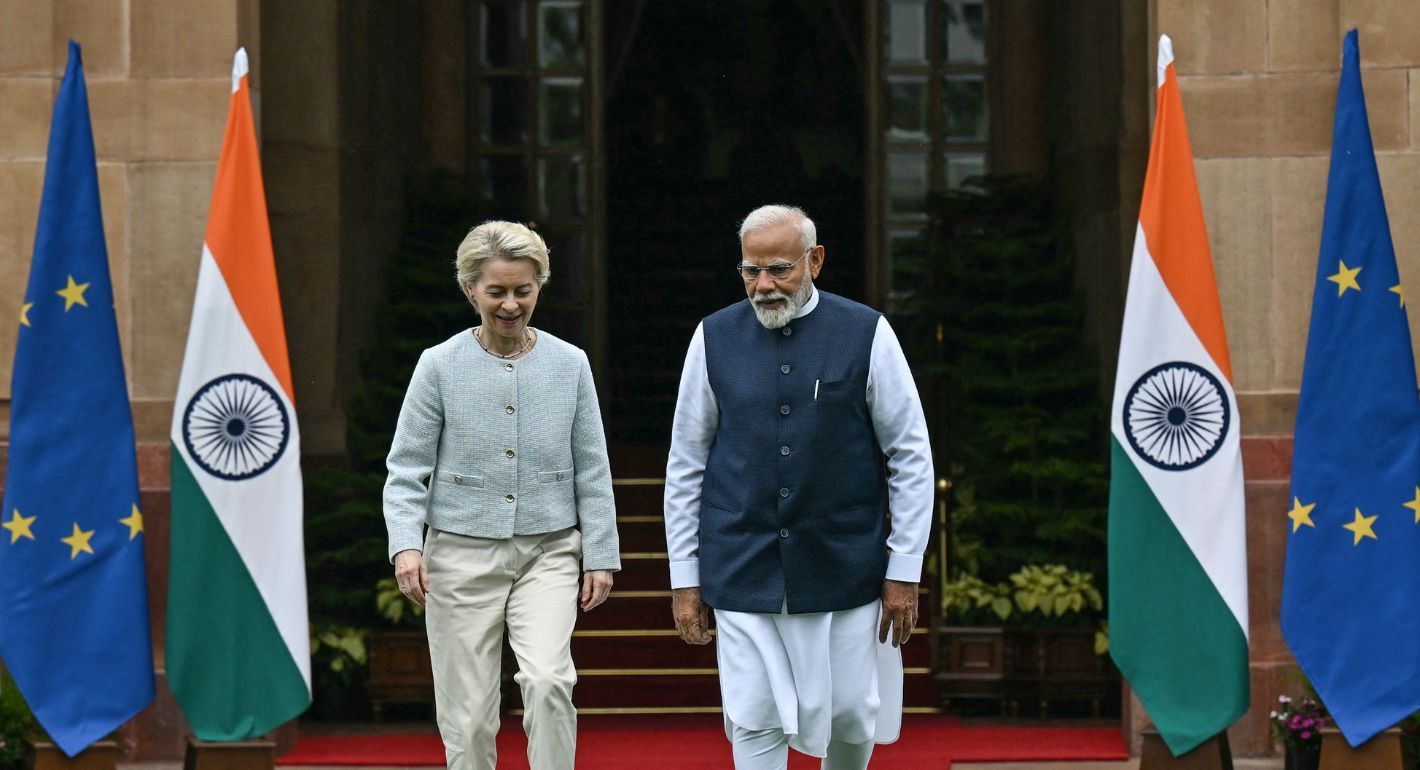
This article argues that the geopolitical circumstances have never been more conducive, not merely for the early conclusion of the free trade agreement (FTA) between India and the EU, but also for crafting a substantive and comprehensive strategic partnership.
Mohan Kumar

China’s central bank has plans to roll out a digital yuan, which could circumvent the U.S. dollar in important global financial transactions. Here are some ways the digital yuan could pose a challenge to the dollar’s prominence.
Rajesh Bansal, Somya Singh
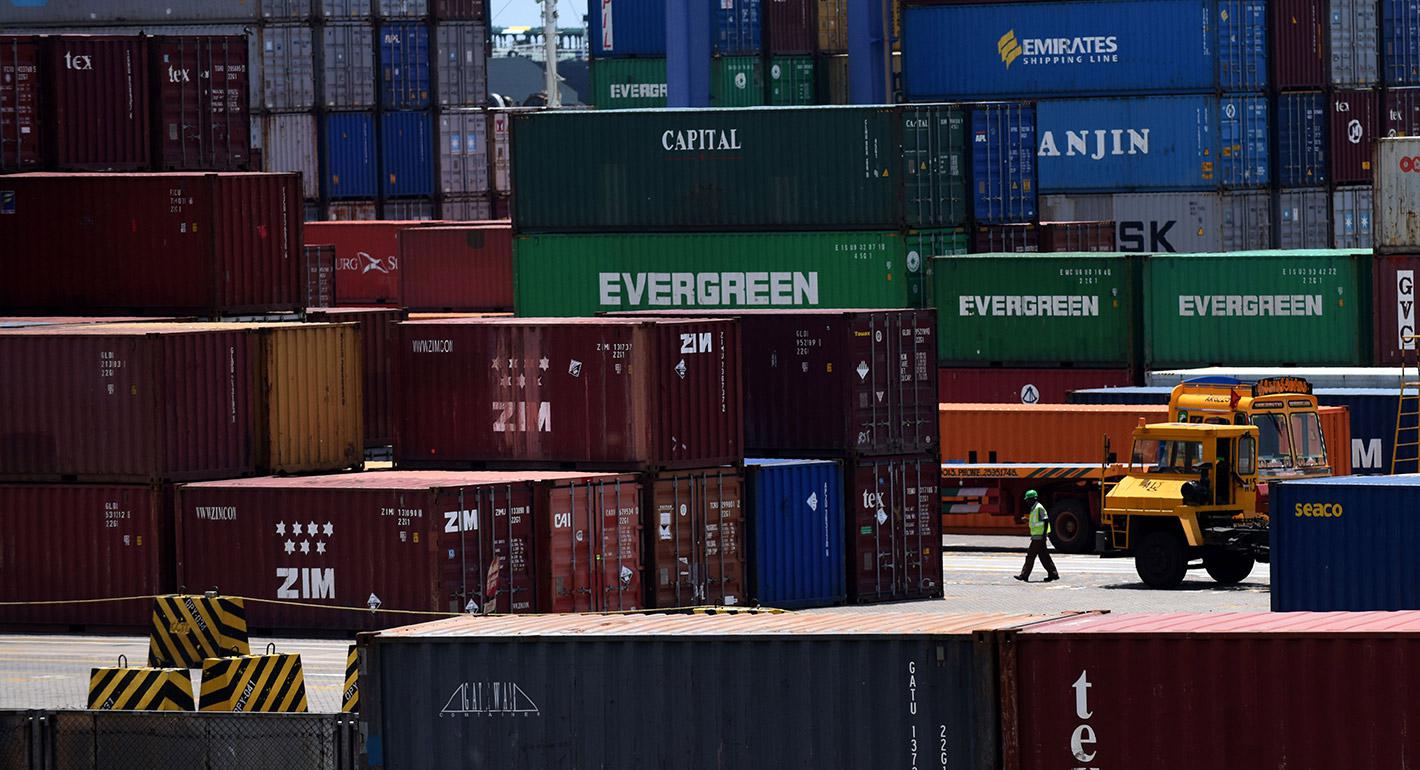
The World Trade Organization’s Trade Facilitation Agreement has placed trade facilitation initiatives high on the agenda of international governments. This case study of India studies what trade facilitation may mean for a fast-paced economy.

Vijay Singh Chauhan, Sruti Vijayakumar