This piece argues that India’s central challenge is not managing a single flashpoint but resolving the underlying tension between expansion and institutional coherency of the BRICS grouping.
Vrinda Sahai
{
"authors": [],
"type": "pressRelease",
"centerAffiliationAll": "dc",
"centers": [
"Carnegie Endowment for International Peace"
],
"collections": [],
"englishNewsletterAll": "ctw",
"nonEnglishNewsletterAll": "",
"primaryCenter": "Carnegie Endowment for International Peace",
"programAffiliation": "russia",
"programs": [
"Russia and Eurasia"
],
"projects": [],
"regions": [
"Caucasus",
"Russia"
],
"topics": [
"Foreign Policy"
]
}REQUIRED IMAGE
FOR IMMEDIATE RELEASE: July 13, 2006
The Carnegie Endowment for International Peace in Washington, DC and the Carnegie Moscow Center have held a series of discussions, press conferences, and meetings in Washington and Moscow in preparation for the G8 Summit from July 15-17 in St. Petersburg. For Carnegie resources on the G8 Summit, including upcoming and past events, publications and expertise, visit the G8 Summit 2006 page.
Related Events:
Related Publications:
Related Links:
Carnegie Moscow Center Resources:
New! Resource:
Contacts: Marina Barnett (REP program) +1 202/939-2283 or Jennifer Linker (media) +1 202/939-2372
Natalia Bubnova (Moscow Center) +7 (495) 935-8904, ext. 230
###
Carnegie India does not take institutional positions on public policy issues; the views represented herein are those of the author(s) and do not necessarily reflect the views of Carnegie, its staff, or its trustees.
This piece argues that India’s central challenge is not managing a single flashpoint but resolving the underlying tension between expansion and institutional coherency of the BRICS grouping.
Vrinda Sahai
A partnership between India, a country of subcontinental size, and Africa, a continent of fifty-four countries, may seem asymmetric until one notes that both are home to nearly the same number of people—1.4 billion. This essay spells out the existing challenges to the partnership, its optimal potential, and the possible pathways to realize it over the next quarter-century.
Rajiv Bhatia
The India–EU Free Trade Agreement (FTA) is shaping up to be one of the most consequential trade negotiations, both economically and strategically. But, what’s in the agreement, what’s missing, and what will determine its success in the years ahead
Vrinda Sahai, Nicolas Köhler-Suzuki
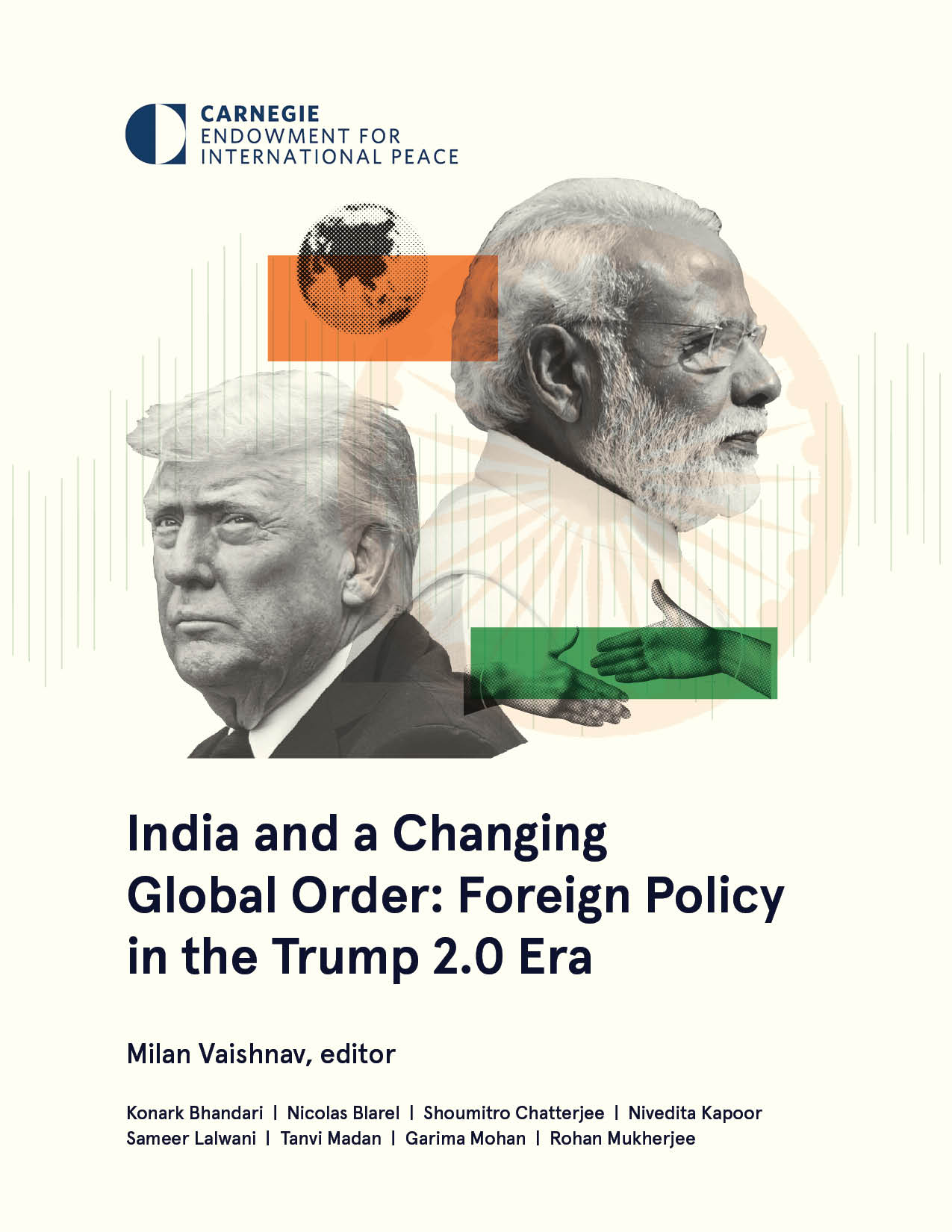
Trump 2.0 has unsettled India’s external environment—but has not overturned its foreign policy strategy, which continues to rely on diversification, hedging, and calibrated partnerships across a fractured order.
Milan Vaishnav, ed., Sameer Lalwani, Tanvi Madan, …
This piece examines India’s response to U.S. sanctions and tariffs, specifically assessing the immediate market consequences, such as alterations in import costs, and the broader strategic implications for India’s energy security and foreign policy orientation.
Vrinda Sahai