• Research
  • About
  • Experts
Carnegie India logoCarnegie lettermark logo
AI
{
  "authors": [
    "Eduardo Zepeda",
    "James Heintz",
    "Carlos Oya"
  ],
  "type": "other",
  "centerAffiliationAll": "",
  "centers": [
    "Carnegie Endowment for International Peace"
  ],
  "collections": [],
  "englishNewsletterAll": "",
  "nonEnglishNewsletterAll": "",
  "primaryCenter": "Carnegie Endowment for International Peace",
  "programAffiliation": "",
  "programs": [],
  "projects": [],
  "regions": [
    "Southern, Eastern, and Western Africa"
  ],
  "topics": [
    "Economy"
  ]
}

Source: Getty

Other

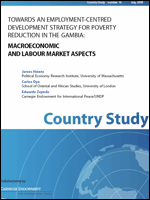
Towards an Employment-Centered Development Strategy for Poverty Reduction in The Gambia: Macroeconomic and Labour Market Aspects

Carnegie's Eduardo Zepeda and James Heintz and Carlos Oya review the growth, employment and poverty record of Gambia.  They focus on the macroeconomic environment and the structure and functioning of labor markets. The authors find that the growth pattern of Gambia does not appear to be pro-poor; improvements in the rate of growth appear to have, at best, halted the spread of poverty.

Link Copied
By Eduardo Zepeda, James Heintz, Carlos Oya
Published on Jul 8, 2008

Source: Carnegie Endowment for International Peace and the International Poverty CentreCountry Study

In this paper, Eduardo Zepeda of the Carnegie Endowment, James Heintz of the University of Massachusetts and Carlos Oya of the University of London review the growth, employment and poverty record of Gambia, focusing on the macroeconomic environment and the structure and functioning of labour markets. The aim of the paper is to identify areas where current policies can be improved or where more knowledge needs to be generated to better inform inclusive development strategies.

The growth pattern of  Gambia does not appear to be pro-poor, as improvements in the rate of growth appear to have at best halted the spread of poverty. Weak productivity performance and the low quality of employment help explain the poverty record. On the macroeconomic side, an excessive emphasis on inflation reduction and reliance on rudimentary monetary policy instruments have helped sustain a high-interest rate environment, which discourages investment and employment creation.

As part of an alternative policy package, Gambia could reformulate macroeconomic policies to target growth instead of inflation, select a more effective mix of policy instruments, and pursue financial reforms to increase the supply of credit to the economy and particularly to employment-intensive activities. In addition, targeted public investments are essential for sustaining more rapid growth and improvements in employment opportunities. A review of the available evidence suggests that labour markets in Gambia do not function in a way conducive to poverty reduction. The employment situation conforms to the typical configuration, whereby traditional activities and informality dominate rural and urban areas.

Gambia also faces high open unemployment rates in cities, particularly among the youth. Measures to increase the labour mobility of the poor are urgently needed. Gambia has benefited from a rapid increase in literacy and basic education, although more progress is needed to improve the quality of education and, particularly, to provide comprehensive training that adequately meets the demand for skilled labour. Finally, there is an urgent need to overhaul labour institutions with the aim of improving labour conditions, reducing labour segmentation and improving knowledge systems.

About the Authors

Eduardo Zepeda

Former Senior Associate, Trade, Equity and Development Program

Zepeda is inter-regional policy coordinator of the Development Policy and Analysis Division, Department of Economic and Social Affairs at the United Nations General Secretariat. He was previously a senior associate in the Trade, Equity, and Development Program at the Carnegie Endowment for International Peace.

James Heintz

Political Economy Research Institute

Carlos Oya

School of Oriental and African Studies

Authors

Eduardo Zepeda
Former Senior Associate, Trade, Equity and Development Program
Eduardo Zepeda
James Heintz
Political Economy Research Institute
Carlos Oya
School of Oriental and African Studies
EconomySouthern, Eastern, and Western Africa

Carnegie India does not take institutional positions on public policy issues; the views represented herein are those of the author(s) and do not necessarily reflect the views of Carnegie, its staff, or its trustees.

More Work from Carnegie India

  • Commentary
    The Impact of U.S. Sanctions and Tariffs on India’s Russian Oil Imports

    This piece examines India’s response to U.S. sanctions and tariffs, specifically assessing the immediate market consequences, such as alterations in import costs, and the broader strategic implications for India’s energy security and foreign policy orientation.

      Vrinda Sahai

  • Paper
    India-China Economic Ties: Determinants and Possibilities

    This paper examines the evolution of India-China economic ties from 2005 to 2025. It explores the impact of global events, bilateral political ties, and domestic policies on distinct spheres of the economic relationship.

      Santosh Pai

  • Commentary
    TRUST and Tariffs

    The India-U.S. relationship currently appears buffeted between three “Ts”—TRUST, Tariffs, and Trump.

      Arun K. Singh

  • Article
    Can Geopolitical Alignment Seal the India-EU FTA?

    This article argues that the geopolitical circumstances have never been more conducive, not merely for the early conclusion of the free trade agreement (FTA) between India and the EU, but also for crafting a substantive and comprehensive strategic partnership.

      Mohan Kumar

  • Article
    The Best of Ideas and Institutions, 2023

    In 2023, the Ideas and Institutions newsletter from Carnegie India's Political Economy team sent out forty-eight essays. This year-end roundup features those essays that the writers of this newsletter consider the best of the year.

      Suyash Rai, Anirudh Burman

Get more news and analysis from
Carnegie India
Carnegie India logo, white
Unit C-4, 5, 6, EdenparkShaheed Jeet Singh MargNew Delhi – 110016, IndiaPhone: 011-40078687
  • Research
  • About
  • Experts
  • Projects
  • Events
  • Contact
  • Careers
  • Privacy
  • For Media
Get more news and analysis from
Carnegie India
© 2026 Carnegie Endowment for International Peace. All rights reserved.