
• Research
  • About
  • Experts
Carnegie India logoCarnegie lettermark logo
Technology
{
  "authors": [
    "Uri Dadush",
    "Bennett Stancil"
  ],
  "type": "other",
  "centerAffiliationAll": "",
  "centers": [
    "Carnegie Endowment for International Peace"
  ],
  "collections": [],
  "englishNewsletterAll": "",
  "nonEnglishNewsletterAll": "",
  "primaryCenter": "Carnegie Endowment for International Peace",
  "programAffiliation": "",
  "programs": [],
  "projects": [],
  "regions": [
    "North America"
  ],
  "topics": [
    "Economy",
    "Trade"
  ]
}

Source: Getty

Other

The World Order in 2050

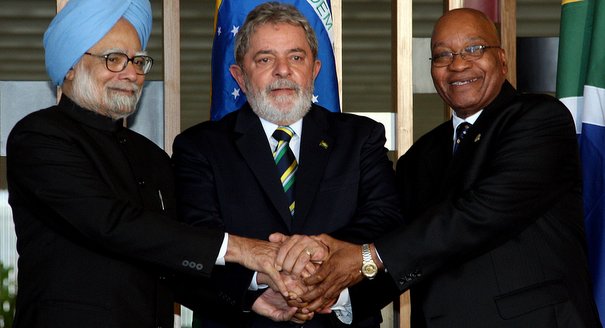
The world’s economic balance of power is shifting, as emerging countries rapidly overtake traditional Western powers as the predominant world economies. The recent global recession has only accelerated this trend.

Link Copied
By Uri Dadush and Bennett Stancil
Published on Apr 21, 2010

The rise of China, India, and other emerging markets has been anticipated for years by numerous economists, and the recent global recession has only accelerated this trend. New projections for economic growth through 2050 offer insight into the implications of this changing economic landscape.

Key Conclusions

  • The world’s economic balance of power is shifting rapidly. China remains on a path to overtake the United States as the world’s largest economic power within a generation, and India will join both as a global leader by mid-century.

  • Traditional Western powers will remain the wealthiest nations in terms of per capita income, but will be overtaken as the predominant world economies by much poorer countries. Given the sheer magnitude of the challenge of lower-wage competition, protectionist pressures in advanced economies may escalate.

  • The global economic transformation will shift international relations in unpredictable ways. To retain their historic influence, European nations will be pressed to conduct foreign policy jointly—an objective implied by their recently ratified constitution—and will need to reach out to emerging powers. Japan and Russia will seek new frameworks of alliances. The largest emerging nations may come to see each other as rivals.

  • Absolute poverty will be confined to small pockets in sub-Saharan Africa and India, though relative poverty will persist, and may even become more acute. Carbon emissions are also on a path toward climate catastrophe, and by mid-century may constitute a serious risk to the global growth forecast.

  • International organizations such as the IMF will be compelled to reform their governance structures to become more representative of the new economic landscape. Those that fail to do so will become marginalized.

Authors

Uri Dadush
Former Senior Associate, International Economics Program
Uri Dadush
Bennett Stancil
Former Research Assistant, International Economics Program
EconomyTradeNorth America

Carnegie India does not take institutional positions on public policy issues; the views represented herein are those of the author(s) and do not necessarily reflect the views of Carnegie, its staff, or its trustees.

More Work from Carnegie India

  • Commentary
    The Impact of U.S. Sanctions and Tariffs on India’s Russian Oil Imports

    This piece examines India’s response to U.S. sanctions and tariffs, specifically assessing the immediate market consequences, such as alterations in import costs, and the broader strategic implications for India’s energy security and foreign policy orientation.

      Vrinda Sahai

  • Paper
    India-China Economic Ties: Determinants and Possibilities

    This paper examines the evolution of India-China economic ties from 2005 to 2025. It explores the impact of global events, bilateral political ties, and domestic policies on distinct spheres of the economic relationship.

      Santosh Pai

  • Commentary
    TRUST and Tariffs

    The India-U.S. relationship currently appears buffeted between three “Ts”—TRUST, Tariffs, and Trump.

      Arun K. Singh

  • Article
    Can Geopolitical Alignment Seal the India-EU FTA?

    This article argues that the geopolitical circumstances have never been more conducive, not merely for the early conclusion of the free trade agreement (FTA) between India and the EU, but also for crafting a substantive and comprehensive strategic partnership.

      Mohan Kumar

  • Source: iStock
    Commentary
    What’s Next for U.S. AI Policy?

    This commentary explores the likely actions of the Trump administration and driving forces on issues of deregulation, the United States’ leadership in AI, national security, and global engagements on AI safety.

      Shatakratu Sahu, Amlan Mohanty

Get more news and analysis from
Carnegie India
Carnegie India logo, white
Unit C-4, 5, 6, EdenparkShaheed Jeet Singh MargNew Delhi – 110016, IndiaPhone: 011-40078687
  • Research
  • About
  • Experts
  • Projects
  • Events
  • Contact
  • Careers
  • Privacy
  • For Media
Get more news and analysis from
Carnegie India
© 2026 Carnegie Endowment for International Peace. All rights reserved.