

Commentary
Nikolay Petrov
{
  "authors": [
    "Nikolay Petrov"
  ],
  "type": "commentary",
  "centerAffiliationAll": "",
  "centers": [
    "Carnegie Endowment for International Peace",
    "Carnegie Russia Eurasia Center"
  ],
  "collections": [],
  "englishNewsletterAll": "",
  "nonEnglishNewsletterAll": "",
  "primaryCenter": "Carnegie Endowment for International Peace",
  "programAffiliation": "",
  "programs": [],
  "projects": [],
  "regions": [],
  "topics": []
}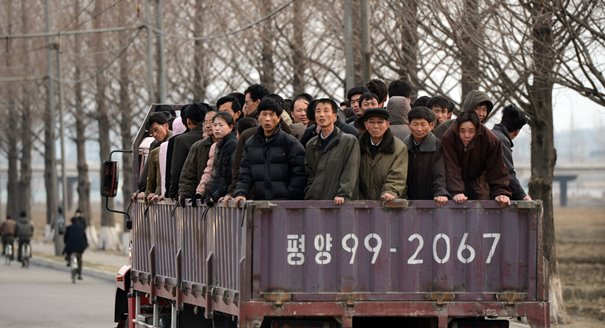
Source: Getty
Construction and agriculture are the two main industries where North Koreans work in Russia. Their work is in the mutual interest of both countries, providing for additional jobs and money in the case of North Korea and substituting for the decreasing labor force in the case of Russia.
As of June 2013, there were almost 11 million foreigners living in Russia, with labor migrants—primarily from the CIS countries—constituting a good part of them. More than one third of them are concentrated in the Moscow Region. The second biggest area of their concentration, attracting one sixth of all migrants, is the Urals Federal District with its oil and gas producing Khanty-Mansi and Yamal-Nenets autonomous districts. Russia’s Far East comes third—with each tenth foreign worker being there, predominantly from China, North Korea, or Vietnam.
Rough estimates indicate that there are several dozen thousand labor migrants from North Korea in this country. Although their number in Russia is 3-4 times smaller than that of the Chinese, the North Koreans lead by the share of their respective country’s population. Moreover, in several of Russia’s regions, such as for instance the Amur Oblast, the regional authorities—when reviewing quotas for foreign labor force—are significantly decreasing the numbers for the Chinese and increasing them for the North Koreans. The number of North Koreans could additionally be much higher if the Korean investments into Russia were more substantial, like the Chinese, since labor migrants follow such investments.
In 2007, when the agreement between Russia and North Korea on regulating labor migration was ratified, there were 16.7 thousand North Koreans in this country. Now their number has grown substantially including five thousand living in Primorye region, about three thousand in Khabarovsk Kray, two thousand in the Amur Oblast, and even 1.4 thousand in St. Petersburg. There is a North Korean Consulate General in Primorye region (Nakhodka) and a Consulate in Khabarovsk.
In 2012, the passenger traffic between Vladivostok and Pyongyang where labor migrants compose 30 percent was 12.8 thousand per annum. This year it increased by about one third despite the complicated situation in North Korea, and in July an additional new flight has been added.
The current third wave of North Korean migration to Russia differs in nature from the previous one, when authorities of the Soviet Union and North Korea had agreed on North Korean timber cutting labor settlements in Russia’s Far East. Now construction and agriculture are the two main industries where North Koreans work in Russia. Their work is in the mutual interest of both countries, providing for additional jobs and money in the case of North Korea and substituting for the decreasing labor force in the case of Russia. One should thus anticipate that North Koreans will significantly contribute to the economic development of the Russian Far East and that their number will further increase in the near future.
Nikolay Petrov is a professor at the Higher School of Economics.
Former Scholar-in-Residence, Society and Regions Program, Moscow Center
Nikolay Petrov was the chair of the Carnegie Moscow Center’s Society and Regions Program. Until 2006, he also worked at the Institute of Geography at the Russian Academy of Sciences, where he started to work in 1982.
Recent Work
Nikolay Petrov
Nikolay Petrov
Carnegie India does not take institutional positions on public policy issues; the views represented herein are those of the author(s) and do not necessarily reflect the views of Carnegie, its staff, or its trustees.