

Article
Thomas de Waal
{
  "authors": [
    "Thomas de Waal"
  ],
  "type": "commentary",
  "centerAffiliationAll": "",
  "centers": [
    "Carnegie Endowment for International Peace",
    "Carnegie Europe",
    "Carnegie Russia Eurasia Center"
  ],
  "collections": [],
  "englishNewsletterAll": "",
  "nonEnglishNewsletterAll": "",
  "primaryCenter": "Carnegie Europe",
  "programAffiliation": "",
  "programs": [],
  "projects": [],
  "regions": [],
  "topics": []
}
Source: Getty
Along with Kashmir’s Line of Control, North Korea and Nagorny Karabakh surely comprise the three most militarized borders in the world. All of them are disputed lines on the map that mark a truce rather than a political settlement.
When you mention the acronym “NK,” it is interesting to hear what the other person thinks you are referring to. For there are two NKs at either end of the Asian land mass—North Korea and Nagorny Karabakh.
Of course, North Korea grabs the headlines for good reasons. A population of 75 million in both Koreas, fears over a nuclear escalation, the bellicose threats by the North Korean leadership—all of that focuses minds on the East Asian NK as a potential flashpoint.
But there are some instructive parallels with the Caucasian NK. Along with Kashmir’s Line of Control, North Korea and Nagorny Karabakh surely comprise the three most militarized borders in the world. All of them are disputed lines on the map that mark a truce rather than a political settlement.
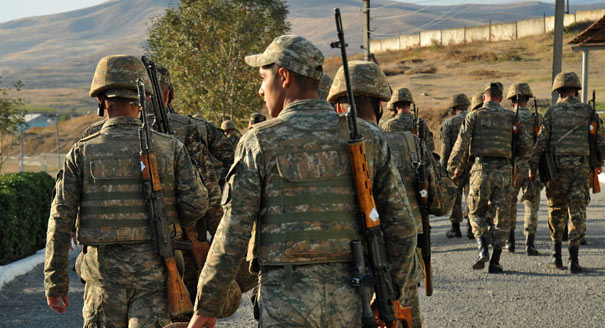
Of these, Karabakh’s Line of Contact (almost the same terminology as in Kashmir) is the most ignored. Yet it is a fearsome scar on the map, more than 200 km long, with World-War-I-style trenches on either side, bristling with heavy weaponry.
Military experts suggest that the Armenian (including Karabakh Armenian) and Azerbaijani militaries each have between 65,000 and 70,000 active troops, of whom about a third are probably stationed on the Line of Contact at any one time.
The risk of new fighting over Karabakh is still relatively low. Azerbaijan, the losing side in the conflict of the 1990s and therefore the party most likely to go back to war, has too much to lose by choosing the military option.
But the lesson of conflicts from August 1914 to August 2008 is that too many of them begin by miscalculation. The main issue in both places is lack of communication. There is no telephone contact between commanders across the Line of Contact—just as there is none across the 38th Parallel. That way, a small military incident could escalate into a larger one.
What could that incident be? There is one obvious reason to worry. This is what could happen if the newly rebuilt airport in Karabakh opens. The Armenian side says it is ready to fly planes between Yerevan and Karabakh. The Azerbaijanis say this would break the Chicago Convention and have threatened (unspecified) retaliation if that happens. So far, the Armenians have acceded to international pressure and done nothing. But sooner or later they are likely to make a flight. Then, given the complete lack of contact and trust between the two sides, things could get dangerous.
Another lesson here is that maybe the most dangerous conflict is the one you were not anticipating.

Senior Fellow, Carnegie Europe
Thomas de Waal is a senior fellow at Carnegie Europe, specializing in Eastern Europe and the Caucasus.
Recent Work
Thomas de Waal
Thomas de Waal
Carnegie India does not take institutional positions on public policy issues; the views represented herein are those of the author(s) and do not necessarily reflect the views of Carnegie, its staff, or its trustees.