

Q&A
Suzanne Maloney, Aaron David Miller, Karim Sadjadpour
{
  "authors": [
    "Karim Sadjadpour"
  ],
  "type": "legacyinthemedia",
  "centerAffiliationAll": "dc",
  "centers": [
    "Carnegie Endowment for International Peace",
    "Malcolm H. Kerr Carnegie Middle East Center"
  ],
  "collections": [
    "Iranian Proliferation"
  ],
  "englishNewsletterAll": "menaTransitions",
  "nonEnglishNewsletterAll": "",
  "primaryCenter": "Carnegie Endowment for International Peace",
  "programAffiliation": "MEP",
  "programs": [
    "Middle East"
  ],
  "projects": [],
  "regions": [
    "North America",
    "United States",
    "Middle East",
    "Iran"
  ],
  "topics": [
    "Foreign Policy"
  ]
}
Source: Getty
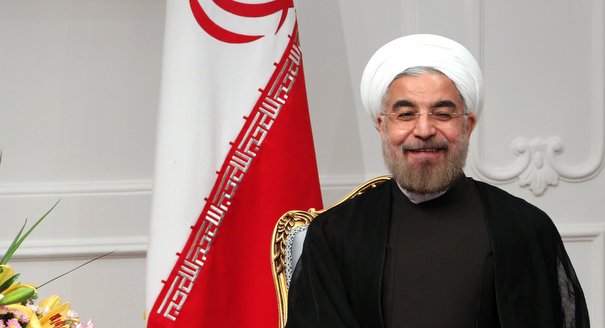
Iranian President Hassan Rouhani may be interested in a détente with the United States, but thorny issues remain. Nonetheless, the United States should seize the opportunity.
Source: NPR's Morning Edition
Launching “one of the greatest charm offensives since Iran’s 1979 revolution,” Iranian President Hassan Rouhani has set a tone vis-à-vis the United States that sharply contrasts with that of his predecessor Mahmoud Ahmadinejad. Describing Rouhani’s election and his actions since then as a “surprise,” Carnegie’s Karim Sadjadpour believes that the Iranian president is interested in a détente between the United States and Iran, and that Iran’s supreme leader Ayatollah Khamenei supports Rouhani’s conciliatory stance.
“The goal of sanctions was … to subject Iran to enough economic pressure in order to compel it to make meaningful nuclear compromises,” Sadjadpour explained. “And now if Iran is showing signs that it’s interested in commencing a diplomatic process, which would culminate in them making meaningful nuclear compromises, I think we have to test that.” However, Sadjadpour argues that the issues of Iran’s support for Hezbollah, its backing the Assad regime in Syria, and its rejection of Israel’s existence will be harder for Rouhani to change and will continue to present a great challenge for U.S.-Iranian relations.
This interview was originally broadcast on NPR’s Morning Edition.

Senior Fellow, Middle East Program
Karim Sadjadpour is a senior fellow at the Carnegie Endowment for International Peace, where he focuses on Iran and U.S. foreign policy toward the Middle East.
Recent Work


Suzanne Maloney, Aaron David Miller, Karim Sadjadpour

Aaron David Miller, Karim Sadjadpour, Robin Wright
Carnegie India does not take institutional positions on public policy issues; the views represented herein are those of the author(s) and do not necessarily reflect the views of Carnegie, its staff, or its trustees.

This piece argues that India’s central challenge is not managing a single flashpoint but resolving the underlying tension between expansion and institutional coherency of the BRICS grouping.

Vrinda Sahai

A partnership between India, a country of subcontinental size, and Africa, a continent of fifty-four countries, may seem asymmetric until one notes that both are home to nearly the same number of people—1.4 billion. This essay spells out the existing challenges to the partnership, its optimal potential, and the possible pathways to realize it over the next quarter-century.

Rajiv Bhatia

The U.S.–India semiconductor cooperation story is well-stocked with top-level strategic intent. What remains unresolved, however, are some underlying challenges that will determine whether the cooperation actually functions. Three such friction points stand out.

Shruti Mittal

The India–EU Free Trade Agreement (FTA) is shaping up to be one of the most consequential trade negotiations, both economically and strategically. But, what’s in the agreement, what’s missing, and what will determine its success in the years ahead
Vrinda Sahai, Nicolas Köhler-Suzuki

Trump 2.0 has unsettled India’s external environment—but has not overturned its foreign policy strategy, which continues to rely on diversification, hedging, and calibrated partnerships across a fractured order.



Milan Vaishnav, ed., Sameer Lalwani, Tanvi Madan, …