

Commentary
Dmitri Trenin
{
  "authors": [
    "Dmitri Trenin"
  ],
  "type": "commentary",
  "centerAffiliationAll": "",
  "centers": [
    "Carnegie Endowment for International Peace",
    "Carnegie Russia Eurasia Center"
  ],
  "collections": [],
  "englishNewsletterAll": "",
  "nonEnglishNewsletterAll": "",
  "primaryCenter": "Carnegie Russia Eurasia Center",
  "programAffiliation": "",
  "programs": [],
  "projects": [],
  "regions": [
    "Russia",
    "Eastern Europe",
    "Ukraine"
  ],
  "topics": [
    "Foreign Policy"
  ]
}
Source: Getty
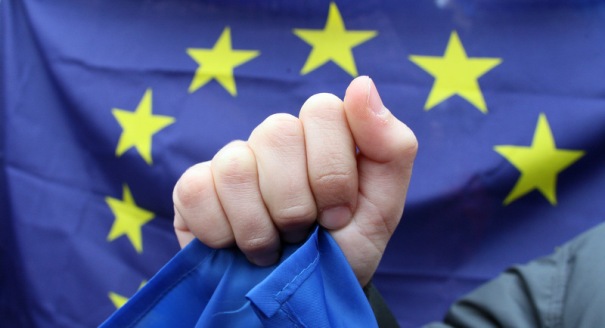
The Ukrainian government’s suspension of the EU association process has come as a bombshell to many. However, it is Russia, ironically, who needs to be wary of this decision.
The Ukrainian government's decision to suspend preparation for an Association Agreement with the European Union, which will now not be signed in Vilnius this week, has come as a bombshell to many. People in Brussels and various EU capitals were profoundly disappointed, people in Washington were greatly annoyed. At a meeting in New York over the weekend, I heard from American friends that President Putin was now leading the West by 2-0, with this recent Ukraine coup coming on top of the earlier Syria one.
International politics is surely more complex than a soccer game, so closer analysis is in order. Ukraine's current leaders had always sought to avoid a clear decision between the EU and Russia, and when pressed hard from both sides, made a decision which they thought would be least bad in terms of their physical safety. Indeed, to President Viktor Yanukovych releasing his sworn enemy Yulia Tymoshenko from jail as a precondition to association with the EU, then signing the Association Agreement itself, and finally reaping the bitter harvest of the Russian reaction looked like a path not only to losing power, in the 2015 election, possibly to Tymoshenko, but very probably going to jail, too. No wonder he put on the brakes.
The Ukrainian government's suspension of the EU association process, however, does not make Ukraine a perpetual "no man's land." Rather, it puts Ukrainians' European aspirations to a real test. Are they willing to embrace the hardships of a much-needed economic reform? Are they ready to start moving toward a system based on the rule of law rather than clan relationships? Are they capable of paying the price for modernization up front, hoping for a compensation which will only come later? The Ukrainian people will need to have a serious debate among themselves, and they will need time—certainly before the 2015 presidential vote.
The Europeans, shocked as they seemingly are today, should not feel defeated. Had Yanukovych decided in favor of the Association Agreement, they would have faced a serious problem down the road. With the IMF tardy with providing funds to Ukraine, and Russia ending Ukraine's trade privileges early in 2014, the EU would have found Ukrainian public opinion blaming both Yanukovych and Brussels for their growing pains. Even if the pro-EU attitudes had held ground in Ukraine under these circumstances, the idea of having a corrupt elite ostensibly leading a largely paternalistic populace toward "Europe" would have lacked much credibility. Rather, the EU would have been saddled with a major burden. Mercifully, courtesy of Yanukovych, they have just escaped the predicament.
It is the Russians, ironically, who need to be wary of the evolving saga on the Dnieper. They have already loosened their purse strings. In appreciation of the Ukrainian government's decision, Gazprom has given Ukraine a discount on gas. Other infusions of Russian money are in the pipeline, to support non-competitive Ukrainian industries and profligate habits of energy consumption. This largesse comes at the time when Russia's economy is stagnating, and the country's financial situation is getting significantly worse. If Moscow were to succeed in getting Ukraine to make the next step and accede to the Customs Union, worse problems would arise. Once inside the tent, Kiev will ask for a big say in how Eurasian integration is run and what Ukraine gets out of that.
President Putin needs to reexamine the basic premises of his Ukraine policy if he wants to avoid a bitter disappointment at the end of the day. It is an illusion to think about Ukrainians and Russians as one nation. It is an illusion to believe that Moscow can run the future Eurasian Union single-handedly, particularly with Ukraine as a member. It is an illusion to expect the Ukrainians, even after they will have received all the Russian support their elites could use, and gotten a big say in the Eurasian integration institutions, to stop looking for the exit sign. Sooner or later, Ukraine will be modernized, and there is no reason for Russia to pay heavily for delaying this modernization.
Former Director, Carnegie Moscow Center
Trenin was director of the Carnegie Moscow Center from 2008 to early 2022.
Recent Work
Dmitri Trenin
Dmitri Trenin
Carnegie India does not take institutional positions on public policy issues; the views represented herein are those of the author(s) and do not necessarily reflect the views of Carnegie, its staff, or its trustees.

After the chill in ties between 2020 and 2024 that brought India–China relations to their lowest point in several decades, the two countries have engaged each other afresh. This paper argues that there are predominantly four imperatives guiding India’s approach to China, and they exist in an order of priority.

Saheb Singh Chadha

This piece argues that India’s central challenge is not managing a single flashpoint but resolving the underlying tension between expansion and institutional coherency of the BRICS grouping.

Vrinda Sahai

A partnership between India, a country of subcontinental size, and Africa, a continent of fifty-four countries, may seem asymmetric until one notes that both are home to nearly the same number of people—1.4 billion. This essay spells out the existing challenges to the partnership, its optimal potential, and the possible pathways to realize it over the next quarter-century.

Rajiv Bhatia

The India–EU Free Trade Agreement (FTA) is shaping up to be one of the most consequential trade negotiations, both economically and strategically. But, what’s in the agreement, what’s missing, and what will determine its success in the years ahead
Vrinda Sahai, Nicolas Köhler-Suzuki
Trump 2.0 has unsettled India’s external environment—but has not overturned its foreign policy strategy, which continues to rely on diversification, hedging, and calibrated partnerships across a fractured order.



Milan Vaishnav, ed., Sameer Lalwani, Tanvi Madan, …