

Commentary
Dmitri Trenin
{
  "authors": [
    "Dmitri Trenin"
  ],
  "type": "legacyinthemedia",
  "centerAffiliationAll": "",
  "centers": [
    "Carnegie Endowment for International Peace",
    "Carnegie Russia Eurasia Center"
  ],
  "collections": [],
  "englishNewsletterAll": "",
  "nonEnglishNewsletterAll": "",
  "primaryCenter": "Carnegie Russia Eurasia Center",
  "programAffiliation": "",
  "programs": [],
  "projects": [],
  "regions": [
    "Russia",
    "Eastern Europe",
    "Ukraine"
  ],
  "topics": [
    "Foreign Policy"
  ]
}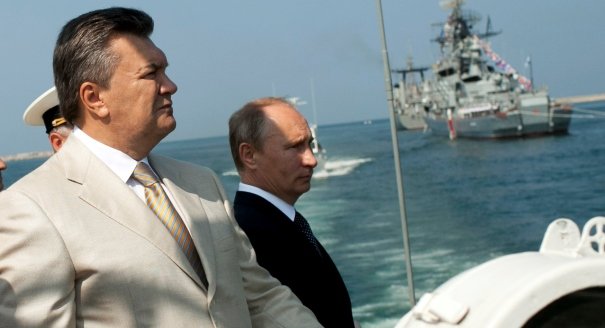
Source: Getty
Integrating Ukraine would have been a terrible deal for Russia. On the other hand, if the EU were to help Ukraine become more modern, Russia would be a net beneficiary.
Source: BBC
Russia has put heavy pressure on Ukraine to join a Russian-led customs union, instead of signing a far-reaching EU-Ukraine pact.
As the Russian and Ukrainian presidents meet again on Tuesday, the director of the Carnegie Moscow Center, Dmitri Trenin, examines Russia's strategy towards its traditional southern partner.
For Russia's President Vladimir Putin international relations are first and foremost about competition, which is intensifying. His approach towards Ukraine reflects that basic philosophy.
The key themes were reiterated in his State of the Nation address to parliament last week. The principal competitors are "large geopolitical units": the US, China and Europe - though the latter is still not a full-fledged strategic player.In this context, Russia is one of very few major independent actors. To compete more successfully, Russia must expand its power base by creating an economic, political and military union in Eurasia.
Russia, according to Mr Putin, is not only a strategic unit, but also possesses a separate civilisation, which it shares with several other countries, such as Ukraine and Belarus. That civilisation is both Christian and European, but it is not a simple extension of Western Europe, or the European Union. Rather, it seeks to become the EU's peer.
The global financial crisis pushed Mr Putin to relaunch a long-delayed project of Eurasian economic integration.
In 2009, Moscow began to work in earnest on a customs union with Belarus and Kazakhstan. By 2012, the customs union had been deepened, putting the three countries into a single economic space. The goal now is to inaugurate the Eurasian Economic Union in 2015.
Two other ex-Soviet states, Armenia and Kyrgyzstan, have applied to join the Eurasian integration process. However, it is Ukraine, with its 46 million inhabitants and the second largest economy in the region (after Russia's), which would really make the difference and provide the project with the critical mass which Mr Putin seeks.
Contrary to the popular view, Mr Putin did not start with sanctions. He offered Ukraine's President Viktor Yanukovych major incentives: significantly lower gas prices, large-scale industrial co-operation projects, and soft credits.
In doing so, he appealed to the spiritual unity of two fellow Slav peoples, both largely adhering to the Orthodox Christian tradition, and to the prominent role that Ukrainians had played in the history of the Russian empire and then the Soviet Union.
Basically, Mr Putin invited them to throw in their lot again with Russia.
Unfortunately for this grand design, however, virtually the entire Ukrainian elite is focused on a purely national project, which sees Ukraine above all as independent from Russia.
Mr Yanukovych and his Prime Minister Mykola Azarov, as well as the eastern Ukrainian tycoons standing behind them, would not mind keeping trade relations with Russia, especially since many Ukrainian exports have no other market. But they do not want to hear about integration. That would put them out of power, and out of business.
The ruling Party of the Regions would prefer the status quo. But the popular majority in the country, and the opposition, demand movement towards the EU.
So Kiev announced its intention to sign an association agreement and deep free trade accord with the European Union, even as it sought to retain favourable terms of trade with Russia.
Seeing that Kiev wants to have its cake and eat it Mr Putin made it clear that it had to choose one or the other. He also decided to demonstrate the cost for Ukraine of spurning his offer and turning west.
Russian health inspectors found fault with Ukrainian sweets, Russian customs officials slowed down cross-border traffic and Russia's energy giant Gazprom reminded Ukraine's Naftogaz of its huge debt.
Ostensibly, these measures were warning shots, suggesting that Russia would defend its economic interests if Ukraine abolished trade barriers with the EU. Essentially, however, they were designed to make the Ukrainian leadership realise how much it would lose by opting for the West rather than the East.
Mr Yanukovych's decision last month to suspend talks with the EU seemed to demonstrate the effectiveness of Russia's tactic. However, the massive protests in Kiev - called "Euromaidan" - then pushed things in the opposite direction.
Moscow is genuinely angry with the EU over what it sees as open meddling in Ukraine - in contrast with what it believes is its own self-restraint. Yet the EU's growing involvement with Ukraine may be a blessing in disguise for Russia.
Had Mr Yanukovych accepted Mr Putin's terms, Russia would have needed to spend billions of dollars to bail Ukraine out and keep its inefficient industries afloat. It would have given Ukraine a privileged position in the Eurasian Union, a blocking vote at least.
Yet, as the Maidan protest has shown, no matter how much Russia were to give, the Ukrainians would still be looking to exit from Russia's orbit.
Integrating Ukraine - as it is, not as it exists in Vladimir Putin's dreams - would have been a terrible deal for Russia.
On the other hand, if the EU were to help Ukraine become more modern - at a huge cost to both the EU and Ukraine - Russia would be a net beneficiary.
It would get a predictable neighbour and a more attractive opportunity to do business - without paying a single rouble. Mr Putin's short-term loss is Russia's long-term gain.
Former Director, Carnegie Moscow Center
Trenin was director of the Carnegie Moscow Center from 2008 to early 2022.
Recent Work
Dmitri Trenin
Dmitri Trenin
Carnegie India does not take institutional positions on public policy issues; the views represented herein are those of the author(s) and do not necessarily reflect the views of Carnegie, its staff, or its trustees.

After the chill in ties between 2020 and 2024 that brought India–China relations to their lowest point in several decades, the two countries have engaged each other afresh. This paper argues that there are predominantly four imperatives guiding India’s approach to China, and they exist in an order of priority.

Saheb Singh Chadha

This piece argues that India’s central challenge is not managing a single flashpoint but resolving the underlying tension between expansion and institutional coherency of the BRICS grouping.

Vrinda Sahai

A partnership between India, a country of subcontinental size, and Africa, a continent of fifty-four countries, may seem asymmetric until one notes that both are home to nearly the same number of people—1.4 billion. This essay spells out the existing challenges to the partnership, its optimal potential, and the possible pathways to realize it over the next quarter-century.

Rajiv Bhatia

The India–EU Free Trade Agreement (FTA) is shaping up to be one of the most consequential trade negotiations, both economically and strategically. But, what’s in the agreement, what’s missing, and what will determine its success in the years ahead
Vrinda Sahai, Nicolas Köhler-Suzuki

Trump 2.0 has unsettled India’s external environment—but has not overturned its foreign policy strategy, which continues to rely on diversification, hedging, and calibrated partnerships across a fractured order.



Milan Vaishnav, ed., Sameer Lalwani, Tanvi Madan, …