• Research
  • About
  • Experts
Carnegie India logoCarnegie lettermark logo
AI
{
  "authors": [
    "Ulrich Speck"
  ],
  "type": "legacyinthemedia",
  "centerAffiliationAll": "dc",
  "centers": [
    "Carnegie Endowment for International Peace",
    "Carnegie Europe"
  ],
  "collections": [
    "Europe’s Eastern Neighborhood",
    "Transatlantic Cooperation"
  ],
  "englishNewsletterAll": "ctw",
  "nonEnglishNewsletterAll": "",
  "primaryCenter": "Carnegie Europe",
  "programAffiliation": "EP",
  "programs": [
    "Europe"
  ],
  "projects": [],
  "regions": [
    "Russia",
    "Europe",
    "North America",
    "Eastern Europe",
    "United States",
    "Ukraine",
    "Western Europe",
    "Iran"
  ],
  "topics": [
    "Foreign Policy"
  ]
}

Source: Getty

In The Media
Carnegie Europe

Putin Planning “Soviet Union Lite”

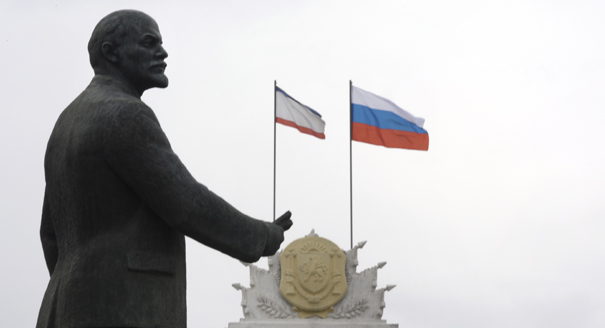
If Vladimir Putin’s Russia succeeds in Ukraine, it will conclude that it can act like an empire. An empire has no borders and does not respect the borders of others.

Link Copied
By Ulrich Speck
Published on Mar 4, 2014

Source: CNN

What's at stake in the conflict between the West and Russia over Ukraine is not just the future of Crimea, it's the future of international order.

Some weeks ago, Crimea was a remote place, to historians known as the center of a war in the 1850s, while ordinary people would have associated it with some kind of sparkling alcoholic beverage. But suddenly and unexpectedly, Crimea has become a geopolitical hotspot in a conflict between Russia and the West that seems to be straight out of a Cold War playbook.

Moscow has raised the stakes dramatically with a de facto annexation of this region, which is home of an important Russian naval base and inhabited by a population whose majority is oriented towards Russia (while an important minority, among them the Cossacks, is strongly attached to Ukraine).

Read the full text of this article on CNN.

About the Author

Ulrich Speck

Former Visiting Scholar, Carnegie Europe

Speck was a visiting scholar at Carnegie Europe in Brussels, where his research focuses on the European Union’s foreign policy and Europe’s strategic role in a changing global environment.

Ulrich Speck
Former Visiting Scholar, Carnegie Europe
Foreign PolicyRussiaEuropeNorth AmericaEastern EuropeUnited StatesUkraineWestern EuropeIran

Carnegie India does not take institutional positions on public policy issues; the views represented herein are those of the author(s) and do not necessarily reflect the views of Carnegie, its staff, or its trustees.

More Work from Carnegie India

  • Article
    India–Africa Strategic Partnership: Challenges, Potential, and Possible Pathways

    A partnership between India, a country of subcontinental size, and Africa, a continent of fifty-four countries, may seem asymmetric until one notes that both are home to nearly the same number of people—1.4 billion. This essay spells out the existing challenges to the partnership, its optimal potential, and the possible pathways to realize it over the next quarter-century.

      Rajiv Bhatia

  • Commentary
    The Unresolved Challenges in U.S.–India Semiconductor Cooperation

    The U.S.–India semiconductor cooperation story is well-stocked with top-level strategic intent. What remains unresolved, however, are some underlying challenges that will determine whether the cooperation actually functions. Three such friction points stand out.

      Shruti Mittal

  • Commentary
    Emerging From the “Zombie State” of Trade Agreements: The India-EU FTA

    The India–EU Free Trade Agreement (FTA) is shaping up to be one of the most consequential trade negotiations, both economically and strategically. But, what’s in the agreement, what’s missing, and what will determine its success in the years ahead

      Vrinda Sahai, Nicolas Köhler-Suzuki

  • India and a Changing Global Order: Foreign Policy in the Trump 2.0 Era
    Research
    India and a Changing Global Order: Foreign Policy in the Trump 2.0 Era

    Trump 2.0 has unsettled India’s external environment—but has not overturned its foreign policy strategy, which continues to rely on diversification, hedging, and calibrated partnerships across a fractured order.

      • Sameer Lalwani
      • +6

      Milan Vaishnav, ed., Sameer Lalwani, Tanvi Madan, …

  • Article
    What Could a Reciprocal Defense Procurement Agreement Do for U.S.-India Ties?

    India and the United States are close to concluding a Reciprocal Defense Procurement Agreement (RDPA) that will allow firms from the two countries to sell to each other’s defense establishments more easily. While this may not remedy the specific grievances both sides may have regarding larger bilateral issues, an RDPA could restore some momentum, following the trade deal announcement.

      Konark Bhandari

Get more news and analysis from
Carnegie India
Carnegie India logo, white
Unit C-4, 5, 6, EdenparkShaheed Jeet Singh MargNew Delhi – 110016, IndiaPhone: 011-40078687
  • Research
  • About
  • Experts
  • Projects
  • Events
  • Contact
  • Careers
  • Privacy
  • For Media
Get more news and analysis from
Carnegie India
© 2026 Carnegie Endowment for International Peace. All rights reserved.









