

Commentary
Dmitri Trenin
{
  "authors": [
    "Dmitri Trenin"
  ],
  "type": "commentary",
  "centerAffiliationAll": "",
  "centers": [
    "Carnegie Endowment for International Peace",
    "Carnegie Russia Eurasia Center"
  ],
  "collections": [],
  "englishNewsletterAll": "",
  "nonEnglishNewsletterAll": "",
  "primaryCenter": "Carnegie Russia Eurasia Center",
  "programAffiliation": "",
  "programs": [],
  "projects": [],
  "regions": [
    "Russia",
    "Eastern Europe",
    "Ukraine"
  ],
  "topics": [
    "Foreign Policy"
  ]
}
Source: Getty
While Kiev is desperate to achieve a full military victory almost at any cost, Moscow is reaching out with humanitarian aid, confusing and confounding its opponents. As to the war there, it still continues.
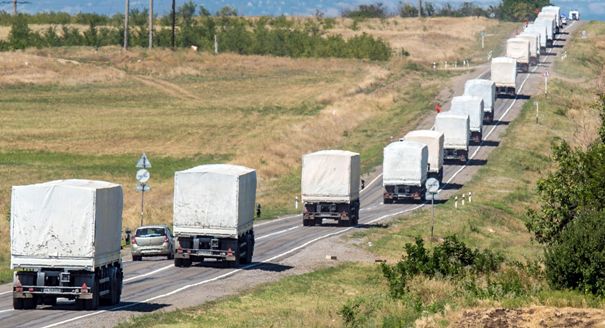
In his wide-ranging remarks to the members of the Russian State Duma in Yalta on August 14, President Vladimir Putin only mentioned Ukraine briefly. Russia, he said, would do all it can to bring an end to the bloodletting there. Even as Putin was talking, the Russian humanitarian convoy was slowly making its way from Moscow to the Ukrainian border.
Meanwhile, at Yalta, an interesting exchange followed. Vladimir Zhirinovsky, Deputy Speaker of the Russian parliament, who spoke after Putin, ostensibly criticized the president' "softness." The last tsar, Zhirinovsky said, when faced with a crisis in the Balkans, did not bother about sending humanitarian relief to the Serbs, but extended military aid to them. "This was a mistake," Zhirinovsky quickly added. Putin, responding to this fake rebuke, said that he proposed to learn from others' mistakes rather than to make some of his own.
By sending the convoy, Vladimir Putin sought to switch the international attention from the fighting in Eastern Ukraine to the human suffering there, and to present Russia as the one country that cared about the people of Donbass. Putin was also clearly responding to the calls in Russia—parodied by Zhirinovsky—to "do something" in the face of the Kievan forces' continuing assault on the rebel strongholds. That "something," however, in Putin's view, did not have to be reckless and leading to catastrophic consequences—just as the Russian emperor's fateful moves in 1914.
Russia, of course, may yet intervene in force—if, for example, the Ukrainian government's efforts to restore Donbass to its control result in a massive loss of civilian life, way above the dozen or so people who are reported killed on a daily basis now. Absent that, Moscow's strategy will focus on helping the rebels to fight Kiev's forces to a standstill—and negotiating a ceasefire making the rebels a party to an agreement.
The sudden departure recently of the top rebel leaders in both Donetsk and Lugansk suggests that Moscow seeks to field a more authentic and presentable group for eventual future talks. While Kiev is desperate to achieve a full military victory almost at any cost, Moscow is reaching out with humanitarian aid, confusing and confounding its opponents. At the foreign ministers' meeting in Berlin on Sunday, a measure of progress was achieved on the issue of the Russian humanitarian aid to Donbass. As to the war there, it still continues.
Former Director, Carnegie Moscow Center
Trenin was director of the Carnegie Moscow Center from 2008 to early 2022.
Recent Work
Dmitri Trenin
Dmitri Trenin
Carnegie India does not take institutional positions on public policy issues; the views represented herein are those of the author(s) and do not necessarily reflect the views of Carnegie, its staff, or its trustees.

After the chill in ties between 2020 and 2024 that brought India–China relations to their lowest point in several decades, the two countries have engaged each other afresh. This paper argues that there are predominantly four imperatives guiding India’s approach to China, and they exist in an order of priority.

Saheb Singh Chadha

This piece argues that India’s central challenge is not managing a single flashpoint but resolving the underlying tension between expansion and institutional coherency of the BRICS grouping.

Vrinda Sahai

A partnership between India, a country of subcontinental size, and Africa, a continent of fifty-four countries, may seem asymmetric until one notes that both are home to nearly the same number of people—1.4 billion. This essay spells out the existing challenges to the partnership, its optimal potential, and the possible pathways to realize it over the next quarter-century.

Rajiv Bhatia

The India–EU Free Trade Agreement (FTA) is shaping up to be one of the most consequential trade negotiations, both economically and strategically. But, what’s in the agreement, what’s missing, and what will determine its success in the years ahead
Vrinda Sahai, Nicolas Köhler-Suzuki
Trump 2.0 has unsettled India’s external environment—but has not overturned its foreign policy strategy, which continues to rely on diversification, hedging, and calibrated partnerships across a fractured order.

Milan Vaishnav, ed., Sameer Lalwani, Tanvi Madan, …