

Commentary
How is AI reshaping space security, creating governance challenges, and where does international diplomacy stand today?
Tejas Bharadwaj, Almudena Azcárate Ortega
{
  "authors": [
    "Eugene Satanovsky"
  ],
  "type": "commentary",
  "centerAffiliationAll": "",
  "centers": [
    "Carnegie Endowment for International Peace",
    "Carnegie Russia Eurasia Center"
  ],
  "collections": [],
  "englishNewsletterAll": "",
  "nonEnglishNewsletterAll": "",
  "primaryCenter": "Carnegie Endowment for International Peace",
  "programAffiliation": "",
  "programs": [],
  "projects": [],
  "regions": [
    "North America",
    "United States",
    "Middle East",
    "Israel",
    "Russia"
  ],
  "topics": [
    "Foreign Policy"
  ]
}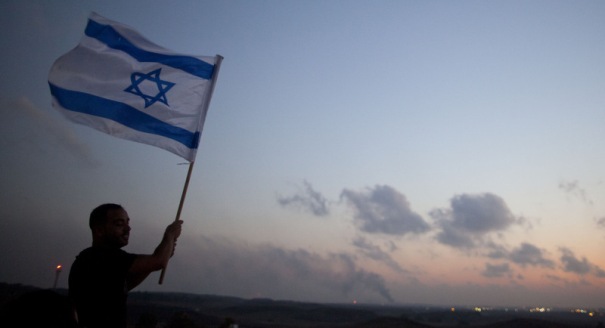
Source: Getty
Israel will maintain its relations with the United States and the European Union, but it will also continue to develop its relations with Russia.
Israel has suspended its military-technological cooperation with Ukraine, just as it did in the case of Georgia in 2008. It is not going to choose sides. Jews do not aspire to the role of the arbiter in Russia’s dispute with Ukrainians or Georgians, and the Jewish state is not going to serve as an instrument for the U.S.’s anti-Russian policies. What for?
Obama does not like Putin, which was reason enough for him to start the Cold War, but it is not the Russians that cut off the heads of Americans—it is done by Islamist militants financed by Qatar, the country that has too many ties to the American president. But Obama does not like Netanyahu, either. And he does not like Israel, in contrast to the Muslim Brotherhood and its numerous clones.
He disowned all of his predecessors’ obligations to cooperate with Israel against Iran. It was his pressure along with his refusal to supply Israel with ammunition and jet fuel that ensured Hamas’ survival. With such allies, shouldn’t Israel start seeking alternative partners?
Тhere is visa-free travel between Israel and Russia. More than a million Russian speakers from the former Soviet Union live in Israel. Thousands of Israelis work in Russia. A lot of Russians have friends and relatives in Israel. Half of the Israeli government and a large number of Knesset members speak Russian. Russian is spoken in the Israeli high-tech sector, science and academia, and, of course, in the military.
Russia-Israel trade volume amounts to slightly over three billion dollars. However, the EU sanctions against Russia and the Russian countersanctions allow for the expansion of Russia’s trade with Israel. This year Israel’s fruit and vegetable imports into Russia will increase three times; besides, unlike the EU, Russia does not restrict Israeli agricultural exports from Judea, Samaria, and the Golan Heights.
There are tremendous opportunities for technological cooperation between Israel and Russia, including cooperation in the military sphere. So far, potential projects have been consistently foiled by the United States, but Obama’s policies undermined many of his predecessors’ achievements in regards to controlling the Israeli military industrial complex.
Politicians’ personal relations play a much greater role for their countries than is generally believed. In this respect, Israeli leaders have much better working relations with the Russian president than with the American administration. Netanyahu’s visits to Russia take place in a much warmer atmosphere than his visits to the United States. Perhaps, it proceeds from the fact that Russia fights the same enemy as Israel—and does so on its own turf.
Theoretically, the United States is also fighting a war against radical Islam. But Israelis believe that the current administration has in fact lost the war, deserted from the battlefield, and is trying to strike a deal with the enemy at Israel’s expense. Obama’s loud pronouncements on the war against ISIS merely underscore this fact.
As a consequence, Israel will maintain its relations with the United States and the European Union, but it will also continue to develop its relations with Russia regardless of which post-Soviet country will become the next testing ground for another State Department democratization strategy. Moscow understands it on every level, especially in light of Israel’s choice not to participate in the UN vote on the American version of the resolution on Ukraine, which clearly demonstrates its neutrality.
Eugene Satanovsky is the president of Institute for Middle Eastern Studies in Moscow.
Eugene Satanovsky
Carnegie India does not take institutional positions on public policy issues; the views represented herein are those of the author(s) and do not necessarily reflect the views of Carnegie, its staff, or its trustees.

How is AI reshaping space security, creating governance challenges, and where does international diplomacy stand today?


Tejas Bharadwaj, Almudena Azcárate Ortega

After the chill in ties between 2020 and 2024 that brought India–China relations to their lowest point in several decades, the two countries have engaged each other afresh. This paper argues that there are predominantly four imperatives guiding India’s approach to China, and they exist in an order of priority.

Saheb Singh Chadha

This piece argues that India’s central challenge is not managing a single flashpoint but resolving the underlying tension between expansion and institutional coherency of the BRICS grouping.

Vrinda Sahai

A partnership between India, a country of subcontinental size, and Africa, a continent of fifty-four countries, may seem asymmetric until one notes that both are home to nearly the same number of people—1.4 billion. This essay spells out the existing challenges to the partnership, its optimal potential, and the possible pathways to realize it over the next quarter-century.

Rajiv Bhatia

The U.S.–India semiconductor cooperation story is well-stocked with top-level strategic intent. What remains unresolved, however, are some underlying challenges that will determine whether the cooperation actually functions. Three such friction points stand out.

Shruti Mittal