

Paper
James L. Schoff, Douglas E. Rake, Joshua Levy
{
  "authors": [
    "James L. Schoff"
  ],
  "type": "legacyinthemedia",
  "centerAffiliationAll": "dc",
  "centers": [
    "Carnegie Endowment for International Peace",
    "Carnegie China"
  ],
  "collections": [
    "China’s Foreign Relations"
  ],
  "englishNewsletterAll": "asia",
  "nonEnglishNewsletterAll": "",
  "primaryCenter": "Carnegie Endowment for International Peace",
  "programAffiliation": "AP",
  "programs": [
    "Asia"
  ],
  "projects": [],
  "regions": [
    "East Asia",
    "Japan"
  ],
  "topics": [
    "Foreign Policy"
  ]
}
Source: Getty
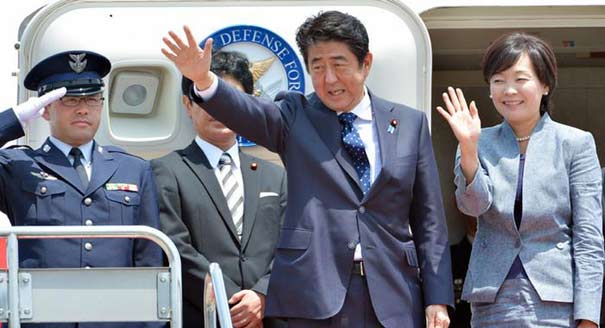
The Japanese prime minister has grown concerned that his country’s influence in the world is shrinking due to China, and so Abe is making it a point to be very active in foreign diplomacy.
Source: Deutsche Welle
Shinzo Abe's travel agenda has been remarkable - shortly after China's President Xi Jinping visited Latin America in July, Abe embarked on a five nation tour of the region as Asia's two largest economies vie for influence in the resource-rich region. The itinerary covered Mexico, Trinidad and Tobago, Colombia, Chile and Brazil.
A few weeks later, Abe visited Bangladesh and Sri Lanka, bringing to 49 the number of countries he has visited since taking office less than two years ago. The trip is set to be followed by President Xi's visit to South Asia in mid-September, with some analysts regarding the many trips as a reflection of the growing competition between the countries.
But despite visiting a dozen Asian nations at least once, Abe has yet to visit neighboring China and South Korea, both countries with which Japan has strained ties. James L. Schoff, Japan expert at the Washington-based Carnegie Endowment for International Peace says in a DW interview that the Japanese PM has grown concerned that his country's voice and influence in the region and the world are shrinking given China's economic and military rise. But just visiting all these nations by themselves won't change those countries' strategic calculations vis-à-vis China, Schoff adds.James L. Schoff: It is uncommon, and in fact you could say that Abe's active international schedule is unprecedented for a prime minister. It is consistent, however, with the unique level of energy he is bringing to his job, in his second try at being PM. Most notably was his accomplishment of visiting all ten nations within ASEAN within his first year in office. Southeast Asia is a key focus of his diplomacy.
In just the six years since Abe was first PM, Japan's stature vis-à-vis China has changed dramatically. China's gross domestic product (GDP) - in purchasing power parity terms - more than doubled and surpassed Japan, along with similar growth in China's defense budget, to become the second largest in the world.
During this time out of office Abe has grown concerned that Japan's voice and influence in the region and the world may be shrinking, and he thinks it is important to restore Japan's position as one of the leading countries in the world.
Abe thinks he can accomplish this through different complementary strategies including strengthening the alliance with the United States, reviving Japan's economy and competitiveness, and strengthening and expanding Japan's diplomatic relations - and strategic cooperation - with other countries.
In this way, he hopes to strengthen international rules and norms - and global as well regional governance - so that Japan is better able to resist coercion or pressure from a much larger China. Japan wants to help solidify the rules of the road now, while it is still influential, in case it is less able to influence things later. After all, Japan is highly dependent on trade and commodities from abroad, and it wants to keep the economic architecture open and rules-based, so that a more powerful China cannot take advantage of Japan in the future.
The efforts are still in its early stages, but they're having an effect. To some extent China is making Abe's life easier by creating doubt in some countries about China's long-term intentions, so there is the willingness to hedge by strengthening relations with Japan.
The Japanese PM is also opening some doors for Japan's private sector in places around Southeast Asia, South Asia, Africa, Europe, and South America. He is also looking for support for Tokyo to become a non-permanent member of the UN Security Council next year, and his visits help. But just visiting all these nations by themselves won't change those countries' strategic calculations vis-à-vis China. It can help on the margins, and some, like India, are pleased to have Japan as a partner, in addition to other strong relationships - not instead of or as part of joining one "camp" vs. another.
I think Japan's international profile was relatively high before Abe came to power, but it was slipping. Japanese manufacturing and culture have long been admired abroad, but the country was certainly less active as a diplomatic player in the past year... seen as a diminishing presence, to some extent. China's rise exacerbated this, and the March 2011 tsunami/nuclear disaster amplified this perception.
Abe wants to sell not just a "cool Japan" in terms of design and culture, but he also wants his country to be seen as relevant on big global policy issues such as technology, the environment, diplomacy, economics, and security. So, even if Japan can't be as active as some other nations' militaries in international security issues, Abe is including diplomatic and security issues in all his bilateral meetings - i.e., not just trade and economics.
The PM wants to build up Japan's defense industrial base and engagement in the world, and he wants to develop military-to-military ties with other countries, even if the focus is on disaster relief and basic non-violent capacity building - such as, for instance, helping a country like Vietnam improve the maintenance of its military transport vehicles.
There is synergy between Abe's trips, the CEOs who travel with him, and follow-up by the relevant ministries and agencies, whether it is developing a special economic zone in Myanmar or attempting to sell special surveillance and search and rescue aircraft to India. These activities reinforce each other, but it is not as if Abe's trips directly translate into a particular level of new business for companies. Abe's impact in this regard is more indirect than direct.
His basic message is that "Japan is back" and he wants these countries to think about his country as a possible partner in a variety of bilateral or multilateral initiatives. Japan is relevant, reforming, ready and able to contribute, and a more reliable and trustworthy partner than China. For some in East Asia he probably also says that where the US might overlook you - since Washington is so distracted in Europe and the Middle East - we are neighbors and won't be going anywhere.
As for how effective the message is, it all depends on the country and how important China is to that country, economically and politically. But more important to me than whether or not he can counter-balance China's influence, is the question of whether or not he can help be a catalyst for altering the expectations of Beijing, so that it has to think and act more in support of broader regional interests, rather than its own. If Japan - and the US and Europe - can set expectations according to international standards and collective benefit, then China might be pushed to move more toward those standards.
Abe would like to improve relations with China and South Korea, but there are challenges with both that are difficult to overcome. China has made a visit conditional on some form of compromise regarding the Senkaku/Diaoyu Islands territorial dispute, which Abe says he cannot accept. He thinks Beijing is trying to bully him into a compromise, and he won't budge on that.
Unfortunately, both China and Japan think the other country needs them more, so they are both willing to wait the other out. The APEC meeting in November in Beijing is an opportunity to overcome this in a face-saving way, so there is some hope there, but it won't be a true bilateral visit.
With South Korea, the problems are more political and emotional with regard to interpretations of history associated with Japan's colonization of Korea in the past. Here too, Abe believes that he must compromise his principles for the sake of a bilateral meeting, and mutual trust is quite low now, so it is difficult to see a breakthrough in the near term.
The challenges with neighbors like China, Korea, and even Russia, have added to the sense in Tokyo that they must improve relations with a wider array of countries around the region and the world. South Korea should be the near-term priority for Abe, and hopefully he and his counterpart in Seoul can come up with a formula that will allow them to hold one-on-one talks soon.
After all, they have a better chance of finding a path towards trust and bilateral compromise if they talk first, rather than demand some sort of gesture or compromise upfront before a meeting. Communication leads to compromise, usually - not the other way around.

Former Senior Fellow, Asia Program
James L. Schoff was a senior fellow in the Carnegie Asia Program. His research focuses on U.S.-Japan relations and regional engagement, Japanese technology innovation, and regional trade and security dynamics.
Recent Work
James L. Schoff, Douglas E. Rake, Joshua Levy
James L. Schoff
Carnegie India does not take institutional positions on public policy issues; the views represented herein are those of the author(s) and do not necessarily reflect the views of Carnegie, its staff, or its trustees.

After the chill in ties between 2020 and 2024 that brought India–China relations to their lowest point in several decades, the two countries have engaged each other afresh. This paper argues that there are predominantly four imperatives guiding India’s approach to China, and they exist in an order of priority.

Saheb Singh Chadha

This piece argues that India’s central challenge is not managing a single flashpoint but resolving the underlying tension between expansion and institutional coherency of the BRICS grouping.

Vrinda Sahai

A partnership between India, a country of subcontinental size, and Africa, a continent of fifty-four countries, may seem asymmetric until one notes that both are home to nearly the same number of people—1.4 billion. This essay spells out the existing challenges to the partnership, its optimal potential, and the possible pathways to realize it over the next quarter-century.

Rajiv Bhatia

The India–EU Free Trade Agreement (FTA) is shaping up to be one of the most consequential trade negotiations, both economically and strategically. But, what’s in the agreement, what’s missing, and what will determine its success in the years ahead
Vrinda Sahai, Nicolas Köhler-Suzuki

Trump 2.0 has unsettled India’s external environment—but has not overturned its foreign policy strategy, which continues to rely on diversification, hedging, and calibrated partnerships across a fractured order.



Milan Vaishnav, ed., Sameer Lalwani, Tanvi Madan, …