

Report
- +3
James M. Acton, Alexey Arbatov, Vladimir Dvorkin, …
{
  "authors": [
    "Petr Topychkanov"
  ],
  "type": "commentary",
  "centerAffiliationAll": "",
  "centers": [
    "Carnegie Endowment for International Peace",
    "Carnegie Russia Eurasia Center"
  ],
  "collections": [],
  "englishNewsletterAll": "",
  "nonEnglishNewsletterAll": "",
  "primaryCenter": "Carnegie Russia Eurasia Center",
  "programAffiliation": "",
  "programs": [],
  "projects": [],
  "regions": [
    "East Asia",
    "Russia"
  ],
  "topics": [
    "Foreign Policy"
  ]
}
Source: Getty
The current political crisis in Russia’s relations with the West gives a strong impetus to Russian rapprochement with Asian countries. However, many analysts are of the opinion that no significant progress in this area has been achieved as of yet.
In his speech at the thirteenth annual Sochi Investment Forum last September, Prime Minister Dmitry Medvedev announced Russia’s new strategy in Asia. Three objectives are at the core of this strategy: confidence building between Russia and Asian countries, increased Russian involvement in regional affairs, and a greater focus on the Asian-Pacific states as Russia’s partners in the spheres of modern technology and finance.
The current political crisis in Russia’s relations with the West, which was triggered by the events in Ukraine, gives a strong impetus to Russian rapprochement with Asian countries. However, many analysts are of the opinion that no significant progress in this area has been achieved as of yet. This may be explained as resulting from difficulties associated with refocusing the Russian economy under conditions of sanctions and other unfavorable trends. Alternatively, one could take comfort in the idea that Russia’s efforts to enhance its relations with the Asia-Pacific states will produce results a few years down the line. Such rationalizations would make sense if the turn toward Asia were actually a new vector in Russia’s foreign policy and commerce.
But given Medvedev’s statement that Moscow has already been oriented toward Asia for over ten years, one must look for more profound explanations for the lack of progress, ranging from human resources to culture and psychology. President Putin reflected the self-identification of most members of the Russian elite when he stated that “Russia is an integral and organic part of the Great Europe, the broad European civilization. Our citizens conceive of themselves as Europeans.”
Among other underlying causes of the last decade of missed Asian opportunities is the lack of strategic vision in the region. It is quite telling that presidential and government speechwriters, followed by journalists and experts of various stripes, have adopted the Russian translation of the English-language term “pivot to Asia,” which originally referred to a strategy announced by the White House in 2010.
Russian policy analysis and strategy formulation in the Asia-Pacific, where the country has maintained its presence for several centuries, quite often revolves around Western concepts and approaches rather than drawing on Russia’s own wealth of experience. This should come as no surprise, though, as fewer and fewer specialists responsible for the analytical component of Russia’s Asia and Asia-Pacific policy are familiar with the history of Russian relations with Asian countries, even the relatively recent history. Not many of these specialists speak Asian languages. This is even more clearly true in the case of the expert and media communities.

Former Fellow, Nonproliferation Program, Moscow Center
Topychkanov was a fellow in the Carnegie Moscow Center’s Nonproliferation Program.
Recent Work


James M. Acton, Alexey Arbatov, Vladimir Dvorkin, …
Petr Topychkanov
Carnegie India does not take institutional positions on public policy issues; the views represented herein are those of the author(s) and do not necessarily reflect the views of Carnegie, its staff, or its trustees.

After the chill in ties between 2020 and 2024 that brought India–China relations to their lowest point in several decades, the two countries have engaged each other afresh. This paper argues that there are predominantly four imperatives guiding India’s approach to China, and they exist in an order of priority.

Saheb Singh Chadha

This piece argues that India’s central challenge is not managing a single flashpoint but resolving the underlying tension between expansion and institutional coherency of the BRICS grouping.

Vrinda Sahai

A partnership between India, a country of subcontinental size, and Africa, a continent of fifty-four countries, may seem asymmetric until one notes that both are home to nearly the same number of people—1.4 billion. This essay spells out the existing challenges to the partnership, its optimal potential, and the possible pathways to realize it over the next quarter-century.

Rajiv Bhatia

The India–EU Free Trade Agreement (FTA) is shaping up to be one of the most consequential trade negotiations, both economically and strategically. But, what’s in the agreement, what’s missing, and what will determine its success in the years ahead
Vrinda Sahai, Nicolas Köhler-Suzuki
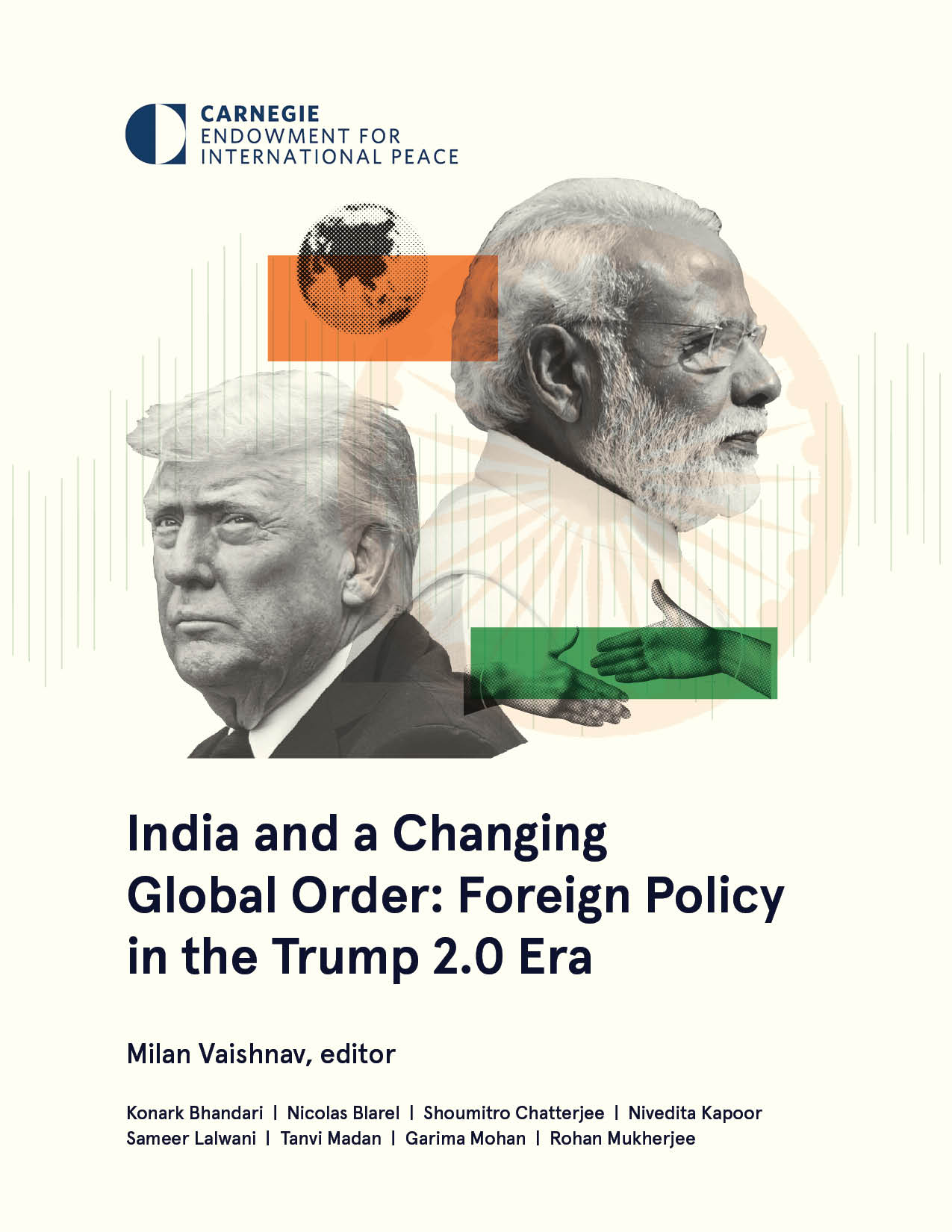
Trump 2.0 has unsettled India’s external environment—but has not overturned its foreign policy strategy, which continues to rely on diversification, hedging, and calibrated partnerships across a fractured order.



Milan Vaishnav, ed., Sameer Lalwani, Tanvi Madan, …