• Research
  • About
  • Experts
Carnegie India logoCarnegie lettermark logo
{
  "authors": [],
  "type": "pressRelease",
  "centerAffiliationAll": "",
  "centers": [
    "Carnegie Endowment for International Peace",
    "Carnegie Europe"
  ],
  "collections": [
    "Europe’s Eastern Neighborhood"
  ],
  "englishNewsletterAll": "",
  "nonEnglishNewsletterAll": "",
  "primaryCenter": "Carnegie Endowment for International Peace",
  "programAffiliation": "",
  "programs": [],
  "projects": [],
  "regions": [
    "Europe"
  ],
  "topics": [
    "Foreign Policy"
  ]
}

Source: Getty

Press Release

Frank-Walter Steinmeier on Europe, Russia, and Ukraine

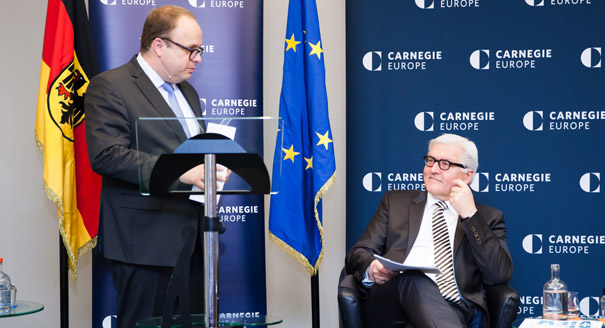
German Foreign Minister Frank-Walter Steinmeier discussed Germany’s recent and unprecedented foreign policy review, Review 2014.

Link Copied
Published on Mar 17, 2015

BRUSSELS—German Foreign Minister Frank-Walter Steinmeier said at a Carnegie Europe event Monday that “today’s international crises—from Ukraine to ISIS—are not a coincidence. They are symptomatic of a world where the structures of international order are eroding.”

Speaking on Germany’s recent and unprecedented foreign policy review, Review 2014, Steinmeier explained that “as a globally connected society and an export-based economy, Germany, more than others, depends on a functioning rules-based order.”

For Steinmeier—in his second stint as foreign minister under Chancellor Angela Merkel—“the European Union is the world’s most sophisticated example of a regional order. As such, we need to defend it.”

Steinmeier emphasized that “Europe can only be strong on the outside if the inside architecture is solid.” He noted that he “could not imagine what the values, the reputation, and the strength of European foreign policy would come to if Great Britain weren’t a part of it, [or] what would happen to [Europe’s] outside credibility and effectiveness if Greece left the euro.”

On the Ukraine conflict, Steinmeier said: “We have to be sure that violence doesn’t escalate again. We need to make sure that the military situation is calmed down in order to set the preconditions necessary to bring about a political process stipulated in the Minsk agreements.”

However, he warned that “we shouldn’t fool ourselves . . . The process will be very long. I don’t exaggerate when I say that it could take years, or decades, or even longer, for a political solution [to the Ukraine conflict].”

On EU-Russia relations, Steinmeier said much “depends on whether Russia will be steering or disturbing the political process [in Ukraine]. The question will be whether we will be able to restore the trust that has been shattered.”

A transcript, audio, and video produced by Deutsche Welle from the event are available on the Carnegie Europe website.

Press Contact: Christine Lynch | +32 2 209 29 93 | clynch@ceip.org

ABOUT CARNEGIE EUROPE

Carnegie Europe is the Brussels-based center of the Carnegie Endowment for International Peace. Through publications, articles, seminars, and private consultations, Carnegie Europe aims to foster new thinking on the daunting international challenges shaping Europe’s role in the world.

Foreign PolicyEurope

Carnegie India does not take institutional positions on public policy issues; the views represented herein are those of the author(s) and do not necessarily reflect the views of Carnegie, its staff, or its trustees.

More Work from Carnegie India

  • Commentary
    The Impact of U.S. Sanctions and Tariffs on India’s Russian Oil Imports

    This piece examines India’s response to U.S. sanctions and tariffs, specifically assessing the immediate market consequences, such as alterations in import costs, and the broader strategic implications for India’s energy security and foreign policy orientation.

      Vrinda Sahai

  • Commentary
    NISAR Soars While India-U.S. Tariff Tensions Simmer

    On July 30, 2025, the United States announced 25 percent tariffs on Indian goods. While diplomatic tensions simmered on the trade front, a cosmic calm prevailed at the Sriharikota launch range. Officials from NASA and ISRO were preparing to launch an engineering marvel into space—the NASA-ISRO Synthetic Aperture Radar (NISAR), marking a significant milestone in the India-U.S. bilateral partnership.

      Tejas Bharadwaj

  • Commentary
    Indian Airstrikes in Pakistan: May 7, 2025

    On May 7, 2025, between 1:05 and 1:30 a.m. (IST), airstrikes carried out by the Indian Air Force hit nine locations inside Pakistan and Pakistan occupied Kashmir (PoK). It was codenamed Operation Sindoor.

      Rudra Chaudhuri

  • Research
    Views From Taipei: Essays by Young Indian Scholars on China

    This compendium brings together three essays by scholars who participated in Carnegie India's Security Studies Dialogue in 2024, each examining a different aspect of China’s policies. Drawing on their expertise and research, the authors offer fresh perspectives on key geopolitical challenges.

      • +1

      Vijay Gokhale, Suyash Desai, Amit Kumar, …

  • Commentary
    The India-U.S. TRUST Initiative: Advancing Semiconductor Supply Chain Cooperation

    As part of the TRUST initiative, leaders of the two countries committed to building trusted and resilient supply chains, including for semiconductors and critical minerals. India and the United States have made steady progress in this area over the years. This essay explores the takeaways from discussions on semiconductor supply chains that took place at Carnegie India’s 9th Global Technology Summit.

      Konark Bhandari

Get more news and analysis from
Carnegie India
Carnegie India logo, white
Unit C-4, 5, 6, EdenparkShaheed Jeet Singh MargNew Delhi – 110016, IndiaPhone: 011-40078687
  • Research
  • About
  • Experts
  • Projects
  • Events
  • Contact
  • Careers
  • Privacy
  • For Media
Get more news and analysis from
Carnegie India
© 2026 Carnegie Endowment for International Peace. All rights reserved.