

Commentary
Dmitri Trenin
{
  "authors": [
    "Dmitri Trenin"
  ],
  "type": "legacyinthemedia",
  "centerAffiliationAll": "",
  "centers": [
    "Carnegie Endowment for International Peace",
    "Carnegie Russia Eurasia Center"
  ],
  "collections": [],
  "englishNewsletterAll": "",
  "nonEnglishNewsletterAll": "",
  "primaryCenter": "Carnegie Russia Eurasia Center",
  "programAffiliation": "",
  "programs": [],
  "projects": [],
  "regions": [
    "East Asia",
    "Russia",
    "North Korea"
  ],
  "topics": [
    "Foreign Policy"
  ]
}
Source: Getty
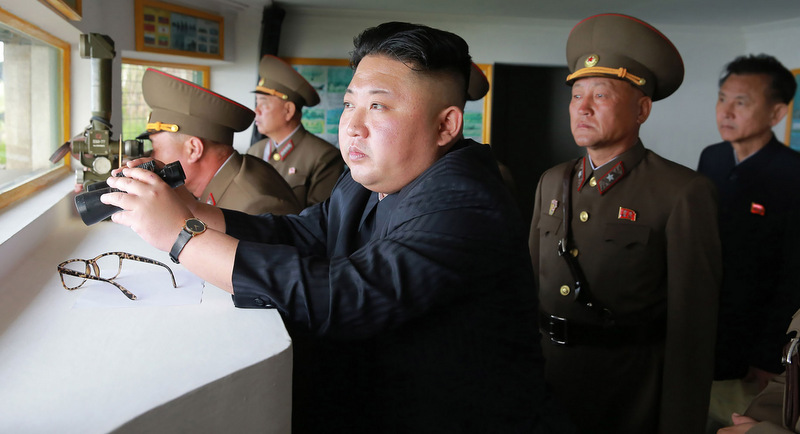
Russia has played it cool in the current North Korea crisis, convinced that the spike in tensions will soon subside. Moscow, however, is under no illusion: The security situation on the Korean Peninsula continues to deteriorate and the next alert is just around the corner.
Source: Global Times
Seen from Moscow, a number of conflicts around the world — notably Ukraine or Syria — command more attention than another nuclear scare over North Korea. However, looking from Vladivostok, Russia's small metropolis on the Pacific, few threats are as serious, or real, as military conflicts between North Korea and the US and its allies. Russia shares a few dozen kilometers of common border with North Korea, and already experienced a missile alert several years ago when a malfunctioning North Korean missile fell within Russia’s exclusive economic zone.
Moscow, of course, is no ally of Pyongyang. It finds the Kim family headstrong and difficult. President Vladimir Putin learned this first-hand as he traveled to meet with Kim Jong-il in 2000, just ahead of a G8 summit in Japan. Russia's mediation attempts between North Korea and the US were not particularly successful. The Russians, however, do not regard the North Korean leaders as irrational: The opposite is likely to be true. They understand that to Pyongyang nuclear weapons are the ultimate guarantee of regime survival. The ruling Kims have certainly learned this from the fate of both Saddam Hussein in Iraq and Muammar Gaddafi in Libya.
North Korea’s record demonstrates that if a country with reasonable resources badly wants to go nuclear, it can and will. Pyongyang is already in possession of several nuclear devices and a growing fleet of short- and medium-range missiles. Not only South Korea and Japan, but much of China and eastern Russia fall within the range of these projectiles. With technology improving, it is only a matter of time before North Korean engineers can develop nuclear-tipped missiles capable of reaching the US West Coast. Moscow has concluded it is futile to expect North Korea to enter into meaningful negotiations on limits to its weapon programs before that happens.
In the Russian assessment, however, Washington will do anything and everything to prevent Pyongyang from ever acquiring that capability. In 1962, then US president John F. Kennedy risked an all-out nuclear war with the Soviet Union rather than allowing Moscow to deploy its missiles in Cuba. With regard to North Korea, neither political pressure nor economic sanctions can push it to give up its nuclear ambitions. Military action against Pyongyang, however, would put the Korean Peninsula on the brink of a major war.
In Moscow’s realpolitik-ordered world, North Korea is considered to be of prime geopolitical importance to China. Having established a stable partnership, a sort of major-power entente with Beijing, Moscow would be foolish to try to undercut China in a region of secondary importance to itself.
Working at cross purposes with Beijing, in order to please the US, Japan or South Korea, is simply not an option, given the current confrontation between Moscow and Washington. Russia will not necessarily follow China every step of the way on North Korea, but will certainly abstain from doing anything against China's interest.
Moreover, like China, Russia is concerned about US ballistic missile defense deployments in Northeast Asia. True, the current deployments in the region pose much more of a problem for Chinese strategic assets than they do for Russia’s own. However, Russia views the US missile defenses in Asia, Europe and North America as part of an emerging global system designed, in the long term, to diminish Moscow's and Beijing’s deterrence capability vis-à-vis Washington. While North Korea has provided useful arguments to the US in favor of these deployments, the Russians believe the real targets are themselves and the Chinese.
Russia is hardly jealous of China being the main partner for the US in Washington’s attempts to make Pyongyang step back. Dealing with North Korea on the US' behalf is an unenvious task. The Russians are content to take a back seat and let the Chinese and Americans tackle this difficult issue. A broad Sino-US strategic understanding, however, is considered unlikely given the serious differences between the two countries’ security interests and intensifying competition. The Russians are also being careful not to be used by Pyongyang: playing Moscow against Beijing has historically been a standard practice of North Korean leadership.
In this situation, Moscow should seek to keep the lines of communications open to all parties: Beijing and Washington, Pyongyang and Seoul and also Tokyo. By now, such diplomatic connectivity has become a salient feature of Moscow’s approach to all international crises. Moscow would continue to warn Pyongyang and Washington/Seoul against the use of force and provocative actions, especially nuclear/missile tests or large-scale military exercises. The Russians would also call for resumption of the Six-Party Talks on the Korean nuclear issue, despite the realization that Pyongyang is in no hurry to return to the negotiating table or that Washington's “strategic patience” with North Korea has run out.
Russia has played it cool in the current crisis, convinced that the spike in tensions will soon subside. Moscow, however, is under no illusion: The security situation on the Korean Peninsula continues to deteriorate and the next alert is just around the corner. As elsewhere across Eurasia, Russia wants to be seen as an indispensable player in Northeast Asia.
Occasionally, it may come up with diplomatic initiatives of its own, including offering its good offices to the main parties of the conflict on the Korean Peninsula. Vladivostok may yet be proposed as a venue for some important international meetings. However, Moscow will hardly neglect to coordinate its policies on North Korea with Beijing, its principal political, security and economic partner.
Former Director, Carnegie Moscow Center
Trenin was director of the Carnegie Moscow Center from 2008 to early 2022.
Recent Work
Dmitri Trenin
Dmitri Trenin
Carnegie India does not take institutional positions on public policy issues; the views represented herein are those of the author(s) and do not necessarily reflect the views of Carnegie, its staff, or its trustees.

After the chill in ties between 2020 and 2024 that brought India–China relations to their lowest point in several decades, the two countries have engaged each other afresh. This paper argues that there are predominantly four imperatives guiding India’s approach to China, and they exist in an order of priority.

Saheb Singh Chadha

This piece argues that India’s central challenge is not managing a single flashpoint but resolving the underlying tension between expansion and institutional coherency of the BRICS grouping.

Vrinda Sahai

A partnership between India, a country of subcontinental size, and Africa, a continent of fifty-four countries, may seem asymmetric until one notes that both are home to nearly the same number of people—1.4 billion. This essay spells out the existing challenges to the partnership, its optimal potential, and the possible pathways to realize it over the next quarter-century.

Rajiv Bhatia

The India–EU Free Trade Agreement (FTA) is shaping up to be one of the most consequential trade negotiations, both economically and strategically. But, what’s in the agreement, what’s missing, and what will determine its success in the years ahead
Vrinda Sahai, Nicolas Köhler-Suzuki
Trump 2.0 has unsettled India’s external environment—but has not overturned its foreign policy strategy, which continues to rely on diversification, hedging, and calibrated partnerships across a fractured order.



Milan Vaishnav, ed., Sameer Lalwani, Tanvi Madan, …