

Article
Paul Stronski
{
  "authors": [
    "Paul Stronski"
  ],
  "type": "legacyinthemedia",
  "centerAffiliationAll": "dc",
  "centers": [
    "Carnegie Endowment for International Peace"
  ],
  "collections": [],
  "englishNewsletterAll": "ctw",
  "nonEnglishNewsletterAll": "",
  "primaryCenter": "Carnegie Endowment for International Peace",
  "programAffiliation": "russia",
  "programs": [
    "Russia and Eurasia"
  ],
  "projects": [],
  "regions": [
    "North America",
    "United States",
    "Russia"
  ],
  "topics": [
    "Foreign Policy"
  ]
}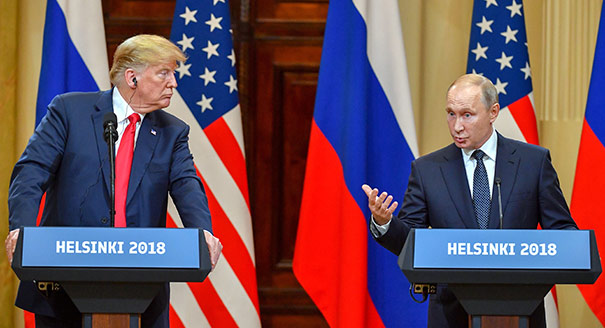
Source: Getty
A conciliatory approach with Russia has not worked out for the past three U.S. presidents or a long list of European leaders, and it likely won’t for Trump either.
Source: Axios
Next week's Helsinki summit poses the risk that President Trump could make a rash offer to Vladimir Putin in an attempt to improve U.S.–Russian relations. It's possible he might recognize Moscow’s annexation of Crimea, assent to Syrian President Assad’s continued rule or waver on America’s commitment to NATO.
The big picture: As much as Trump may want to turn the page with Putin, his recent call for a one-on-one meeting without aides is risky. Putin is a shrewd negotiator. A conciliatory approach with Russia has not worked out for the past three American presidents or a long list of European leaders, and it likely won't for Trump either.
Putin has been playing leaders for years:
Trump wants splashy deliverables to show he can go toe-to-toe with Putin on the global stage. But instead of agreeing to whatever Putin wants on Ukraine or Syria for the sake of a deal, Trump should articulate a vision for how his administration plans to secure U.S. interests vis-à-vis Russia. Reviving arms-control discussions or agreeing to increase educational, cultural and scientific exchanges would be good places to start. Both would help rebuild trust and lay the groundwork for future improvements in relations.
The bottom line: Trump boasts of not “preparing very much” for high-stakes diplomacy — an approach that has not secured results with North Korea's denuclearization. To avoid getting played again, he should approach the Helsinki summit with concrete objectives to avoid improvising a costly deal.
Former Senior Fellow, Russia and Eurasia Program
Paul Stronski was a senior fellow in Carnegie’s Russia and Eurasia Program, where his research focuses on the relationship between Russia and neighboring countries in Central Asia and the South Caucasus.
Recent Work
Paul Stronski
Paul Stronski
Carnegie India does not take institutional positions on public policy issues; the views represented herein are those of the author(s) and do not necessarily reflect the views of Carnegie, its staff, or its trustees.

How is AI reshaping space security, creating governance challenges, and where does international diplomacy stand today?


Tejas Bharadwaj, Almudena Azcárate Ortega

After the chill in ties between 2020 and 2024 that brought India–China relations to their lowest point in several decades, the two countries have engaged each other afresh. This paper argues that there are predominantly four imperatives guiding India’s approach to China, and they exist in an order of priority.

Saheb Singh Chadha

This piece argues that India’s central challenge is not managing a single flashpoint but resolving the underlying tension between expansion and institutional coherency of the BRICS grouping.

Vrinda Sahai

A partnership between India, a country of subcontinental size, and Africa, a continent of fifty-four countries, may seem asymmetric until one notes that both are home to nearly the same number of people—1.4 billion. This essay spells out the existing challenges to the partnership, its optimal potential, and the possible pathways to realize it over the next quarter-century.

Rajiv Bhatia

The U.S.–India semiconductor cooperation story is well-stocked with top-level strategic intent. What remains unresolved, however, are some underlying challenges that will determine whether the cooperation actually functions. Three such friction points stand out.

Shruti Mittal