

Commentary
Matthew T. Page, Feyi Fawehinmi
{
  "authors": [
    "Matthew T. Page"
  ],
  "type": "other",
  "centerAffiliationAll": "dc",
  "centers": [
    "Carnegie Endowment for International Peace"
  ],
  "collections": [
    "Anti-Corruption"
  ],
  "englishNewsletterAll": "democracy",
  "nonEnglishNewsletterAll": "",
  "primaryCenter": "Carnegie Endowment for International Peace",
  "programAffiliation": "DCG",
  "programs": [
    "Democracy, Conflict, and Governance"
  ],
  "projects": [],
  "regions": [
    "Southern, Eastern, and Western Africa"
  ],
  "topics": [
    "Democracy",
    "Economy"
  ]
}
Source: Getty
The Nigerian government has rolled out big-budget programs with the stated aim of helping small businesspeople, but these schemes are more often used by corrupt officials to help themselves.
Source: Quartz Africa
Forget Rodeo Drive, Fifth Avenue, or Regent Street—Balogun Market in Lagos truly is the shopping capital of the world. Its densely-packed, umbrella-shielded corrugated metal stalls is abuzz with trades and transactions. Hundreds more shops, wholesalers, and cramped workshops fill the honeycombed concrete buildings that ring the market.
Balogun Market is in many ways a microcosm of Nigeria: a country known globally as a petro-economy, but one that in reality is a country of small business people. Nigeria’s entrepreneurs collectively power Africa’s largest economy, generating almost 50% of its GDP and employing 60 million people—roughly 84% of its labor force.
Yet high borrowing costs, multiple taxation, currency volatility, infrastructure shortfalls, and red tape all make doing business in Nigeria exceptionally difficult. Seizing on an opportunity to expand its reach, the Nigerian government has created an alphabet soup of agencies and rolled out big-budget programs to help. Rather than meeting the needs of small businesspeople, however, these schemes are more often used by corrupt officials to help themselves.
Businesspeople like the wheeler-dealers of Balogun Market are not only undermined by everyday graft—shakedowns by licensing officials, extortion by safety inspectors, racketeering by police, customs officers, and local gang members—they are also hurt by the grand corruption that pervades government programs meant to help them, we write in a new report which I co-authored with Celestine Okeke for the Carnegie Endowment for International Peace.
Relative to their high cost, these programs appear to help very few actual small businesses. Instead, they are set up to fail—eroding trust in government and functioning as conduits for embezzlement, contract fraud, and the distribution of political patronage. This top-down corruption amounted to over $1 billion between 2014 and 2018—more than Nigeria’s combined capital expenditure on health and education over the same period.
These agencies and programs exude corruption red flags. They lack transparency, shirk accountability, incur high administrative overheads, and are guarded by reams of red tape. Politicians routinely interfere in them, handpicking beneficiaries and steering contracts to their cronies. Even more disturbing, this kind of corruption is self-reinforcing. It undermines the effectiveness and impact of small business programs, increasing the need for assistance, and thus makes it easier for politicians to justify expensive follow-on initiatives.
Two such schemes illustrate the huge scale, massive opportunity costs, and glaring impunity this type of corruption involves:
Nigeria government programs meant to help small businesses are awash with red flags. They have a history of malfeasance and an ineffective track record. Many appear to have lost touch with the very same entrepreneurs they should be helping, like the tireless traders of Balogun Market.
These agencies and programs do not require more funding as officials and even some private sector proponents claim. Rather, they urgently need root-and-branch reform, stronger oversight, and greater transparency aimed at reducing runaway corruption and mitigating its effects. Unless the situation changes, Nigeria’s small business-focused agencies and programs will continue to do more harm than good.
On track to be the world’s third-most populous country by 2050, Nigeria needs to rein in this kind of corruption so small businesses can get the help they need to help power its economy and provide the jobs its rapidly growing population desperately needs.
To make this happen, Nigeria’s leaders must also do more to address the range of other obstacles—including their own policies and missteps—that make it one of the most difficult places in the world to do business.. Instead of opaquely spending even larger sums to offset these challenges, government should step back and ask how it can do no harm.

Former Nonresident Scholar, Democracy, Conflict, and Governance Program
Matthew T. Page was a nonresident scholar at the Carnegie Endowment for International Peace.
Recent Work
Matthew T. Page, Feyi Fawehinmi
Matthew T. Page, Abdul H. Wando
Carnegie India does not take institutional positions on public policy issues; the views represented herein are those of the author(s) and do not necessarily reflect the views of Carnegie, its staff, or its trustees.

A partnership between India, a country of subcontinental size, and Africa, a continent of fifty-four countries, may seem asymmetric until one notes that both are home to nearly the same number of people—1.4 billion. This essay spells out the existing challenges to the partnership, its optimal potential, and the possible pathways to realize it over the next quarter-century.

Rajiv Bhatia

On March 10, 2026, India’s Union Cabinet approved amendments to Press Note 3, a regulation that mandated government approval on all foreign direct investment (FDI) from countries sharing a land border with India. This amendment raises questions primarily about whether its stated benefits will materialize and if the risks have been adequately weighed. This piece will address the same.

Konark Bhandari

This piece examines India’s response to U.S. sanctions and tariffs, specifically assessing the immediate market consequences, such as alterations in import costs, and the broader strategic implications for India’s energy security and foreign policy orientation.

Vrinda Sahai

This paper examines the evolution of India-China economic ties from 2005 to 2025. It explores the impact of global events, bilateral political ties, and domestic policies on distinct spheres of the economic relationship.

Santosh Pai
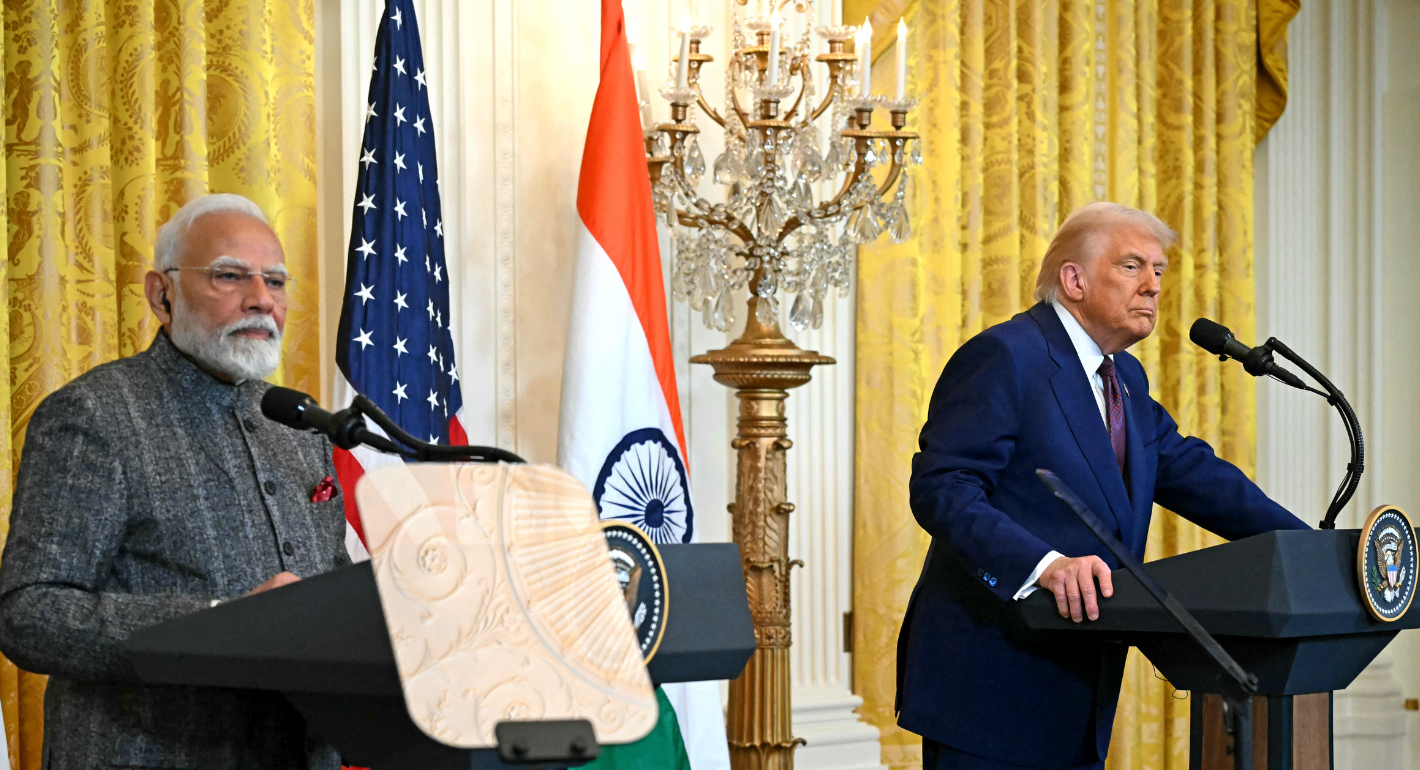
The India-U.S. relationship currently appears buffeted between three “Ts”—TRUST, Tariffs, and Trump.
Arun K. Singh