

Commentary
How is AI reshaping space security, creating governance challenges, and where does international diplomacy stand today?
Tejas Bharadwaj, Almudena Azcárate Ortega
{
  "authors": [
    "John Kerry",
    "Chuck Hagel"
  ],
  "type": "legacyinthemedia",
  "centerAffiliationAll": "",
  "centers": [
    "Carnegie Endowment for International Peace"
  ],
  "collections": [],
  "englishNewsletterAll": "",
  "nonEnglishNewsletterAll": "",
  "primaryCenter": "Carnegie Endowment for International Peace",
  "programAffiliation": "",
  "programs": [],
  "projects": [],
  "regions": [
    "North America",
    "United States"
  ],
  "topics": [
    "Climate Change",
    "Foreign Policy",
    "Global Governance"
  ]
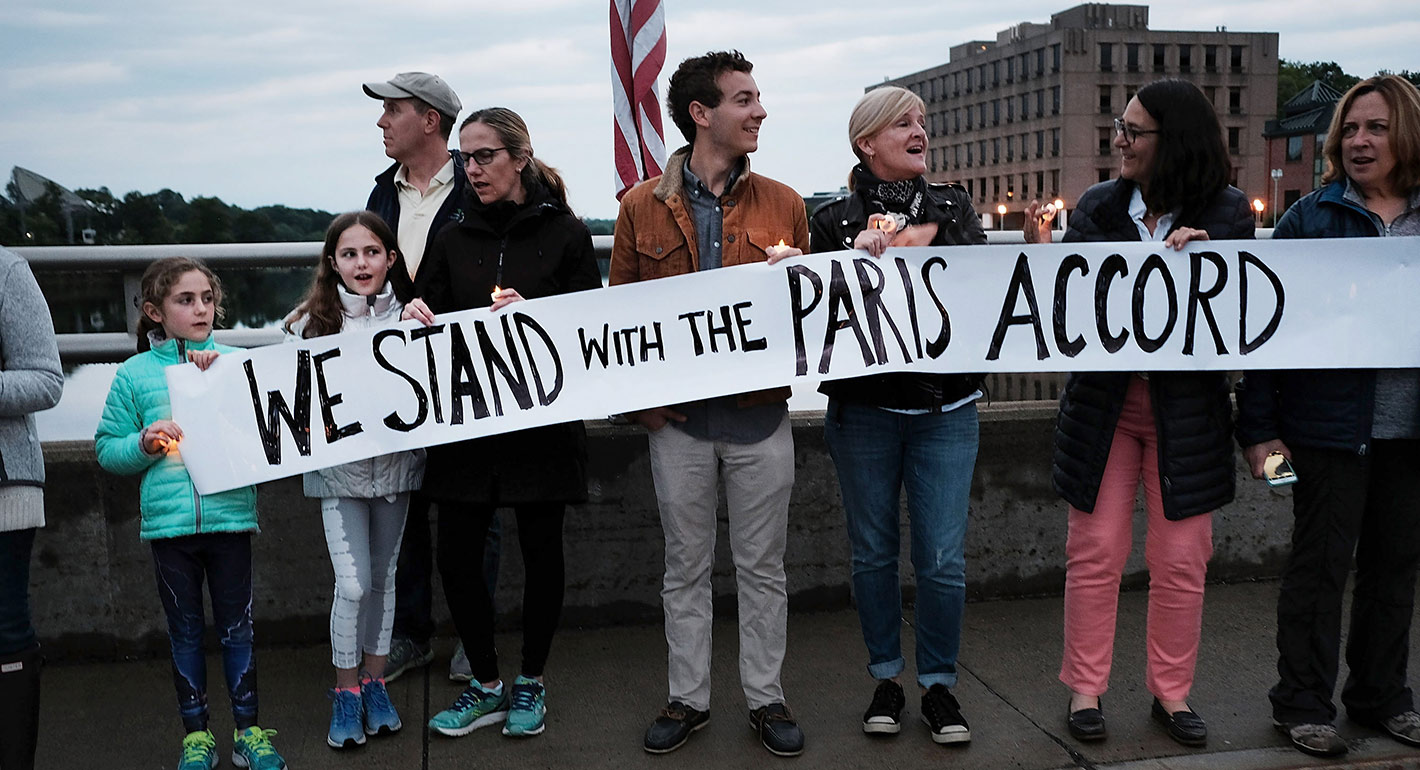
}
Source: Getty
By putting up roadblocks to the necessary transition to a low-carbon global economy, Trump is making American businesses less competitive and leaving new jobs and economic opportunities up for grabs to other countries.
Source: Washington Post
On Monday, President Trump took the step he promised in 2017 to officially withdraw the United States from the Paris agreement on climate change, which every other country on Earth has signed. This is not America first; once again, it’s America isolated.
Climate change is already affecting every sector and region of the United States, as hundreds of top scientists from 13 federal agencies made clear in a report the White House itself released last year. The past five years were the warmest ever recorded. Without steep pollution reductions, climate change will risk tens of thousands of U.S. lives every year by the end of the century. Rising seas, increased storm surge and tidal flooding threaten $1 trillion in public infrastructure and private property now along U.S. coastlines. The United States has experienced at least $400 billion in weather and climate disaster costs since 2014. The recent hurricanes that slammed America’s southern coasts, as well as historic wildfires in California, resulted in more American victims of severe weather juiced by climate change than ever before.
Climate change also threatens national security. As we testified to the House Committee on Oversight and Government Reform in April, this link has been clear for decades. Our military bases, and hence our security preparedness, are threatened by sea-level rise and other impacts. If you put a map of places with high political instability today over a map of places with high climate vulnerability, the two would be nearly identical. The American Security Project, an organization of retired flag officers who spent their careers in uniform and other leaders, calls climate change a “ring road” issue, meaning that climate change will worsen other threats facing the nation. “It will change disease vectors. It will drive migration. These changes, in turn, could affect state stability and harm global security,” the ASP reported.
Other major powers will benefit economically from the U.S. withdrawal from Paris. By putting up roadblocks to the necessary transition to a low-carbon global economy, Trump is making American businesses less competitive and leaving new jobs and economic opportunities up for grabs to other countries. The 2018 report by the Global Commission on the Economy and Climate details the evidence that between now and 2030, policies and measures aimed at solving this problem and building resilience could generate at least $26 trillion in economic benefits worldwide in industries including renewables and energy efficiency.
The clean-energy economy already employs 3.3 million Americans, with solar employing twice as many people as coal. But the United States is lagging far behind other countries that are determined to capitalize on this low-carbon market. For every dollar the United States invests in renewable energy, China puts in three. That’s why globally 99 percent of electric buses on the road are in China. India has the largest solar and wind targets in the world, and the nation is making steady progress in achieving them. And the European Union announced last year that at least 25 percent of its next budget will go toward transitioning to a low-carbon economy.
The Paris agreement was a start, not a finish line. But it was the best ignition switch the world could agree on to spark international cooperation on this critical issue, something that many leading Republicans agree is essential to do because the United States can’t solve this problem alone. Without this agreement, China, India and many other major emitters would not have a commitment to the world to reduce their emissions, let alone one with transparency and international oversight for all.
Monday marks a dark day among those of us who believe in working with allies to share the burden of solving tough problems — especially a climate crisis that demands a World War II-style mass mobilization before it’s too late. But there’s a silver lining: Even as the Trump administration submits the paperwork to surrender our leadership on a climate accord we wrote, we won’t officially exit the agreement until Nov. 4, 2020. We have an election in our country on Nov. 3, 2020.
The United States can rejoin the agreement at any time once we have a leader willing to do so. We must all mitigate the damage Trump does to the United States before then, but if there was ever an election in which U.S. leadership and the nation’s security were on the ballot, 2020 is it. Americans can pull the lever for the clearest choice ever on climate action to ensure that on Day One of a new administration, America will be back.
Nonresident Scholar, Sustainability, Climate, and Geopolitics Program
John Kerry is a nonresident scholar the Carnegie Endowment for International Peace.
Chuck Hagel
Chuck Hagel was U.S. defense secretary from 2013 to 2015.
Carnegie India does not take institutional positions on public policy issues; the views represented herein are those of the author(s) and do not necessarily reflect the views of Carnegie, its staff, or its trustees.

How is AI reshaping space security, creating governance challenges, and where does international diplomacy stand today?


Tejas Bharadwaj, Almudena Azcárate Ortega

After the chill in ties between 2020 and 2024 that brought India–China relations to their lowest point in several decades, the two countries have engaged each other afresh. This paper argues that there are predominantly four imperatives guiding India’s approach to China, and they exist in an order of priority.

Saheb Singh Chadha

This piece argues that India’s central challenge is not managing a single flashpoint but resolving the underlying tension between expansion and institutional coherency of the BRICS grouping.

Vrinda Sahai

A partnership between India, a country of subcontinental size, and Africa, a continent of fifty-four countries, may seem asymmetric until one notes that both are home to nearly the same number of people—1.4 billion. This essay spells out the existing challenges to the partnership, its optimal potential, and the possible pathways to realize it over the next quarter-century.

Rajiv Bhatia

The U.S.–India semiconductor cooperation story is well-stocked with top-level strategic intent. What remains unresolved, however, are some underlying challenges that will determine whether the cooperation actually functions. Three such friction points stand out.

Shruti Mittal