

{
  "authors": [
    "Alexander Gabuev",
    "Robyn Dixon",
    "Max Seddon"
  ],
  "type": "commentary",
  "centerAffiliationAll": "",
  "centers": [
    "Carnegie Endowment for International Peace",
    "Carnegie Russia Eurasia Center"
  ],
  "collections": [],
  "englishNewsletterAll": "",
  "nonEnglishNewsletterAll": "",
  "primaryCenter": "Carnegie Endowment for International Peace",
  "programAffiliation": "",
  "programs": [],
  "projects": [],
  "regions": [],
  "topics": []
}
Source: Getty
Podcast: What's It Like to Be a Foreign Correspondent in Russia?
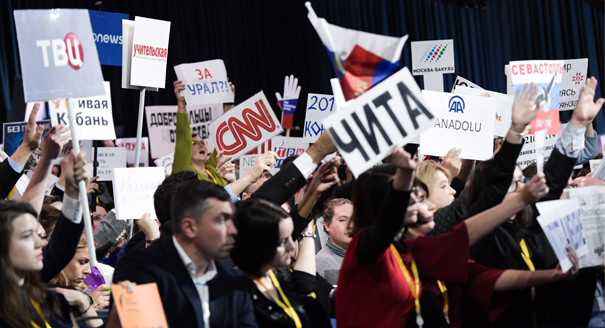
Alex Gabuev, Robyn Dixon and Max Seddon discuss the work of the foreign media in Moscow.
In this new episode of the Carnegie Moscow Center podcast, host Alex Gabuev talks to two foreign correspondents currently based in Moscow. Robyn Dixon recently returned to Russia as head of the Washington Post Moscow bureau, having previously worked here for eight years through 2003. Our other guest is Max Seddon of the Financial Times, who has been working in Russia since 2012. Together they discuss what it's like to be a foreign journalist in Moscow, what has changed in the last 20 years, the differences in reporting from China and Russia, and how to deliver the most accurate and least biased story from Russia under the current circumstances.
Listen or download: SoundCloud | Subscribe: iTunes, Google Podcasts, Google Play, Spotify, RSS
About the Authors

Director, Carnegie Russia Eurasia Center
Alexander Gabuev is director of the Carnegie Russia Eurasia Center. Gabuev’s research is focused on Russian foreign policy with particular focus on the impact of the war in Ukraine and the Sino-Russia relationship. Since joining Carnegie in 2015, Gabuev has contributed commentary and analysis to a wide range of publications, including the Financial Times, the New York Times, the Wall Street Journal, and the Economist.
Robyn Dixon
Washington Post

Max Seddon
Financial Times
Moscow bureau chief of the Financial Times.
Carnegie India does not take institutional positions on public policy issues; the views represented herein are those of the author(s) and do not necessarily reflect the views of Carnegie, its staff, or its trustees.