

Commentary
- +11
Cornelius Adebahr, Dan Baer, Rosa Balfour, …
{
  "authors": [
    "Erik Brattberg"
  ],
  "type": "commentary",
  "centerAffiliationAll": "",
  "centers": [
    "Carnegie Endowment for International Peace"
  ],
  "collections": [
    "Coronavirus"
  ],
  "englishNewsletterAll": "",
  "nonEnglishNewsletterAll": "",
  "primaryCenter": "Carnegie Endowment for International Peace",
  "programAffiliation": "",
  "programs": [],
  "projects": [],
  "regions": [
    "North America",
    "United States",
    "Western Europe"
  ],
  "topics": [
    "Foreign Policy"
  ]
}
Source: Getty
With the bungled announcement of an ill-conceived policy, the Trump administration forfeited another opportunity for global leadership.
The novel coronavirus outbreak is the most serious global challenge since the financial crisis of 2008. International cooperation is a must, and so far the administration of President Donald Trump is failing.
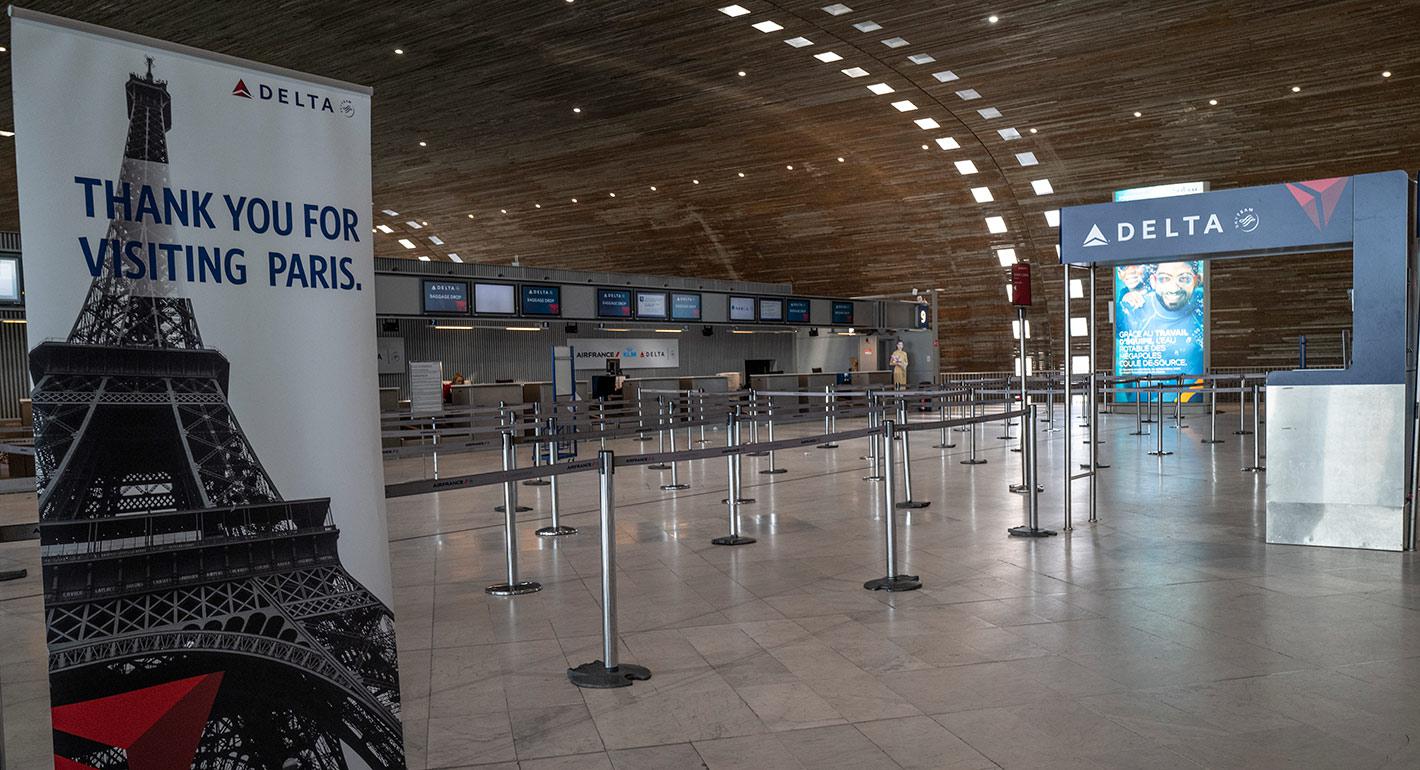
Trump announced in his Oval Office address on Wednesday evening that the United States would impose unilateral restrictions on travel from Europe. Waking up the next morning, EU leaders greeted the news with scorn.
It is not hard to see why Trump’s move did so little to offer reassurance. First, the travel ban is unlikely to prove effective given that the virus is already spreading rapidly in the United States. Though the U.S. Centers for Disease Control and Prevention claims that some 70 percent of U.S. cases are linked to Europe, Trump’s draconian ban is more or less meaningless at this point. Rather than banning European travelers altogether, the administration could have simply increased screening at U.S. arrival airports or mandated that travelers be tested before boarding U.S.-bound flights.
Trump’s travel ban better serves a different purpose: to scapegoat Europe in order to cover up for his administration’s mishandling of the outbreak. Having already blamed China for the “foreign virus,” Trump’s latest policy is in line with his past claims that the EU is a “foe” aiming to “take advantage” of the United States. His criticism of European countries for not closing off flights from China also mirrors his earlier attacks on Europe’s handling of the refugee crisis, which he claims has led to an increase in crime.
Second, although early travel restrictions may slow the spread of the virus, the ban was implemented without regard for diplomatic protocols. Trump did not coordinate with European governments in advance, leaving European diplomats unprepared to deal with the ensuing chaos and confusion. When asked about the ban during a press conference with Irish Prime Minister Leo Varadkar on Thursday, Trump explained the lack of consultation as retaliation for European leaders’ failure to consult him on tax issues.
Rather than using his Oval Office address to express solidarity with the people of Italy, who have been hit the hardest in Europe, Trump opted to slam the door in Europe’s face. Meanwhile, China is stepping in to provide medical help and equipment to Italy. That contrast reinforces Europeans’ impression that the United States is no longer a reliable partner, while allowing Beijing to score “brownie points” that could have a lasting impact.
Third, the UK’s exclusion from the ban makes little sense. Trump apparently misspoke during his address when he suggested that all of Europe would be affected as opposed to only the Schengen Area countries. The UK is outside that open-border zone but has more than 460 confirmed cases, suggesting Trump’s motivations may be at least as political as scientific. It’s true that the Trump Organization maintains properties in the UK, but a more likely explanation for excluding the UK from the ban is Trump’s affinity for Britain’s pro-Brexit prime minister, Boris Johnson.
Fourth, Trump’s handling of the virus illustrates his disdain for multilateral institutions and cooperation. As recently as February, his administration sought to reduce U.S. funding for the World Health Organization. As the chair for 2020 of the Group of Seven, the United States should use its convening power to rally major partners around a coordinated public health and economic effort like the one recently proposed by French President Emmanuel Macron and those implemented by Trump’s predecessors in response to SARS, H1N1, and other outbreaks. During the November 2009 EU-U.S. summit, President Barack Obama’s administration and EU leaders set up a transatlantic task force on antibiotic resistance.
European confidence in U.S. leadership under the Trump administration was already at rock bottom. Having previously failed to convince Trump to stick to multilateral arrangements such as the Paris climate accord and the Iran nuclear deal or to rescind unilateral trade tariffs, most European leaders have been planning just to wait out his first term.
Going forward, transatlantic ties will likely take another beating. If Trump is reelected in November, many European leaders fear that he would feel emboldened to double down on his “America first” instincts, including his assault on multilateral institutions, and that U.S. isolationism and retrenchment would deepen. As some in Europe conclude they can no longer rely on the United States, the risk of a perceived moral equivalence between the United States and China will grow.
While countries around the world struggle to contain the coronavirus pandemic, the United States should be leading the pursuit of multilateral solutions. Instead, Trump has resorted to acting unilaterally, pointing fingers at others, and arbitrarily throwing up barriers around U.S. borders. Unless reversed quickly, his administration’s approach to the virus both at home and abroad could exact a devastating, long-term toll on U.S. credibility and global leadership.
This quick take has been updated to reflect recent developments.

Former Director, Europe Program, Fellow
Erik Brattberg was director of the Europe Program and a fellow at the Carnegie Endowment for International Peace in Washington. He is an expert on European politics and security and transatlantic relations.
Recent Work



Cornelius Adebahr, Dan Baer, Rosa Balfour, …

Erik Brattberg, Philippe Le Corre, Paul Stronski, …
Carnegie India does not take institutional positions on public policy issues; the views represented herein are those of the author(s) and do not necessarily reflect the views of Carnegie, its staff, or its trustees.

How is AI reshaping space security, creating governance challenges, and where does international diplomacy stand today?


Tejas Bharadwaj, Almudena Azcárate Ortega

After the chill in ties between 2020 and 2024 that brought India–China relations to their lowest point in several decades, the two countries have engaged each other afresh. This paper argues that there are predominantly four imperatives guiding India’s approach to China, and they exist in an order of priority.

Saheb Singh Chadha

This piece argues that India’s central challenge is not managing a single flashpoint but resolving the underlying tension between expansion and institutional coherency of the BRICS grouping.

Vrinda Sahai

A partnership between India, a country of subcontinental size, and Africa, a continent of fifty-four countries, may seem asymmetric until one notes that both are home to nearly the same number of people—1.4 billion. This essay spells out the existing challenges to the partnership, its optimal potential, and the possible pathways to realize it over the next quarter-century.

Rajiv Bhatia

The U.S.–India semiconductor cooperation story is well-stocked with top-level strategic intent. What remains unresolved, however, are some underlying challenges that will determine whether the cooperation actually functions. Three such friction points stand out.

Shruti Mittal